Key takeaways
- Opening width: If your whole hand plus a cloth won’t fit through the tank opening, you will never truly clean the inside. Top-fill designs with a wide mouth are the single strongest predictor of a unit that stays fresh past month three.
- Seam and crevice count: Every gasket, groove, and decorative channel is a place biofilm anchors. Simple cylindrical tanks and smooth one-piece bases wipe down in under two minutes; sculptural designs rarely do.
- Serviceable base: The base — not the tank — is where standing water sits longest. Look for a shallow, removable or fully accessible reservoir you can tip out and dry each morning, plus an easily reached transducer disc.
- Runtime versus refill hygiene: Long runtimes are convenient, but water sitting untouched for three or four days is water growing something. Match tank size to your room so you’re emptying and refilling every day or two rather than topping off stale water.
- Quiet operation and light control: For sleep specifically, target roughly 30 dB or below and dimmable or fully defeatable lighting. A unit you can’t sleep next to gets turned off, and a humidifier that’s off is a humidifier that’s stagnating.
What's inside
Most bedroom humidifiers don’t fail because they stop making mist. They fail because the tank develops a film you can’t reach, the base grows a pink ring in the corners, and the whole thing starts pushing a faintly sour smell into the air you breathe for eight hours a night. At that point people unplug it, shove it in a closet, and conclude humidifiers “aren’t worth it.” The machine worked fine. The design just made maintenance feel like a chore nobody scheduled.
From a sleep-wellness standpoint, this matters more than the spec sheet suggests. Bedroom air between roughly 40 and 55 percent relative humidity keeps nasal passages moist, reduces the dry-throat wake-ups that fragment the back half of the night, and takes the edge off winter congestion. But a neglected unit aerosolizes whatever is living in its tank, which is the opposite of restorative. This guide focuses on the humidifiers that stay clean because they’re built to be cleaned — wide top openings, few internal crevices, removable bases, and no narrow-necked bottles that require a bottle brush and a prayer. Below you’ll find the picks, the criteria that actually predict easy upkeep, and answers to the questions readers ask most.
As an Amazon Associate we earn from qualifying purchases.



🛒 Best Price Today on Amazon
Prime members get fast, free shipping on everything above, plus member-only deals. New members get a 30-day free trial — cancel anytime.
How to Choose a/an Humidifier For Bedroom That Is Easy To Clean (2026)
- Opening width: If your whole hand plus a cloth won’t fit through the tank opening, you will never truly clean the inside. Top-fill designs with a wide mouth are the single strongest predictor of a unit that stays fresh past month three.
- Seam and crevice count: Every gasket, groove, and decorative channel is a place biofilm anchors. Simple cylindrical tanks and smooth one-piece bases wipe down in under two minutes; sculptural designs rarely do.
- Serviceable base: The base — not the tank — is where standing water sits longest. Look for a shallow, removable or fully accessible reservoir you can tip out and dry each morning, plus an easily reached transducer disc.
- Runtime versus refill hygiene: Long runtimes are convenient, but water sitting untouched for three or four days is water growing something. Match tank size to your room so you’re emptying and refilling every day or two rather than topping off stale water.
- Quiet operation and light control: For sleep specifically, target roughly 30 dB or below and dimmable or fully defeatable lighting. A unit you can’t sleep next to gets turned off, and a humidifier that’s off is a humidifier that’s stagnating.
The Best Humidifier For Bedroom That Is Easy To Clean (2026)s Reviewed
DREO 3L Humidifier (30H, 26 dB)
This is the most sensible default for a standard bedroom: a wide top-fill opening you can reach into with a microfiber cloth, a smooth interior with almost nothing for mineral scale to grip, and a genuinely low 26 dB output that disappears beneath ambient room noise. The precise humidity control means it cycles to a target instead of over-saturating the room, which also slows condensation on nearby surfaces.
Homvana 3.6L Top-Fill Cool Mist Humidifier
Homvana’s version leans hardest into the easy-clean brief — a broad top opening, minimal internal structure, and a 23 dB rating that makes it one of the quietest options here for light sleepers. The 2-in-1 diffuser function is a nice extra, though I’d run oils sparingly and rinse the base afterward, since residue is the one thing that complicates otherwise simple upkeep.
DREO 8L Smart Humidifier (HM717S)
For larger bedrooms or open-plan spaces up to around 600 square feet, the 8L unit delivers warm and cool mist with app, voice, and Alexa control, so you can adjust the target humidity without getting out of bed. Warm mist adds a modest hygiene advantage, and the tank remains wide enough to service properly — just commit to a weekly descale, since higher capacity means more mineral load over time.
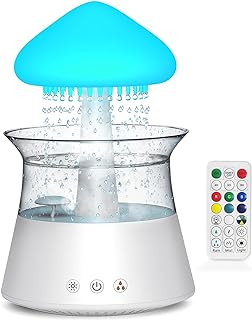
Diffuserlove Cloud Rain Humidifier
The waterfall-and-rain-sound design is a legitimate sleep tool for people who use white noise, combining gentle humidification with a rainfall audio loop and remote control. It has more nooks than the cylindrical units, so plan on a short rinse of the drip tray every couple of days rather than treating it as set-and-forget.
Raindrop 350ml Cool Mist Humidifier
At 350ml this is a nightstand-scale device — best understood as personal, close-range moisture for a small room or desk, with seven-color lighting and four timer settings. Its real advantage is that the tank is so small it gets emptied constantly, which is the most reliable hygiene strategy there is.
Frequently Asked Questions
How often should I clean a bedroom humidifier?
Empty and dry the tank and base daily, and do a fuller clean weekly with white vinegar to dissolve scale followed by a thorough rinse. Daily drying does more for air quality than any deep clean performed monthly.
Does distilled water really make a difference?
Yes, for ultrasonic models. Tap water minerals become the white dust you see on furniture and the crust you scrub off the transducer, so distilled water cuts both cleaning time and airborne particulate.
Should the humidifier run all night?
If it has a humidistat, let it run and hold a target of 40 to 50 percent. Without one, use a timer or a lower mist setting so the room doesn’t tip into damp territory, which invites condensation and mold.
Where should I place it in the bedroom?
Elevate it a couple of feet off the floor, keep it several feet from the bed and away from walls, wood furniture, and electronics. Mist needs room to disperse before it settles.
Final Thoughts
For most bedrooms, the DREO 3L is the pick that balances quiet operation, real humidity control, and a tank you can actually clean; the Homvana 3.6L is the choice if maximum silence and the widest top-fill opening matter most to you. If you’re humidifying a larger room and want scheduling and voice control, step up to the DREO 8L Smart and put a weekly descale on the calendar.