Key takeaways
- Look for a separate reservoir, not a shared one: Machines that recirculate meltwater into the same tank they draw from will run indefinitely. A side tank or dual-tank design lets meltwater drain away from the freezing chamber, which cuts the number of overnight cycles dramatically.
- Treat the decibel number as a floor, not an average: A 40 dB rating describes steady-state operation. Startup surges and the auger grind on nugget models routinely spike 10–15 dB above spec, so anything advertised above roughly 45 dB belongs well away from sleeping spaces.
- Prefer cubes if retention is your priority: Nugget and pebble ice is chewable because it’s porous and air-filled, and that same structure makes it melt roughly twice as fast as a solid bullet cube. Cube machines simply hold their output longer in an unrefrigerated bin.
- Insist on a real off switch or scheduling: Some units resume production automatically whenever the ice level drops. App-controlled or timer-equipped models let you stop production at bedtime and restart it before you wake, which is the single most effective fix for nighttime cycling.
- Check the drain plug and basket removability: If you plan to power down overnight, you’ll want to empty the reservoir easily and transfer the batch to your freezer. Fiddly drains discourage the habit, and standing water invites biofilm within days.
What's inside
Most countertop ice makers share a quiet secret: they don’t actually store ice. They produce it, drop it into an uninsulated bin, and then let it melt back into the reservoir to be frozen again — which means the compressor kicks on repeatedly through the night, cycling in ten- or fifteen-minute bursts long after the kitchen has gone dark. As someone who spends most of my working hours helping people troubleshoot fractured sleep, I can tell you that intermittent mechanical noise is far more disruptive than steady noise. A refrigerator hum disappears into the background within minutes. A compressor that clicks awake every quarter hour never does, and if your kitchen shares a wall with a bedroom, that pattern can shave real minutes off your deep sleep without you ever fully waking.
So the honest framing for this guide is this: no countertop unit is a freezer, but some manage retention far better than others, and a few let you sidestep the melt-refreeze loop entirely with side tanks, pre-cooling logic, and genuinely low decibel floors. Below I’ve assessed six popular 2026 models on three things that actually matter for a household that values rest — how long ice survives in the bin, how loud the machine is when it recycles, and whether you can shut it down overnight without waking up to a puddle and an empty basket.
As an Amazon Associate we earn from qualifying purchases.


How to Choose a Countertop Ice Maker That Keeps Ice Frozen (2026)
- Look for a separate reservoir, not a shared one: Machines that recirculate meltwater into the same tank they draw from will run indefinitely. A side tank or dual-tank design lets meltwater drain away from the freezing chamber, which cuts the number of overnight cycles dramatically.
- Treat the decibel number as a floor, not an average: A 40 dB rating describes steady-state operation. Startup surges and the auger grind on nugget models routinely spike 10–15 dB above spec, so anything advertised above roughly 45 dB belongs well away from sleeping spaces.
- Prefer cubes if retention is your priority: Nugget and pebble ice is chewable because it’s porous and air-filled, and that same structure makes it melt roughly twice as fast as a solid bullet cube. Cube machines simply hold their output longer in an unrefrigerated bin.
- Insist on a real off switch or scheduling: Some units resume production automatically whenever the ice level drops. App-controlled or timer-equipped models let you stop production at bedtime and restart it before you wake, which is the single most effective fix for nighttime cycling.
- Check the drain plug and basket removability: If you plan to power down overnight, you’ll want to empty the reservoir easily and transfer the batch to your freezer. Fiddly drains discourage the habit, and standing water invites biofilm within days.
The Best Countertop Ice Makers That Keep Ice Frozen (2026), Reviewed
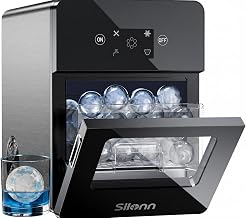
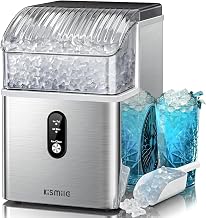
Kismile Nugget Ice Maker, 35 lbs/Day
At a claimed 43 dB, this is one of the calmer nugget machines in the category, and the stainless housing does a reasonable job damping auger noise. Retention is average for pebble ice, so plan on batching in the evening and freezing what you don’t use rather than leaving it to run.
GE Profile Opal MINI PRO with Side Tank
The side tank is the meaningful feature here — it decouples the water supply from the melt cycle, so the unit isn’t chasing its own losses all night long. Build quality and descaling support are the best of this group, which matters because scale buildup makes any compressor work harder and louder over time.
GoveeLife Smart Ice Maker 2 Pro, 47 lbs/Day
This is my pick for anyone whose kitchen borders a bedroom: 40 dB operation, dual tanks, and app scheduling that lets you halt production at 10 p.m. and resume at 6 a.m. without touching the machine. Cube output in three sizes also holds up considerably better in the bin than nugget ice.
Antarctic Star Nugget Ice Maker, 33 lbs/24H
The auto ice-drop dispenser and 1.8 L tank make this a tidy pick for smaller kitchens and offices. Bin retention is modest and there’s no insulated storage, so it rewards users who draw ice frequently through the day rather than stockpiling it.
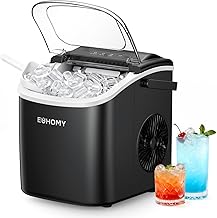
EUHOMY Nugget Ice Maker, 35 lbs/24H
Seven-minute first ice and dependable self-cleaning make this a strong value entry in the pebble category. It runs noticeably busier than the Govee or Opal, so I’d keep it in a kitchen with a door you can close.
Frequently Asked Questions
Will any countertop ice maker keep ice frozen indefinitely?
No. These are ice producers, not freezers — the bins are unrefrigerated and unpowered. The realistic goal is slowing melt and reducing how often the machine restarts, not eliminating melt altogether.
Is it safe to run one overnight?
Electrically, yes. From a sleep standpoint I’d advise against it in any room adjoining a bedroom, since the on-off compressor pattern is exactly the kind of variable noise that fragments slow-wave sleep even when it doesn’t fully wake you.
Why does my ice smell stale after a day?
Because meltwater has been recirculated repeatedly through a warm tank. Empty and refill daily, run the self-clean weekly, and descale monthly if your water is hard.
Nugget or cube for longer-lasting ice?
Cube, without much debate. Nugget ice is prized for texture, but its air pockets accelerate melting significantly in an open basket.
Final Thoughts
If quiet overnight behavior is your priority, the GoveeLife Smart Ice Maker 2 Pro is the clear choice thanks to its 40 dB floor, dual tanks, and genuine scheduling control. The GE Profile Opal MINI PRO’s side tank makes it the best nugget option for reducing melt-refreeze cycling, and the Kismile is the value pick if you want chewable ice at a lower noise ceiling than most of its rivals.