Key takeaways
- Drawer runners: Ball bearing slides glide smoothly, carry more weight, and stay quiet even when loaded — friction slides bind and screech within a year. If you work evenings near sleeping family, quiet runners are a genuine feature, not a luxury.
- Portable vs. rolling: A carry-handle box suits apprentices and job-site work. A rolling chest wins if your tools live in one garage and you’d rather push 80 lbs than lift it. Wheeled models with telescoping handles split the difference nicely.
- Security: Look for a keyed lock that secures every drawer at once, not just the top one. Shared garages, curious kids, and rental units all make this non-negotiable.
- Material honesty: Powder-coated steel resists impacts; structural resin shrugs off moisture and won’t rust in a damp shed. Neither is universally better — match it to your climate and how rough you are on gear.
- Stackability and expansion: Modular systems like TSTAK and VERSASTACK let you add cases as your kit grows, so you buy once and extend later instead of replacing the whole chest.
What's inside
Ask anyone who has stood in a garage at 10 p.m. hunting for a 10mm socket: disorganized tools cost more than time. In my work on sleep and evening routines, I keep seeing the same pattern — unfinished projects and cluttered workspaces follow people indoors. A half-sorted pile of tools on a bench is an open loop, and open loops are what your brain replays at 2 a.m. A proper tool chest closes the loop. You put the wrench away, you close the drawer, you’re done for the night.
The problem is that “affordable tool chest” covers everything from a stamped-steel box that dents if you look at it wrong to a rolling cabinet with genuine ball-bearing slides. Below I’ve pulled together the models that deliver real build quality without the professional-grade price tag, plus the specs that actually matter — drawer runners, load ratings, locking systems, and whether it can survive being wheeled across a cracked driveway. Here’s what’s worth your money in 2026.
As an Amazon Associate we earn from qualifying purchases.


How to Choose a Tool Chest For The Money (2026)
- Drawer runners: Ball bearing slides glide smoothly, carry more weight, and stay quiet even when loaded — friction slides bind and screech within a year. If you work evenings near sleeping family, quiet runners are a genuine feature, not a luxury.
- Portable vs. rolling: A carry-handle box suits apprentices and job-site work. A rolling chest wins if your tools live in one garage and you’d rather push 80 lbs than lift it. Wheeled models with telescoping handles split the difference nicely.
- Security: Look for a keyed lock that secures every drawer at once, not just the top one. Shared garages, curious kids, and rental units all make this non-negotiable.
- Material honesty: Powder-coated steel resists impacts; structural resin shrugs off moisture and won’t rust in a damp shed. Neither is universally better — match it to your climate and how rough you are on gear.
- Stackability and expansion: Modular systems like TSTAK and VERSASTACK let you add cases as your kit grows, so you buy once and extend later instead of replacing the whole chest.
The Best Tool Chest For The Money (2026)s Reviewed
24″ Portable Metal Tool Box, 5 Drawers, Lockable
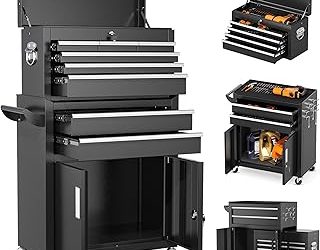
This is the value benchmark: five steel drawers on ball bearing runners, a lidded top tray for fasteners, and a single lock that secures the lot. It’s genuinely portable at 24 inches wide, and the drawer action is smoother than the price suggests — a sensible first “real” chest for a home workshop.
DEWALT Rolling Tool Box with Telescopic Handle (DWST17820)
The best mobile option here. The deep lower bin swallows power tools and cordless kits, the telescoping handle saves your lower back on gravel and curbs, and it clips into the wider TSTAK ecosystem so you can stack lighter cases on top. Ideal if your tools travel between house and job site.
Keter Masterloader Resin Rolling Tool Box
The pick for damp garages, sheds, and anyone tired of rust. Weatherproof resin construction, all-terrain wheels that handle uneven ground far better than hard plastic casters, and removable bins that let you carry only what a given task needs. Not as rigid as steel under heavy loads, but exceptionally durable day to day.
DEWALT TSTAK II Flat Top Case (DWST17807)
A 13-inch stackable case rated to 66 lbs, best used as a module rather than a standalone chest. Pair one or two with the DWST17820 base and you have a scalable system for a fraction of a full cabinet’s cost — the smartest way to build up gradually.
TUFFIOM 5-Drawer Rolling Tool Chest
Punches above its weight with five lined drawers, a cushioned top that doubles as a work surface, and lockable casters that keep it planted while you’re wrenching. The drawer liners are a small touch that pays off: less rattle, less metal-on-metal noise, less waking the house.
Frequently Asked Questions
How much should I spend on a tool chest?
For home and hobby use, the sweet spot sits well under professional cabinet pricing. Spend enough to get ball bearing slides and a working lock; beyond that, extra money mostly buys capacity and heavier gauge steel you may not need.
Steel or resin — which lasts longer?
Steel handles heavier loads and impacts; resin resists humidity, salt air, and rust indefinitely. In a heated garage, choose steel. In an unheated shed or coastal climate, resin like the Keter Masterloader typically outlives it.
Do I need a rolling chest if my garage is small?
Often yes — mobility matters more in tight spaces, since you can reposition the chest instead of squeezing past it. Just insist on locking casters so it doesn’t wander mid-job.
Can a tool chest really affect how well I sleep?
Indirectly, but meaningfully. Finishing a task cleanly — tools stowed, drawer shut, lock turned — signals closure, and that transition ritual is one of the most reliable ways to stop replaying unfinished work in bed.
Final Thoughts
For most home workshops, the 24″ 5-Drawer Metal Tool Box delivers the most capability per dollar, with steel drawers and a full lock at an entry-level price. Choose the DEWALT DWST17820 if your tools need to travel, and the Keter Masterloader if moisture is your real enemy. Any of the three closes the loop on garage clutter — and that’s worth more than a tidy bench.