Key takeaways
- Drawer count vs. drawer depth: Twenty shallow drawers sound impressive, but they only help if your tools are small and sortable. Mixed configurations — a few deep drawers for power tools plus shallow ones for sockets and wrenches — serve most home users better than a uniform grid.
- Caster quality and locking wheels: Look for at least two locking casters and a stated total load capacity. Cheap hard plastic wheels chatter loudly on concrete and gouge epoxy floors; larger rubberized casters roll quieter and handle expansion joints and thresholds without fighting you.
- Slide type and full extension: Ball-bearing slides that fully extend let you see the back of every drawer. Friction slides bind under weight and are the single most common long-term complaint in this category.
- Security you’ll actually use: A central lock bar that secures every drawer at once beats individual keyed drawers, especially in shared garages or homes with curious kids. Confirm the chest ships with at least two keys.
- Top surface and detachability: A stainless or reinforced worktop turns the chest into a staging area. A detachable top box adds real flexibility — carry a curated kit to the job instead of wheeling the whole cabinet.
What's inside
Most garage frustration doesn’t start with the project — it starts with the search. A 10-minute repair stretches into an hour because the 10mm socket migrated into a coffee can, the torque wrench is under a tarp, and the drill bits are somewhere in a bucket of loose hardware. That kind of low-grade friction is why so many home projects stall out at 9 p.m. on a Sunday, half-finished, with tools scattered across the floor. As someone who spends a lot of time studying how environments affect rest and recovery, I’d argue a disorganized workshop costs you more than time: unfinished tasks and cluttered spaces are quietly stressful, and that tension follows you into the house and into bed.
A rolling tool chest solves this with a single move — everything gets a fixed home, on wheels, at working height. But the category is crowded, and the differences that matter (drawer slide quality, caster load rating, lock design, whether the top detaches) aren’t obvious from a product listing. This guide breaks down what to prioritize in 2026, then reviews the standout rolling chests for home garages, workshops, and small repair spaces, from compact modular carriers to eight-drawer cabinets built to swallow an entire collection.
As an Amazon Associate we earn from qualifying purchases.


How to Choose a Roller Tool Chest (2026)
- Drawer count vs. drawer depth: Twenty shallow drawers sound impressive, but they only help if your tools are small and sortable. Mixed configurations — a few deep drawers for power tools plus shallow ones for sockets and wrenches — serve most home users better than a uniform grid.
- Caster quality and locking wheels: Look for at least two locking casters and a stated total load capacity. Cheap hard plastic wheels chatter loudly on concrete and gouge epoxy floors; larger rubberized casters roll quieter and handle expansion joints and thresholds without fighting you.
- Slide type and full extension: Ball-bearing slides that fully extend let you see the back of every drawer. Friction slides bind under weight and are the single most common long-term complaint in this category.
- Security you’ll actually use: A central lock bar that secures every drawer at once beats individual keyed drawers, especially in shared garages or homes with curious kids. Confirm the chest ships with at least two keys.
- Top surface and detachability: A stainless or reinforced worktop turns the chest into a staging area. A detachable top box adds real flexibility — carry a curated kit to the job instead of wheeling the whole cabinet.
The Best Roller Tool Chests (2026) Reviewed
20 Drawer Tool Chest (5+7+8 Drawer Modular System)
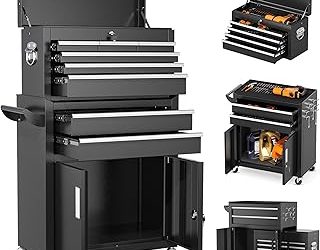
This three-section stack is the closest thing here to a full shop solution, with a stainless countertop, connection buckles between modules, lock and keys, and a portable tool box tucked inside. It’s the pick if you own a genuinely large collection and want everything sorted by function rather than crammed by size.
DEWALT TSTAK Rolling Tool Box (DWST17820)
Not a traditional chest but arguably the smartest choice for anyone who works away from a fixed bench — a deep rolling base with a telescopic handle that stacks with the wider TSTAK ecosystem. Ideal for apartment dwellers, renters, and DIYers who need storage that travels and stores vertically in a closet.
VEVOR Rolling Tool Chest, 2-in-1 Design
The detachable metal top box is the standout feature: five drawers stay in the garage while the carry section goes to the project. Protective liners, a lock bar, and an integrated tool rack round out a genuinely well-considered package at a mid-tier price.
8-Drawer Rolling Tool Chest with Detachable Top
Ships assembled, which saves an evening of bracket-sorting, and arrives with liners, a tray divider, and side hooks already accounted for. Eight drawers plus the removable top box give you enough compartments to separate automotive, electrical, and woodworking tools without doubling up.
7-Drawer Heavy-Duty Rolling Tool Chest Cabinet
A straightforward, sturdy mobile cart with a keyed lock and a footprint that fits alongside a bench rather than dominating the bay. Best for users who want durable drawer capacity and don’t need modular extras.
Frequently Asked Questions
How many drawers do I actually need?
Count your tool categories, not your tools. Most home users land comfortably at five to eight drawers; beyond that, you’re either running a small business or you’ll end up with empty drawers collecting hardware you can’t identify.
Will a rolling chest damage my garage floor?
Loaded chests concentrate a lot of weight on four small contact points. Larger-diameter rubber casters distribute better and roll more quietly, and many chests include foot pads to take load off the wheels once positioned.
Are these safe to keep in an unheated garage?
Powder-coated steel handles temperature swings fine, but humidity is the enemy. Drawer liners plus a couple of desiccant packs in the drawers holding precision tools will prevent surface rust.
Should I choose a chest or a stackable modular system?
Choose a chest if your work stays in one place and you value worktop space. Choose modular if you frequently carry tools to a second location or need storage that breaks down for transport.
Final Thoughts
For most home garages, the VEVOR 2-in-1 hits the best balance of drawer capacity, security, and portability, while the assembled 8-drawer chest is the stronger pick if you want maximum sorted storage out of the box. If your tools travel more than they sit, the DEWALT TSTAK rolling box is the one to buy — and whichever you choose, a workshop you can close, lock, and walk away from is worth far more than the price on the tag.