Key takeaways
- Measure the clearance, not the table: Leave roughly 30–36 inches between the table edge and the nearest wall or sofa so chairs can pull out without a shuffle. A 40-inch table in a 90-inch nook works; a 48-inch one turns every meal into a negotiation.
- Choose expandable over permanent: Drop-leaf, flip-leaf, and extension-leaf designs let you run a 24-inch surface on weekdays and a 47-inch one when guests arrive. This is the single highest-value feature in a small home.
- Favor round or oval for tight rooms: Curved edges eliminate the hip bruises that make a table feel intrusive, and they seat one extra person in the same square footage as a rectangle.
- Look for built-in storage: A lower shelf or hidden compartment gives chargers, notebooks, and mail a home that isn’t the tabletop — which matters if you want the surface clear enough to signal “the day is done.”
- Check the finish under warm light: Matte walnut, oak, and natural wood tones reflect far less glare from overhead fixtures than high-gloss white. If this table sits in the room where you unwind, the softer finish genuinely helps your evening lighting.
What's inside
Most small-space dining problems don’t announce themselves at dinner. They show up at 11 p.m., when you’re still hunched over a laptop on the same 30-inch surface where you ate breakfast, and your brain has quietly filed that corner of the apartment under “work.” As someone who spends most days helping people repair their sleep, I can tell you the fix is rarely a new mattress. It’s usually a boundary — a physical place where the day’s productive hours end and the wind-down begins. In a studio or one-bedroom, the dining table is often the only candidate for that job, which makes choosing the right one a genuine sleep-hygiene decision rather than a purely decorative one.
This guide looks at compact dining tables through two lenses at once: the practical (footprint, seating capacity, assembly, durability) and the behavioral (whether the table encourages you to sit down, eat without a screen, and then close the evening cleanly). I’ve prioritized designs that fold, expand, or tuck away, because a table you can shrink at 9 p.m. is a table that stops competing for your attention. Below are the models worth your money in 2026, followed by the criteria I’d apply before you commit.
As an Amazon Associate we earn from qualifying purchases.


How to Choose a Dining Table for a Small Space (2026)
- Measure the clearance, not the table: Leave roughly 30–36 inches between the table edge and the nearest wall or sofa so chairs can pull out without a shuffle. A 40-inch table in a 90-inch nook works; a 48-inch one turns every meal into a negotiation.
- Choose expandable over permanent: Drop-leaf, flip-leaf, and extension-leaf designs let you run a 24-inch surface on weekdays and a 47-inch one when guests arrive. This is the single highest-value feature in a small home.
- Favor round or oval for tight rooms: Curved edges eliminate the hip bruises that make a table feel intrusive, and they seat one extra person in the same square footage as a rectangle.
- Look for built-in storage: A lower shelf or hidden compartment gives chargers, notebooks, and mail a home that isn’t the tabletop — which matters if you want the surface clear enough to signal “the day is done.”
- Check the finish under warm light: Matte walnut, oak, and natural wood tones reflect far less glare from overhead fixtures than high-gloss white. If this table sits in the room where you unwind, the softer finish genuinely helps your evening lighting.
The Best Small-Space Dining Tables of 2026, Reviewed
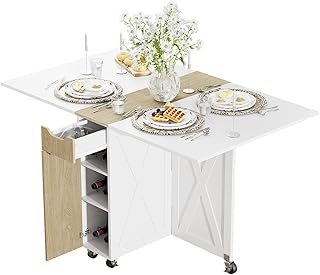
Folding Dining Table with 6 Wheels (White)
The most disciplined option here: it rolls out for meals and folds flat against a wall the moment you’re finished, which enforces the separation between eating, working, and resting that most studio dwellers struggle to maintain. It doubles capably as a sewing or hobby table, and the casters mean you’ll actually move it rather than leaving it deployed out of inertia.
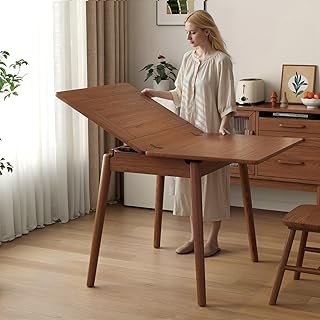
Solid Wood Expandable Dining Table for 2–6 (Walnut)
A 23.6-inch weekday footprint that stretches to 47.2 inches makes this the most versatile pick for anyone hosting occasionally in a tight apartment. Solid wood construction and straightforward assembly put it well ahead of the particleboard competition at this size, and the warm walnut tone reads as furniture rather than equipment.
Extendable Round-to-Oval Table with Hidden Storage (Oak)
Going from a 35.4-inch circle to a 47.2-inch oval covers nearly every scenario a small dining area throws at you, and the concealed leaf storage means you’re not stashing a panel behind the couch. My favorite detail is the hidden compartment — it’s the easiest way to clear the surface completely before bed.
42″–58″ Extendable Round Table with Flip Leaf
The built-in flip leaf is faster to deploy than a removable panel, and the metal legs give it a stability advantage over most wood-legged extendables in this price range. The storage shelf underneath earns its keep in apartments where cabinet space is the real constraint.
MAHANCRIS 31.5″ Round Dining Table with Storage Shelf
At 31.5 inches, this is the right answer for a genuine two-person nook where an extendable table would simply never extend. The farmhouse styling and lower shelf make it feel intentional rather than provisional — a small but real psychological difference in a compact home.
Frequently Asked Questions
What’s the smallest dining table that still works for two people?
Around 30–32 inches in diameter for a round table, or 28 by 36 inches for a rectangle. Below that, plates and glasses start colliding, and the meal feels rushed — which is worth avoiding if dinner is meant to be a wind-down cue.
Does eating at my dining table really affect my sleep?
Indirectly, yes. Eating at a defined table rather than in bed or on the sofa keeps those surfaces associated with rest, which is the core principle behind stimulus-control sleep therapy. Finishing a meal two to three hours before bed helps as well.
Are folding tables durable enough for daily use?
Good ones are. Look for locking hinges, a rated weight capacity, and casters with brakes. The trade-off is usually surface thickness, so a folding table is better suited to two diners than to heavy nightly use by four.
Should I choose a table set or buy chairs separately?
A matched set like the AWQM 3-piece is the simpler, more affordable route for a true two-seater breakfast nook. Buying separately makes sense only if you need chairs that tuck fully under the table or stack away between meals.
Final Thoughts
If you want one table that adapts to your whole week, the Solid Wood Expandable Dining Table in walnut is the strongest all-rounder, with the Extendable Round-to-Oval Oak table close behind for its hidden leaf storage and forgiving curved footprint. For genuinely tight studios where the table has to disappear each evening, the Folding Dining Table with wheels is the one I’d recommend without hesitation — it’s the rare piece of furniture that helps you end the day rather than extend it.