Key takeaways
- 600–1000 PSI: Softwood decking, painted surfaces, upholstered outdoor cushions, window frames, vehicles. Gentle rinsing territory.
- 1200–1900 PSI: Composite decking, vinyl siding, wicker and rattan furniture, plastic patio sets, garden fencing.
- 2000–2800 PSI: Sealed hardwood decks, brick, stone patios, most driveways with light staining. The sweet spot for the majority of homeowners.
- 2900–3500 PSI: Concrete, heavy oil stains, mildew-blackened masonry, paint stripping prep.
What's inside
As someone who spends most of my working life talking to people about sleep, I’ve learned that rest is rarely just about the bedroom. It’s about the whole home — the patio you actually want to sit on in the evening, the deck chairs that aren’t furred with green algae, the garden furniture that feels clean enough to linger in as the light goes. Restorative environments lower the mental noise that keeps people wired at 11pm. And a pressure washer, used well, is one of the fastest ways to reclaim an outdoor space you’ve been quietly avoiding.
The catch is that “more pressure” is not the same as “better cleaning,” and choosing the wrong machine can mean gouged cedar, splintered decking, a stripped teak finish, or a two-stroke engine roaring at a volume that will make you unpopular with every neighbour on the street. Below, I’ll walk you through what PSI actually measures, the pressure ranges that suit different surfaces around a home, how PSI interacts with water flow, and the accessories that matter more than the number on the box. By the end you’ll know exactly which figure to shop for — and how to finish the job without wrecking your afternoon or your evening wind-down.
As an Amazon Associate we earn from qualifying purchases.


What PSI Actually Tells You (And What It Doesn’t)
PSI — pounds per square inch — is the force of water leaving the nozzle. It’s the “impact” figure: how hard the stream hits a surface to break the bond between dirt and material. But force alone doesn’t rinse anything away. That job belongs to GPM, gallons per minute, which is the volume of water carrying the loosened grime off the surface. Multiply the two and you get Cleaning Units (CU), the most honest single measure of a machine’s real-world capability. A 2500 PSI unit at 1.76 GPM delivers roughly 4,400 CU; a 3400 PSI unit at 2.6 GPM delivers nearly 8,800. Same category of tool, twice the working speed. Judge machines on both numbers, never one.
The Right PSI For The Surface In Front Of You
- 600–1000 PSI: Softwood decking, painted surfaces, upholstered outdoor cushions, window frames, vehicles. Gentle rinsing territory.
- 1200–1900 PSI: Composite decking, vinyl siding, wicker and rattan furniture, plastic patio sets, garden fencing.
- 2000–2800 PSI: Sealed hardwood decks, brick, stone patios, most driveways with light staining. The sweet spot for the majority of homeowners.
- 2900–3500 PSI: Concrete, heavy oil stains, mildew-blackened masonry, paint stripping prep.
Notice how much of a typical home falls under 2000 PSI. Higher-pressure machines aren’t wrong for these jobs — you simply step down using a wider-angle nozzle and increase your distance. A capable machine dialled back is far more useful than an underpowered one held at full throttle.
Electric Or Gas: The Decision That Actually Matters
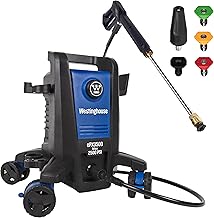
Electric units generally top out around 2500 PSI, start instantly, need no fuel or oil changes, and run at a conversational volume — often 70–80 dB. The Westinghouse ePX3500 is a sensible example of the class: 2500 max PSI, 1.76 GPM, anti-tipping design, and an onboard soap tank for pre-soaking furniture before rinsing. For patios, cars, fences and garden sets, this is plenty.
Gas machines are the answer when you have a large driveway, a long fence run, or genuinely stubborn masonry. The Westinghouse WPX3400 (3400 PSI, 2.6 GPM) and the DeWalt DXPW3300-S (3300 PSI, 2.4 GPM, AAA axial cam pump) both roughly double the throughput of an electric. The trade-off is noise near 90 dB, engine maintenance, and the sheer physical intensity of the work — which brings me to a point most buying guides skip entirely.
The Sleep Angle: Noise, Timing And Nervous-System Load
Sustained noise above 85 dB elevates cortisol and heart rate, and a two-hour session of vibration, spray, bracing and engine roar leaves most people wired rather than pleasantly tired. If you’re already a light or fragmented sleeper, schedule pressure washing for late morning or early afternoon — not the evening. Wear hearing protection, take a hydration break every 30 minutes, and build in a genuine buffer between finishing the job and going to bed: a shower, low light, no screens. Also spare a thought for your neighbours’ children and shift workers; before 8am is nobody’s friend.
Accessories: Where Real Control Comes From
Your nozzle governs effective pressure at the surface far more than your machine’s rating. A 0° red tip concentrates everything into a pinpoint and will scar wood instantly — most homeowners never need it. Live in the 25° green and 40° white tips, with 15° yellow for concrete. An adjustable trigger gun such as the GDHXW or the Sooprinse 3000 PSI gun lets you modulate output mid-sweep, which is invaluable when a single patio contains stone, timber and painted metal. For furniture specifically, a dual-connector foam cannon kit is the best upgrade available: thick detergent foam does the chemical work over five to ten minutes so you can rinse at low pressure and never risk the finish.
Tips
- Always test on a hidden section — under a bench slat, behind a planter — before committing to a visible surface.
- Keep the wand moving in overlapping passes; pausing in one spot is what creates the tell-tale striping on decking and concrete.
- Start at 24 inches from the surface and close the gap gradually rather than starting close and hoping.
- Let detergent dwell but never dry. A dried soap film is harder to remove than the dirt you started with.
Frequently Asked Questions
What is the best all-round PSI for a home?
For most households, 2000–2800 PSI paired with at least 1.7 GPM handles patios, driveways, fencing, siding and furniture without excessive risk. Go above 3000 PSI only if you have large hard-surface areas or heavy staining.
Can high PSI damage outdoor furniture?
Yes. Softwood, rattan, painted metal and older teak can all be scarred. Use a 40° nozzle, stay 18–24 inches back, and let a foam pre-treatment do the loosening instead of raw force.
Is 2500 PSI enough for a concrete driveway?
For general grime, yes — though you’ll work more slowly. Deep-set oil and years of traffic film clean much faster at 3000+ PSI with 2.4 GPM or more, ideally with a surface-cleaner attachment.
How loud are pressure washers, really?
Electric models typically sit around 70–80 dB, comparable to a vacuum cleaner. Petrol models commonly reach 85–95 dB, which warrants hearing protection and consideration of the time of day.
Conclusion
The best PSI is the lowest one that finishes the job — which for most homes means a 2500 PSI electric like the ePX3500, or a 3300–3400 PSI gas machine such as the DeWalt DXPW3300-S or Westinghouse WPX3400 if you’re covering serious ground. Match the number to your surfaces, invest in a good adjustable gun and a foam cannon, respect the noise, and schedule the work so it energises your weekend rather than eroding your sleep. A clean, inviting outdoor room is worth far more to your rest than any gadget you’ll ever put in a bedroom.