Key takeaways
- Ask where EMF was measured: A credible listing states the reading at the seated position, not just at the panel face. Figures under roughly 8 mG at body distance are the current benchmark; vague “ultra-low” claims with no number or measurement point tell you nothing.
- Match capacity to your actual ritual: Single-person cabins reach temperature faster and cost less to run, which makes a nightly 20-minute session realistic. Two- and four-person models buy you room to lie down or stretch, but demand more space, more patience, and often a dedicated circuit.
- Check the electrical requirements first: Most one- and two-person units run on standard 120V household power. Larger cabins may want their own dedicated circuit — worth confirming with an electrician before delivery, not after.
- Treat lighting as a sleep variable: Chromotherapy and red light panels are pleasant, but anything bright and blue-heavy in the hour before bed works against you. Prioritize models where the interior light dims independently or switches off entirely.
- Look at wood and joinery, not just the spec sheet: Canadian hemlock and European aspen are both sensible choices — low resin, low odor, dimensionally stable under repeated heat cycles. Tongue-and-groove panels with a tight fit hold heat better and creak less as the cabin ages.
What's inside
Anyone who has spent an evening scrolling sauna listings knows the frustration: every cabin claims to be “low EMF,” almost none define what that means, and the numbers that do appear rarely specify whether they were measured at the heater surface or where your body actually sits. For people buying a sauna primarily to unwind before bed — which, in my experience advising clients on sleep environments, is most of them — that ambiguity matters. A cabin you sit in for 30 minutes at night should not be a source of low-grade unease about the electrical field around your spine.
This guide looks at low-EMF infrared saunas through a specific lens: how well each one supports a repeatable evening wind-down ritual. That means honest notes on field readings and heater construction, but also the unglamorous details that decide whether you use the thing three times a week or three times a year — footprint, warm-up time, glare from the interior lighting, and whether the door swing works in a real bedroom or basement corner. Below are the models worth shortlisting in 2026.
As an Amazon Associate we earn from qualifying purchases.


🛒 Best Price Today on Amazon
Prime members get fast, free shipping on everything above, plus member-only deals. New members get a 30-day free trial — cancel anytime.
How to Choose a Low Emf Infrared Sauna (2026)
- Ask where EMF was measured: A credible listing states the reading at the seated position, not just at the panel face. Figures under roughly 8 mG at body distance are the current benchmark; vague “ultra-low” claims with no number or measurement point tell you nothing.
- Match capacity to your actual ritual: Single-person cabins reach temperature faster and cost less to run, which makes a nightly 20-minute session realistic. Two- and four-person models buy you room to lie down or stretch, but demand more space, more patience, and often a dedicated circuit.
- Check the electrical requirements first: Most one- and two-person units run on standard 120V household power. Larger cabins may want their own dedicated circuit — worth confirming with an electrician before delivery, not after.
- Treat lighting as a sleep variable: Chromotherapy and red light panels are pleasant, but anything bright and blue-heavy in the hour before bed works against you. Prioritize models where the interior light dims independently or switches off entirely.
- Look at wood and joinery, not just the spec sheet: Canadian hemlock and European aspen are both sensible choices — low resin, low odor, dimensionally stable under repeated heat cycles. Tongue-and-groove panels with a tight fit hold heat better and creak less as the cabin ages.
The Best Low Emf Infrared Sauna (2026)s Reviewed
OUTEXER Far Infrared Sauna Spa Room
A compact 1200W cabin with a tempered glass door that keeps a small room from feeling like a closet, plus seven-color interior lighting you can dial down to something bedtime-appropriate. The 35″ width is generous for a single-occupant footprint, making this a strong pick for a spare-room corner where every inch is negotiable.
Joyous 2-Person Low EMF Far Infrared Sauna
Seven carbon fiber heaters distribute warmth more evenly than the older ceramic-rod layouts, which in practice means fewer hot spots on your back and a more relaxing session. The Canadian hemlock build and two-person bench make this the sensible choice for couples who want the sauna to be a shared evening habit rather than a solo appliance.
Bergamo 4-Person Low EMF Far Infrared Sauna
The largest cabin here, and the only one with genuine room to recline — worth considering if your wind-down involves lying flat rather than sitting upright. Budget for the space and the longer warm-up; this is a basement or converted-garage installation, not a bedroom one.
Dynamic Saunas Venice 2-Person
Dynamic publishes a specific figure — under 8 mG — which puts it ahead of most competitors on transparency alone. The Venice is a well-proportioned two-person cabin with a straightforward feature set, ideal for buyers who want measurable specs over accessory count.
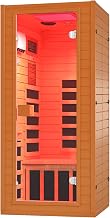
1 Person Infrared Sauna, European Aspen with Red Light
At 905W, this is the most energy-efficient cabin on the list, and European aspen is an excellent choice for anyone sensitive to wood odor during long sessions. The left-hinged door is a small detail that solves a real problem in tight rooms — check your wall clearance before ordering.
Frequently Asked Questions
How long before bed should I use an infrared sauna?
Finish your session roughly 90 minutes to two hours before you plan to sleep. Core body temperature needs to fall for sleep onset, and the post-sauna cooldown amplifies that drop — but only if you give it time to happen.
What does “low EMF” actually mean?
It refers to reduced electromagnetic field emissions from the heating elements, typically achieved through shielded wiring and carbon panel design. Ask for the reading at seated distance rather than at the heater surface, since the two figures can differ substantially.
Is hemlock or aspen the better wood?
Both perform well. Canadian hemlock is slightly warmer in tone and widely available; European aspen is nearly odorless and stays cooler to the touch, which some people prefer for bare-skin contact.
Can I assemble one of these alone?
Most one-person cabins are manageable solo in an hour or two. Two-person and larger models involve heavy wall panels — arrange a second pair of hands and confirm whether delivery is curbside or threshold.
Final Thoughts
For most buyers building an evening routine, the Dynamic Saunas Venice offers the best balance of published EMF data, sensible sizing, and value. Solo users in tight spaces should look hard at the European Aspen 905W model for its efficiency and low-odor build, while couples wanting even heat and a comfortable shared bench will be well served by the Joyous two-person hemlock cabin.