Most people shopping for an infrared sauna aren’t chasing a spa aesthetic — they’re chasing a better night’s sleep. The physiology behind that instinct is sound: sleep onset is triggered less by fatigue than by a falling core body temperature, and passive heating followed by rapid cooling produces a steeper thermal drop than doing nothing at all. The problem is that the category has become almost unshoppable. “Full spectrum” is applied loosely, wattage claims are measured inconsistently, EMF data is often absent, and two cabins with nearly identical listings can deliver very different experiences at 7 p.m. on a Tuesday.
This guide approaches the 2026 lineup through a sleep-wellness lens rather than a fitness one. Below you’ll find the models worth considering, followed by the specifications that genuinely affect your evening wind-down — heater placement, red light wavelengths, low-EMF construction, warm-up time, and whether the cabin fits your home without becoming a piece of furniture you resent.
Our top picks



As an Amazon Associate we earn from qualifying purchases at no extra cost to you.
🛒 Best Price Today on Amazon
Prime members get fast, free shipping on everything above, plus member-only deals. New members get a 30-day free trial — cancel anytime.
How to Choose a Full Spectrum Infrared Sauna in 2026
- True spectrum coverage: Full spectrum means near, mid, and far infrared. Far infrared drives the deep, sustained warming that matters most for thermoregulation; near infrared and 660nm/850nm red light are the surface-level additions. Confirm all three bands are present rather than assuming the label guarantees them.
- Low-EMF heaters: You’ll sit 12 to 18 inches from these panels for 30 to 45 minutes at a stretch. Manufacturers publishing verified low-EMF or low-ELF figures deserve preference over those that stay silent on the subject.
- Warm-up speed: A cabin that needs 35 minutes to reach temperature will quietly fall out of your routine. Look for 1,290W or higher with seven or more panels, which typically brings a one- or two-person cabin to operating range in 10 to 15 minutes.
- Circadian-friendly lighting: Red and amber wavelengths won’t blunt evening melatonin the way blue-rich light does. If a model includes chromotherapy, make sure you can dim it or hold it to the warm end after sunset.
- Footprint and placement: Measure the diagonal clearance, not just the base. Canadian Hemlock is the sensible choice for indoor use — dimensionally stable, low-resin, and virtually odorless, which matters if the sauna lives near a bedroom.
The Best Full Spectrum Infrared Saunas of 2026, Reviewed
1-Person Full Spectrum Sauna with 660nm & 850nm Red Light
Seven heating panels and a dedicated foot warmer make this the most thermally complete single-person cabin here, and the foot heater is not a gimmick — warming the extremities accelerates the peripheral vasodilation that precedes core temperature decline. An excellent fit for a spare bedroom or converted closet.
springspa Full Spectrum Infrared Sauna, 1-Person
At roughly 31.5 by 30 inches, springspa’s cabin slots into spaces most saunas can’t reach while still delivering 1,290W across seven panels and the same 660nm/850nm red light array. The Bluetooth speakers are genuinely useful for anyone who winds down with breathwork audio or low-tempo playlists.
DYNAMIC SAUNAS Cordoba 2-Person Full Spectrum Sauna
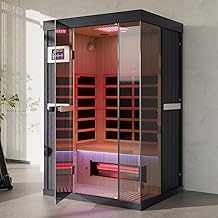
The Cordoba is the most refined build in this group, with the kind of Hemlock joinery and interior finish that justifies putting it in a living space rather than a garage. Two-person capacity also makes an evening session something a couple can share, which does more for routine adherence than any feature on a spec sheet.
LTCCDSS Full Spectrum Outdoor Sauna, 4-Person
The only outdoor-rated option here, and the only one built for a household rather than an individual — 73 inches wide with low-EMF heaters and chromotherapy lighting. Stepping from a warm cabin into cool night air produces a particularly sharp thermal drop, which is exactly the gradient you want before bed.
2-Person Full Spectrum Sauna, 1990W with 12″ Red Light Panel
At 1,990W this is the fastest-heating cabin on the list, and the oversized 12-inch red light panel offers far more usable coverage than the small emitters common at this price. Best suited to buyers who want minimal lead time between deciding to use the sauna and actually being in it.
What to Look For in a Full Spectrum Infrared Sauna
Wavelengths Listed on the Spec Sheet
“Full spectrum” generally means a cabin combines far-infrared carbon or ceramic heaters with near- and mid-infrared sources, and sometimes a red-light panel. Red light is usually quoted around 630 to 660 nm and near-infrared around 810 to 850 nm. A listing that spells out its wavelengths, as the 660nm and 850nm model here does, gives you something concrete to compare; a listing that only repeats the phrase “full spectrum” does not. The sleep evidence for red light itself is still thin and mixed, so treat the panel as a bonus and judge the cabin mainly on how well it heats and how well it is built.
Power Draw and Your Circuit
This is the spec most buyers skip. A standard US outlet circuit is rated 15 amps at 120 volts, which is 1,800 watts, and continuous loads are normally kept to about 80 percent of that, near 1,440 watts. A heater rated at 1990W draws roughly 16.6 amps (1990 divided by 120), more than an ordinary 15-amp circuit is meant to carry for a long session. Single-person cabins with lower wattage are easier to plug in; larger or higher-output cabins often call for a dedicated 20-amp circuit or a 240-volt supply. Confirm the electrical requirements on the listing and have an electrician check your panel before you commit.
Cabin Size, Wood and Airflow
Occupancy labels are generous. A “2-person” cabin usually seats two adults shoulder to shoulder, so measure the room, the doorway and the ceiling before you order. Hemlock, cedar and basswood are the common cabin woods; cedar carries a noticeable scent when warm, while hemlock is milder. Look for a vent and a glass door so the cabin does not feel stuffy. An outdoor cabin like the 4-person model also needs a roof and sealed seams built for weather, and an indoor unit should never be placed outside, since moisture damages the heater wiring and the wood.
Session Timing for Sleep
Guidance for sleep-minded users commonly suggests finishing a session one to two hours before bed so core temperature has time to fall. Far-infrared cabins usually run at roughly 110 to 140°F, well below a traditional Finnish sauna, so 20 to 30 minutes is a typical starting point. Drink water before and after. Anyone who is pregnant, has a heart condition or takes medication that affects heat tolerance should speak with a clinician first.
Which One Should You Buy?
| If you… | Choose… |
|---|---|
| Live alone and want the smallest footprint | springspa Full Spectrum Infrared Sauna, 1-Person |
| Want named red and near-infrared wavelengths in a solo cabin | 1-Person Full Spectrum Sauna with 660nm & 850nm Red Light |
| Share sessions with a partner | DYNAMIC SAUNAS Cordoba 2-Person Full Spectrum Sauna |
| Want a two-seat cabin with a large red-light panel and can supply the power | 2-Person Full Spectrum Sauna, 1990W with 12″ Red Light Panel |
| Have a covered backyard space and a family to fit | LTCCDSS Full Spectrum Outdoor Sauna, 4-Person |
Common Mistakes When Buying a Full Spectrum Infrared Sauna
- Ignoring the circuit. Wattage matters more than the label on the box. Do the amps arithmetic before checkout, not after delivery.
- Trusting the occupancy number. Two people in a two-person cabin is a snug fit, not a spacious one.
- Treating the red-light panel as the main feature. Heating performance, build quality and warranty terms deserve more weight.
- Placing an indoor cabin on carpet or hard against a wall. Manuals typically call for clearance and a hard, level floor; read them before choosing a spot.
- Using it right before bed. Heating raises core temperature, and sleep onset is easier once it has dropped again.
A Simple Evening Routine
- Preheat the cabin for the time the manual specifies, usually 10 to 20 minutes, and drink a glass of water.
- Sit for 20 to 30 minutes, stepping out early if you feel dizzy or lightheaded.
- Cool down gradually with a lukewarm rinse or by simply resting, since the falling core temperature is the part linked to sleepiness.
- Rehydrate, then wait an hour or two before getting into bed.
Frequently Asked Questions
When should I use an infrared sauna for better sleep?
Finish your session 60 to 120 minutes before lights out. The sleep benefit comes from the cooling phase, not the heating phase, so you want that rebound to land as you’re getting into bed rather than while you’re still toweling off.
Is full spectrum meaningfully better than far infrared alone?
For pure thermoregulation, far infrared does the heavy lifting. Full spectrum adds near infrared and red light, which are associated with recovery and skin benefits — worthwhile additions, but choose based on heater quality and warm-up time first.
Does red light therapy actually improve sleep?
Evidence for 660nm and 850nm wavelengths is promising but still early. The clearer, more immediate benefit is what red light doesn’t do: unlike overhead white lighting, it won’t suppress your evening melatonin release.
Will these run on a standard household outlet?
The 1,290W models operate on a standard 120V circuit. Higher-wattage cabins like the 1,990W unit should have a dedicated circuit to avoid nuisance breaker trips mid-session.
Final Thoughts
For most buyers, the DYNAMIC SAUNAS Cordoba strikes the best balance of build quality, capacity, and living-room presentability. If space is tight, the springspa 1-person cabin delivers a full seven-panel spectrum in a genuinely small footprint, and households with outdoor space should look hard at the LTCCDSS 4-person — the cool-air exit alone makes it a compelling pre-bed ritual.