Key takeaways
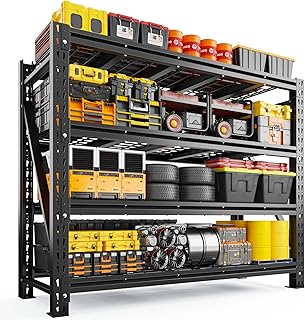
- Read capacity per shelf, not per unit: A “5000LBS” rating is the total across all tiers, evenly distributed. Divide by the number of shelves to get the realistic per-tier figure, and never concentrate that weight in one spot.
- Match depth to what you actually store: 24″ depth swallows storage totes, coolers, and tire sets without overhang. 18″ is friendlier in a single-car garage or pantry where you still need to walk past the unit with a bag of groceries.
- Look for one-piece uprights and side bracing: Stacked or sleeved posts introduce wobble as loads shift. Continuous uprights plus diagonal or side braces are what keep a tall rack from racking side to side.
- Check the deck construction: Solid steel panels with supporting ribs underneath handle point loads best. Wire decking sheds dust and lets light through, which is genuinely useful in a dim basement corner.
- Plan the height against your ceiling and your reach: A 70–72″ unit clears most garage door tracks, but anything above shoulder height should hold light, infrequently used items. Heavy things belong on the bottom two tiers — for your back and for stability.
What's inside
Most garage clutter doesn’t start as clutter. It starts as a stack of paint cans in a corner, a bin of sports gear that never made it back to the wall, a box of holiday lights parked on the floor “just for now.” Within a season, the floor is the storage system — and the cost isn’t only lost square footage. As someone who spends most days helping people build calmer evening routines, I see the same pattern again and again: the household that trips over a snowblower attachment at 9 p.m. carries that low-grade friction straight into the bedroom. Visual chaos in the spaces we pass through is a real contributor to the wound-up, can’t-settle feeling people describe as “my brain won’t shut off.”
Heavy duty shelving is the least glamorous, most effective fix. Get everything off the concrete and onto rated steel, and the garage stops being a daily stressor. The trouble is that spec sheets in this category are noisy — capacity claims range from 3,200 to 8,000 pounds, and few listings explain what those numbers actually mean. Below, I’ve broken down what matters when you’re comparing units, then reviewed the standouts for 2026 across widths, tiers, and load ratings, so you can buy once and forget about it.
As an Amazon Associate we earn from qualifying purchases.




How to Choose Heavy Duty Garage Shelving (2026)
- Read capacity per shelf, not per unit: A “5000LBS” rating is the total across all tiers, evenly distributed. Divide by the number of shelves to get the realistic per-tier figure, and never concentrate that weight in one spot.
- Match depth to what you actually store: 24″ depth swallows storage totes, coolers, and tire sets without overhang. 18″ is friendlier in a single-car garage or pantry where you still need to walk past the unit with a bag of groceries.
- Look for one-piece uprights and side bracing: Stacked or sleeved posts introduce wobble as loads shift. Continuous uprights plus diagonal or side braces are what keep a tall rack from racking side to side.
- Check the deck construction: Solid steel panels with supporting ribs underneath handle point loads best. Wire decking sheds dust and lets light through, which is genuinely useful in a dim basement corner.
- Plan the height against your ceiling and your reach: A 70–72″ unit clears most garage door tracks, but anything above shoulder height should hold light, infrequently used items. Heavy things belong on the bottom two tiers — for your back and for stability.
The Best Heavy Duty Garage Shelving (2026), Reviewed
Bepatio 8000LBS 77″ Heavy Duty Garage Shelving
The highest-rated capacity here and the widest footprint, which makes it the natural pick for a workshop wall or a commercial storeroom where you’re staging pallet-adjacent loads. At 77″ wide by 24″ deep, it’s a genuine commitment of wall space — measure twice before you order.
71.3″ W Metal Storage Shelves, 5000LBS 4-Tier
A well-judged middle ground: four adjustable tiers, 24″ of depth, and a 5,000-pound rating that comfortably covers tool chests, lumber offcuts, and bulk bins. The 70″ height clears most garage door hardware, which is exactly why I recommend this size class to first-time buyers.
Romorgniz Heavy Duty Steel Rack, 5000LBS
The engineering details are the story: one-piece uprights, side braces, and sixteen supporting ribs under solid steel decks mean minimal flex when you load it unevenly — which everyone eventually does. A strong choice if rock-solid rigidity matters more to you than maximum width.
RAVIGIN 5000LBS 71″ Garage Shelving
Essentially the same footprint and rating as the other 71″ units, with fully adjustable shelf heights in a clean black finish. Worth a look if you want flexibility to reconfigure tiers around bulky, awkward items like generators or bike frames.
REIBII 3200LBS 55.5″ 5-Tier Wire Shelving
The most versatile unit on the list, and the one I’d put in a basement or walk-in pantry rather than a working garage. Five tiers at 18″ deep give you more organizing levels in less floor space, and the wire decking keeps things visible and ventilated.
Frequently Asked Questions
Do I need to anchor heavy duty shelving to the wall?
It isn’t always required, but it’s always smart — especially with tall units, children in the house, or seismic risk. Anchoring the top rail to studs eliminates tip-over risk entirely and costs a few dollars in hardware.
How long does assembly take?
Most boltless rivet-style racks go together in 30 to 60 minutes with a rubber mallet and no tools. Plan for a helper on 71″–77″ units; the uprights are awkward to hold square alone.
Will steel shelving rust in an unheated garage?
Powder-coated and rust-resistant finishes hold up well, but humidity is the real enemy. Keep units a few inches off exterior walls for airflow, avoid storing wet gear directly on the decks, and wipe up spills promptly.
Can I use garage shelving indoors?
Absolutely. Narrower, wire-decked units like the REIBII look at home in a pantry, laundry room, or utility closet — and moving overflow storage out of bedrooms is one of the simplest changes I recommend for people whose sleep space has quietly become a storage space.
Final Thoughts
For most garages, the 71.3″ 5000LBS 4-tier unit is the sweet spot of width, depth, and capacity. Step up to the Bepatio 8000LBS 77″ if you’re outfitting a shop or warehouse bay, or choose the Romorgniz for its one-piece uprights and ribbed steel decks when rigidity is the priority. Any of the three will get your floor back — and a garage you can walk through is a surprisingly good investment in how the rest of your house feels at the end of the day.