Key takeaways
- Measured noise, not marketing noise: Look for a published dBA figure. Anything at or under about 70 dBA is livable indoors; the 60 dBA class is quiet enough to hold a conversation beside. Brands that omit the number usually have a reason.
- Duty cycle versus your actual project: A 6-gallon pancake tank recovers fast enough for brad nailers, upholstery staplers, and furniture repair. Framing, roofing, or long spray sessions need more stored air and higher recovery, not just a bigger PSI headline.
- Oil-free pumps for indoor use: Oil-free designs skip the maintenance schedule and the oil-mist smell that lingers in poorly ventilated rooms. They’re slightly louder by nature, which makes the quiet oil-free models genuinely impressive engineering.
- Vibration transfer and placement: Rubber feet and a wide stance matter as much as raw decibels. Structure-borne vibration travels through joists and shows up in a bedroom two floors up; a mat under the tank is the cheapest upgrade you’ll ever make.
- Portability that matches the work: Pancake tanks carry easily for one-room jobs. Wheeled tanks and cordless inflators exist for a reason — pick based on how far the tool travels, not on what looks capable in a photo.
What's inside
Air compressors have a reputation problem in the home, and it isn’t about power — it’s about peace. Anyone who has run a brad nailer in a finished basement while a toddler naps upstairs, or inflated tires in an attached garage at 6 a.m., knows the real cost of a poorly chosen pump. As someone who spends most of my working life studying how sound, vibration, and household stress affect sleep architecture, I look at compressors differently than a typical tool reviewer does: a machine that hits 90+ decibels in an enclosed space isn’t just loud, it’s a sleep disruptor with a power cord. Brief noise spikes can pull a sleeper out of slow-wave sleep even when they never fully wake, and the fatigue shows up hours later.
This guide ranks the brands worth your money in 2026 through both lenses: build quality and airflow first, acoustic behavior and vibration a very close second. I’ve grouped picks by the jobs people actually do at home — furniture assembly, trim and upholstery work, tire top-offs, and light finishing — and flagged which models are genuinely quiet enough for a shared wall, a nursery-adjacent garage, or a weekend project schedule that doesn’t revolve around everyone else’s nap.
As an Amazon Associate we earn from qualifying purchases.


How to Choose a/an Air Compressor Brand (2026)
- Measured noise, not marketing noise: Look for a published dBA figure. Anything at or under about 70 dBA is livable indoors; the 60 dBA class is quiet enough to hold a conversation beside. Brands that omit the number usually have a reason.
- Duty cycle versus your actual project: A 6-gallon pancake tank recovers fast enough for brad nailers, upholstery staplers, and furniture repair. Framing, roofing, or long spray sessions need more stored air and higher recovery, not just a bigger PSI headline.
- Oil-free pumps for indoor use: Oil-free designs skip the maintenance schedule and the oil-mist smell that lingers in poorly ventilated rooms. They’re slightly louder by nature, which makes the quiet oil-free models genuinely impressive engineering.
- Vibration transfer and placement: Rubber feet and a wide stance matter as much as raw decibels. Structure-borne vibration travels through joists and shows up in a bedroom two floors up; a mat under the tank is the cheapest upgrade you’ll ever make.
- Portability that matches the work: Pancake tanks carry easily for one-room jobs. Wheeled tanks and cordless inflators exist for a reason — pick based on how far the tool travels, not on what looks capable in a photo.
The Best Air Compressor Brand (2026)s Reviewed
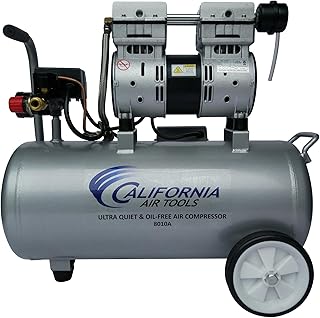
California Air Tools 8010A Ultra Quiet
At a rated 60 dBA, this is the only compressor here I’d run in a finished space while someone is sleeping down the hall, and the 8-gallon aluminum tank means fewer restarts — which matters, because it’s the sudden motor kick-on, not steady hum, that fragments sleep. The oil-free pump and wheeled aluminum tank make it the default recommendation for anyone working in or near living areas.
DEWALT DWFP55126 Pancake, 6 Gallon
The 165 max PSI rating and 2.6 SCFM at 90 PSI give it noticeably better recovery than the standard 150 PSI pancake class, so nailer work flows without waiting on the pump. It’s the loudest of my top picks, so treat it as a garage-and-daytime machine rather than an evening one.
BOSTITCH BTFP02012-WPK Quiet Pancake Kit
BOSTITCH’s quiet pancake is the sensible middle ground: light enough to carry one-handed, tuned well below the category average, and bundled with hose and accessories so you’re working the day it arrives. Ideal for furniture assembly, upholstery tacking, and small trim jobs.
PORTER-CABLE Pancake, 6 Gallon
The value pick, and an honest one — 150 max PSI, 2.6 CFM at 90 PSI, oil-free and maintenance-free, with nothing clever going on acoustically. Buy it if budget leads and your workspace is detached from where people sleep.
DEWALT D55146 Hand Carry with Wheels
A 225 PSI max rating and 4.5-gallon wheeled tank make this the one to choose when air demand outpaces a pancake — longer spray runs, bigger nailers, extended sessions. Higher pressure storage means fewer motor cycles overall, though it’s still a shop machine, not a house-adjacent one.
Frequently Asked Questions
Is a “quiet” compressor really quieter, or is that just marketing?
It’s real and measurable. Decibels are logarithmic, so a 60 dBA unit is perceived as roughly a quarter as loud as an 80 dBA one. That’s the difference between background conversation and a garbage disposal.
Can compressor noise actually affect someone’s sleep?
Yes. Intermittent noise events are more disruptive than continuous sound, and they can trigger brief arousals and shifts out of deep sleep without full waking. A cycling compressor is close to a worst-case pattern.
Do I need more than 6 gallons for home projects?
Rarely. Six gallons handles brad nailers, staplers, inflation, and blow-off comfortably. Step up only for spray finishing, framing, or continuous-demand tools.
What’s the fastest way to make any compressor quieter?
Set it on a dense rubber mat, keep it off shared walls, and add hose length so the tank sits farther from you. Placement often beats a decibel spec on paper.
Final Thoughts
For most homes, the California Air Tools 8010A is the pick that respects both your projects and everyone else’s rest — 60 dBA and 8 gallons is a rare combination. If you want more punch for trim and nailer work, the DEWALT DWFP55126 leads on recovery, while the BOSTITCH quiet pancake kit is the best-balanced starter setup for furniture and upholstery work.