Key takeaways
- Single-user cabins — footprints around 35″ x 28″ fit a closet or bathroom corner. The OUTEXER is in this territory. Expect to sit upright with knees close.
- One-to-two person cabins — roughly 40″ x 36″ x 73″, like the Bluetooth-equipped 1-2 Person model, offer real shoulder room without dominating a spare bedroom.
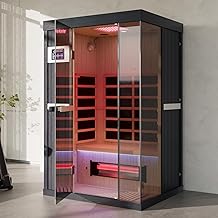
- Two-to-three person cabins — the 3-Person Hemlock Deluxe with glass front and granite backdrop reads as furniture rather than equipment, which matters if it’s going in a living space.
- Portable tents and boxes — the Infrared Sauna Tent with 3L steamer or the Sauna Box with 660nm/850nm lamp collapse for storage, suit renters, and cost a fraction. You lose the wood-cabin ambience and some heat retention.
What's inside
- Understand What “Far,” “Near,” and “Full Spectrum” Actually Mean
- Take EMF and Heater Material Seriously — But Proportionately
- Size for the Room You Have, Not the Room You Want
- Check Your Circuit Before You Check Out
- Time Sessions to Support the Sleep Window
- Tips
- Frequently Asked Questions
- Conclusion
- Related Articles
- Related Guides
Heat has a curious relationship with sleep. Your body doesn’t drift off because it gets warm — it drifts off because it cools down. Core temperature falls by roughly a degree in the ninety minutes before sleep arrives, and that downslope is one of the strongest signals your brain uses to release melatonin and settle into slow-wave rest. An infrared sauna works with that mechanism rather than against it: you deliberately raise skin and core temperature, then step out and let the body’s thermoregulatory rebound carry you into a deeper trough than you’d have reached on your own. This is why so many people report their best sleep on sauna evenings, and why a cabin in the spare room has quietly become one of the more defensible pieces of home wellness equipment.
- Understand What “Far,” “Near,” and “Full Spectrum” Actually Mean
- Take EMF and Heater Material Seriously — But Proportionately
- Size for the Room You Have, Not the Room You Want
- Check Your Circuit Before You Check Out
- Time Sessions to Support the Sleep Window
- Tips
- Frequently Asked Questions
- Conclusion
- Related Articles
- Related Guides
The catch is that “infrared sauna” now covers everything from a 1,990-watt hemlock cabin to a zip-up fabric tent you fold under a bed. They are not interchangeable, and the marketing rarely tells you which one suits your room, your wiring, or your routine. Below, you’ll learn how the three infrared wavelengths actually differ, what EMF numbers and heater materials mean in practice, how to size a unit honestly, what your electrical panel will and won’t tolerate, and how to time sessions so they help your sleep instead of wrecking it. A few current models are referenced where they illustrate a point.
As an Amazon Associate we earn from qualifying purchases.




🛒 Best Price Today on Amazon
Prime members get fast, free shipping on everything above, plus member-only deals. New members get a 30-day free trial — cancel anytime.
Understand What “Far,” “Near,” and “Full Spectrum” Actually Mean
Far infrared is the long wavelength that penetrates shallowly and heats efficiently — it’s what produces the steady, radiant sweat most people associate with these cabins, and it’s the backbone of nearly every unit sold, including value-focused rooms like the OUTEXER Canadian Hemlock 1200W. Near infrared sits at the short end, penetrates deeper into tissue, and is what red light therapy panels emit at the familiar 660nm and 850nm bands. Mid infrared falls between. A “full spectrum” cabin, such as the 2-Person Full Spectrum 1990W model, includes emitters across all three. For sleep purposes, far infrared alone does the thermal work perfectly well; near infrared and red light are worth paying for if you also want them for skin, recovery, or joint comfort. Just be aware that bright red light late at night is stimulating for some people — a 3-Person Ceramic cabin with a dedicated red light panel gives you the option to leave it off.
Take EMF and Heater Material Seriously — But Proportionately
Cheap heating elements with poorly shielded wiring produce measurable electromagnetic fields at close range, which matters because you’re sitting inches away for half an hour. “Low EMF” is largely unregulated as a claim, so look for a manufacturer that publishes actual milligauss figures at bench distance rather than a badge. Heater type also shapes the experience: ceramic emitters run hotter and reach temperature faster; carbon panels spread heat over a larger surface at lower intensity, which most users find gentler over longer sessions. Neither is objectively better. Ceramic suits short, intense sessions; carbon suits the forty-minute wind-down.
Size for the Room You Have, Not the Room You Want
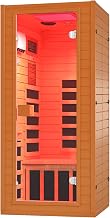
- Single-user cabins — footprints around 35″ x 28″ fit a closet or bathroom corner. The OUTEXER is in this territory. Expect to sit upright with knees close.
- One-to-two person cabins — roughly 40″ x 36″ x 73″, like the Bluetooth-equipped 1-2 Person model, offer real shoulder room without dominating a spare bedroom.
- Two-to-three person cabins — the 3-Person Hemlock Deluxe with glass front and granite backdrop reads as furniture rather than equipment, which matters if it’s going in a living space.
- Portable tents and boxes — the Infrared Sauna Tent with 3L steamer or the Sauna Box with 660nm/850nm lamp collapse for storage, suit renters, and cost a fraction. You lose the wood-cabin ambience and some heat retention.
Measure ceiling height and doorway clearance before ordering. Assembled cabins do not fit through standard doors.
Check Your Circuit Before You Check Out
Most home infrared cabins run on standard 110–120V, but wattage varies enormously. A 1,200W unit shares a circuit comfortably. A 1,990W unit draws close to 17 amps and needs a dedicated 20-amp circuit — plugging it into a shared kitchen line will trip breakers or, worse, heat an extension cord. Never use an extension cord with a sauna. If your only nearby outlet is on a busy circuit, either budget for an electrician or size down.
Time Sessions to Support the Sleep Window
The most common mistake is saunaing thirty minutes before bed. You get into sheets while still radiating heat, and the cooling signal never lands. Aim to finish your session 90 minutes to two hours before your intended sleep time, then let a cool shower and a cool bedroom (around 65–68°F) do the rest. That gap is where the sleep benefit lives.
Tips
- Hydrate with electrolytes, not just water — sodium loss is what causes post-sauna lightheadedness.
- Start at 15 minutes and 120°F, adding five minutes weekly. Heat tolerance is trainable.
- Keep a towel under you and one behind your back; hemlock absorbs sweat and eventually stains.
- Preheat for 20 minutes with the door shut. Sessions timed from a cold start are mostly spent waiting.
Frequently Asked Questions
Will a sauna session actually improve my sleep the same night?
Often, yes — passive heating studies consistently show shortened time to fall asleep and more slow-wave sleep, provided there’s a cooling window between the session and bedtime.
Is a tent-style sauna a real substitute for a cabin?
For the thermal effect, largely yes. Tents like the 3L steamer model raise core temperature effectively. What you sacrifice is comfort, longevity, and the ritual quality that keeps people consistent.
How often should I use it?
Three to four sessions weekly captures most of the observed benefits. Daily use is fine if you’re well hydrated and tolerating it comfortably.
Do speakers and Bluetooth matter?
Only if they change your behaviour. If audio makes you stay in for the full session instead of cutting it short, features on units like the 1-2 Person model with radio and Bluetooth earn their place.
Conclusion
The best infrared sauna is the one that matches your electrical capacity, your available floor space, and the hour you actually have free — because consistency, not wattage, produces the sleep improvements people are chasing. Decide honestly whether you want furniture or equipment, verify the circuit, then build the habit of finishing well before bedtime and letting your body’s own cooling curve carry you the rest of the way down.