Key takeaways
- Match CFM, not horsepower: Size the dryer to the volume your compressor actually delivers at working pressure. Undersizing forces air through too fast to shed moisture, and you’ll get wet lines despite a shiny new filter bowl.
- Choose your drying method: Coalescing filters and water separators pull out bulk liquid and are plenty for tire work, blowguns, and light framing. Refrigerated dryers chill air below its dew point and are what you want for spray finishing, plasma cutting, or any tool with a precision valve.
- Prioritize automatic drainage: A manual petcock only works if you remember it. Semi-auto and fully automatic drains empty themselves, which matters most in an unheated garage where a forgotten bowl can freeze and crack.
- Check micron rating and element material: A 5-micron brass element resists heat and cleans up repeatedly, unlike disposable paper media. For finishing work, stack a second stage to catch oil aerosols the first pass misses.
- Think about placement and noise: Mount the dryer downstream and well away from the pump so air has time to cool. Distance from shared walls also keeps the compressor’s cycling out of your bedroom, which is the whole point.
What's inside
Most people don’t connect an air compressor to how well they sleep, but anyone who has spent years studying rest environments knows the link is real. A compressor that gulps humid air runs hotter, cycles longer, and rattles through your floor joists at the exact hours you’re trying to wind down. Worse, the moisture riding through those lines corrodes tanks and fittings from the inside, which is how a quiet garage becomes a garage with a shrieking pressure leak at 2 a.m. Water in your air is a mechanical problem, an acoustic problem, and — if your shop shares a wall with a bedroom — a recovery problem.
There’s a second reason this belongs on a furniture site. If you spray finish on a headboard, nightstand, or bed frame, a single droplet of condensate will blister the coat and leave you sanding a piece you’d hoped to sleep beside that week. Below, I’ve broken down what actually matters when choosing an air dryer for your compressor in 2026 — flow capacity, filtration stages, drain type — followed by honest notes on six units that span from a modest inline separator to a full refrigerated system.
As an Amazon Associate we earn from qualifying purchases.


How to Choose a/an Air Dryer For Compressor (2026)
- Match CFM, not horsepower: Size the dryer to the volume your compressor actually delivers at working pressure. Undersizing forces air through too fast to shed moisture, and you’ll get wet lines despite a shiny new filter bowl.
- Choose your drying method: Coalescing filters and water separators pull out bulk liquid and are plenty for tire work, blowguns, and light framing. Refrigerated dryers chill air below its dew point and are what you want for spray finishing, plasma cutting, or any tool with a precision valve.
- Prioritize automatic drainage: A manual petcock only works if you remember it. Semi-auto and fully automatic drains empty themselves, which matters most in an unheated garage where a forgotten bowl can freeze and crack.
- Check micron rating and element material: A 5-micron brass element resists heat and cleans up repeatedly, unlike disposable paper media. For finishing work, stack a second stage to catch oil aerosols the first pass misses.
- Think about placement and noise: Mount the dryer downstream and well away from the pump so air has time to cool. Distance from shared walls also keeps the compressor’s cycling out of your bedroom, which is the whole point.
The Best Air Dryer For Compressor (2026)s Reviewed
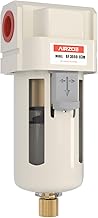
AIRZOE AF3000-03 Water Separator
This 3/8″ NPT separator is the sensible starting point for most home shops: a 5-micron brass element, a poly bowl you can actually see the water collecting in, and a semi-auto drain that clears itself between cycles. It won’t hit refrigerated-dryer dew points, but it stops the slugs of water that ruin tools and finishes.
VEVOR 85 CFM Refrigerated Air Dryer
At 85 CFM on standard 110–120V household power, this is the unit for a serious two-car-garage shop running a 15HP or 20HP compressor. The color control screen and automatic drainage make it genuinely set-and-forget, which is exactly what you want from equipment sharing a foundation with your house.
Schulz 35 CFM Refrigerated Dryer
Schulz has a long reputation in compressed air, and this 35 CFM unit sized for 7.5HP and 10HP compressors is the best-balanced refrigerated option here. The included pre-filter is not a throwaway accessory — it protects the refrigeration circuit and extends the service life meaningfully.
BLCH AF2000-02Z Air Line Dryer
A compact 1/4″ NPT inline dryer rated 0–160 PSI with 5μm filtration, best suited to a single workstation or a portable setup. The manual drain is its main limitation, so treat emptying the bowl as part of your shutdown routine.
1/2″ NPT 3-Stage Filter Dryer System
Three stages of filtration, a built-in regulator, an automatic drain, and a 0–240 PSI range make this the pick for plasma cutting and spray painting on a budget. For finishing bedroom furniture without a refrigerated dryer, this is the most capable non-refrigerated option on the list.
Frequently Asked Questions
Do I really need a refrigerated dryer for hobby work?
Usually not. A quality water separator or three-stage filter handles impact wrenches, nailers, and blowguns. Move up to refrigerated only when you’re spraying finishes or running moisture-sensitive machinery regularly.
Where should the dryer be installed?
Downstream of the tank, after a run of pipe long enough for the air to cool. Installing directly at the pump outlet gives hot air no chance to condense, and the dryer can’t remove vapor it never sees as liquid.
Will a dryer make my compressor quieter?
Not directly, but dry air means shorter cycles, less corrosion, and fewer leaks — all of which reduce how often the pump kicks on. Fewer startups is the practical noise win, especially overnight.
How often do these need maintenance?
Check bowls weekly at first to learn your climate’s rhythm. Brass elements rinse clean; pre-filters on refrigerated units typically want replacement annually under moderate use.
Final Thoughts
For most readers finishing furniture in a home shop, the Schulz 35 CFM refrigerated dryer is the investment that pays off in flawless coats and a compressor that isn’t fighting itself. Scale up to the VEVOR 85 CFM if you’re running 15HP or larger, and if you simply want clean, dry air for general work at a modest price, the AIRZOE AF3000-03 is the honest choice — quiet, tidy, and one less thing waking you up.