Key takeaways
- Airflow with headroom: Island hoods lose capture efficiency to cross-drafts on all four sides, so budget roughly 30–50% more CFM than a comparable wall model. A 1200 CFM unit lets you clear a room on speed two rather than pinning the fan at maximum — which is the single biggest factor in perceived noise.
- Sound behaviour, not just a decibel number: Ask how the hood sounds, not only how loud it is. Baffle filters and larger blower housings produce a lower-frequency hum that the brain habituates to easily, while small high-RPM fans generate a whine that stays perceptually intrusive even at modest volume.
- Ducted whenever the structure allows: Recirculating carbon filters trap odour and some grease but return heat and ultrafine particles to the room. If your bedrooms share air with the kitchen, ducting outdoors is the version that genuinely improves your overnight air quality.
- Lighting you can dim or ignore: Four bright LEDs directly above an island become a light source aimed at your face during evening cooking. Look for warm-toned or multi-level lighting; cool white at full output for an hour before bed suppresses melatonin measurably.
- Delay timers and touch-free control: A timer that runs the fan for ten minutes after you leave finishes the air exchange without you standing there. Gesture sensing keeps you from pressing buttons with oily hands and reduces the fiddling that turns a wind-down evening into a chore.
What's inside
Most people shop for an island hood with their eyes: they want the sculptural stainless chimney floating over the range, the glass visor catching the pendant light. What they rarely consider is that a ceiling-mounted hood sits in open air, unshielded by cabinetry, in the one room that increasingly opens straight into the living space — and in many homes, straight up a stairwell toward the bedrooms. As someone who spends their working life on sleep quality, I can tell you that the sound signature of a kitchen appliance matters more than the spec sheet suggests. A hood that roars at 68 dB during a late dinner prep session raises your heart rate, delays melatonin onset, and lingers in the nervous system long after the dishes are done.
This guide looks at island hoods through two lenses at once: how well they actually capture grease, steam, and combustion byproducts, and how gently they do it. Ventilation is itself a sleep-hygiene tool — unvented cooking pushes fine particulates and nitrogen dioxide into the air you’ll be breathing for the next eight hours. The goal is a hood strong enough to clear the air completely before you go to bed, quiet enough that you’ll actually run it, and controllable enough that you’re not slapping a greasy panel at 10 p.m. Below are the models worth your attention in 2026.
As an Amazon Associate we earn from qualifying purchases.


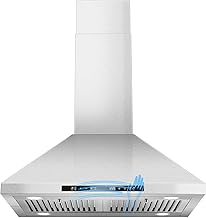

How to Choose an Island Kitchen Hood (2026)
- Airflow with headroom: Island hoods lose capture efficiency to cross-drafts on all four sides, so budget roughly 30–50% more CFM than a comparable wall model. A 1200 CFM unit lets you clear a room on speed two rather than pinning the fan at maximum — which is the single biggest factor in perceived noise.
- Sound behaviour, not just a decibel number: Ask how the hood sounds, not only how loud it is. Baffle filters and larger blower housings produce a lower-frequency hum that the brain habituates to easily, while small high-RPM fans generate a whine that stays perceptually intrusive even at modest volume.
- Ducted whenever the structure allows: Recirculating carbon filters trap odour and some grease but return heat and ultrafine particles to the room. If your bedrooms share air with the kitchen, ducting outdoors is the version that genuinely improves your overnight air quality.
- Lighting you can dim or ignore: Four bright LEDs directly above an island become a light source aimed at your face during evening cooking. Look for warm-toned or multi-level lighting; cool white at full output for an hour before bed suppresses melatonin measurably.
- Delay timers and touch-free control: A timer that runs the fan for ten minutes after you leave finishes the air exchange without you standing there. Gesture sensing keeps you from pressing buttons with oily hands and reduces the fiddling that turns a wind-down evening into a chore.
The Best Island Kitchen Hoods (2026) Reviewed
36″ Island Range Hood, 1200 CFM Stainless Steel
This is the extraction workhorse of the group, and its real advantage is restraint: 1200 CFM means an aggressive stir-fry gets handled at mid-speed, keeping the room noticeably calmer than a weaker hood run flat out. Four speeds, gesture control, a timer, and dishwasher-safe filters make it the most complete package here for open-plan homes.
VIKIO HOME 30″ Island Range Hood
At 390 CFM this is the quiet specialist — a sensible match for electric or induction cooktops in apartments and loft layouts where noise travels. The dual-sided controls are a genuinely thoughtful touch on an island, letting you adjust from whichever side you happen to be standing.
Cosmo Lumin 30″ Ducted Island Range Hood
Cosmo’s soft-touch panel and glass visor give this hood the most refined presence of the six, and the permanent baffle filters mean no consumables to forget about. At 380 CFM it’s best suited to modest cooktops and lighter cooking styles rather than heavy searing.
36″ Island Range Hood, 700 CFM Black Stainless
The matte black finish is the practical choice for anyone who dislikes the mirror-bright stainless look — it hides fingerprints and reflects far less pendant glare back into your eyes. 700 CFM over 36 inches is a well-judged middle ground for most family kitchens.
30″ Island Range Hood, 700 CFM
Strong airflow in a narrower body, which makes it the pick for smaller islands that still see real cooking. Gesture control, three speeds, and a timer cover the essentials without complication.
Frequently Asked Questions
Can a range hood really affect how well I sleep?
Indirectly but meaningfully. Cooking generates fine particulates and, on gas ranges, nitrogen dioxide — both associated with poorer sleep quality and more nighttime respiratory disruption. Clearing them before bed is the point.
How high should an island hood be mounted?
Generally 30–36 inches above the cooktop. Mounting too high forces you onto higher, louder fan speeds to compensate for lost capture.
How long should I run the hood after cooking?
Ten to fifteen minutes at a low setting, which is exactly what the timer function is for. Air exchange continues well after the stove is off.
Are ductless island hoods worth it?
They’re better than nothing and sometimes the only option in a condo. Just replace the carbon filters on schedule, or they stop working silently.
Final Thoughts
For most open-plan homes, the 36″ 1200 CFM stainless model is the strongest overall choice precisely because its surplus power lets it work quietly at moderate speeds. Choose the VIKIO HOME 30″ if noise control in a compact space is your priority, or the Cosmo Lumin 30″ if you want understated design and maintenance-free baffle filters over raw airflow.