Key takeaways
- Match profile to your side rails: Measure from the deck or slats to the top of the rail. A mattress that clears the rail by more than a couple of inches loses back support when you sit; one that sits well below turns the daybed into a trench. Five to eight inches suits most frames, while deeper 10- to 14-inch builds work only on low-rail or platform-style daybeds.
- Weight the sleeper, not the aesthetic: Children and occasional overnight guests do fine on 5- to 6-inch foam. Adults over roughly 180 pounds, or anyone sleeping on it more than a few nights a month, need 8 inches or more — ideally with pocketed springs or higher-density foam that won’t bottom out at the hips and shoulders.
- Insist on medium-firm: Firmness does double duty on a daybed. Medium-firm keeps your pelvis from sinking when you’re seated upright and still allows enough surface give for side sleepers to release shoulder pressure overnight. Soft foam fails at both tasks.
- Verify the safety credentials in writing: Look for explicit fiberglass-free construction and CertiPUR-US certification on the foam. This is non-negotiable for anything a child sleeps on, and it also correlates with lower VOC emissions during the first weeks after unboxing.
- Confirm trundle clearance before buying: If a pull-out sits beneath, the upper mattress dictates how much room the lower one has to roll and rise. Add the trundle mattress height to the drawer height and compare that against your frame’s under-bed opening; 5- and 6-inch models exist precisely for this constraint.
What's inside
A daybed asks one piece of bedding to do two jobs at once. By day it’s a sofa you lean back into with a coffee and a laptop; by night it’s where your sister-in-law sleeps for four days over the holidays. That dual identity is exactly why so many people end up disappointed: they buy a plush conventional mattress that swallows the frame’s clean lines and sags over the side rails, or they grab the thinnest foam slab available and discover their guests wake up cataloguing their own vertebrae. Depth, density, and edge behavior matter more here than they do on a standard bed, and almost nobody tells you that before you click buy.
This guide approaches the problem from a sleep-wellness perspective rather than a purely decorative one. Below you’ll find our vetted picks for 2026, a practical framework for matching profile height to your frame and your sleepers, and straight answers on the questions that come up most — trundle clearance, fiberglass, off-gassing, and how thin is genuinely too thin for an adult spending a week in your spare room.
As an Amazon Associate we earn from qualifying purchases.


🛒 Best Price Today on Amazon
Prime members get fast, free shipping on everything above, plus member-only deals. New members get a 30-day free trial — cancel anytime.
How to Choose a Daybed Mattress (2026)
- Match profile to your side rails: Measure from the deck or slats to the top of the rail. A mattress that clears the rail by more than a couple of inches loses back support when you sit; one that sits well below turns the daybed into a trench. Five to eight inches suits most frames, while deeper 10- to 14-inch builds work only on low-rail or platform-style daybeds.
- Weight the sleeper, not the aesthetic: Children and occasional overnight guests do fine on 5- to 6-inch foam. Adults over roughly 180 pounds, or anyone sleeping on it more than a few nights a month, need 8 inches or more — ideally with pocketed springs or higher-density foam that won’t bottom out at the hips and shoulders.
- Insist on medium-firm: Firmness does double duty on a daybed. Medium-firm keeps your pelvis from sinking when you’re seated upright and still allows enough surface give for side sleepers to release shoulder pressure overnight. Soft foam fails at both tasks.
- Verify the safety credentials in writing: Look for explicit fiberglass-free construction and CertiPUR-US certification on the foam. This is non-negotiable for anything a child sleeps on, and it also correlates with lower VOC emissions during the first weeks after unboxing.
- Confirm trundle clearance before buying: If a pull-out sits beneath, the upper mattress dictates how much room the lower one has to roll and rise. Add the trundle mattress height to the drawer height and compare that against your frame’s under-bed opening; 5- and 6-inch models exist precisely for this constraint.
The Best Daybed Mattresses (2026) Reviewed
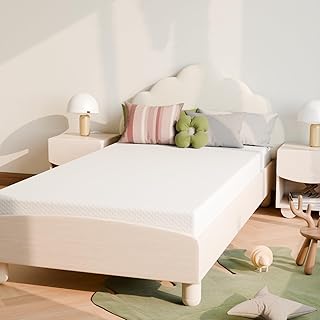
Twin 5-Inch Cooling Gel Memory Foam (Fiberglass-Free, Kid-Certified)
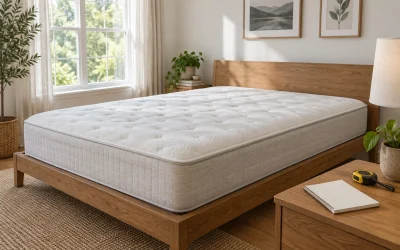
This is the reference-standard slim daybed mattress: enough gel-infused foam to disperse heat and cushion pressure points, thin enough to preserve the frame’s proportions and leave room for a trundle underneath. The medium-firm feel makes it genuinely comfortable to sit on for an evening, which is the test most low-profile foam fails.
Twin 5-Inch Medium-Firm for Kids and Adults
A close sibling with the same 5-inch cooling-gel formula and CertiPUR-US certification, positioned squarely at mixed-use households where the daybed serves a child most nights and an adult guest occasionally. Expect a slightly resilient response rather than deep sink — appropriate for shorter, lighter sleepers and short guest stays.
LETMOON 8-Inch Hybrid Twin
Our pick for daybeds that host real adults regularly. The pocketed coil layer supplies genuine lift and edge stability that all-foam slabs of this height can’t match, so the perimeter doesn’t collapse when someone sits on the front edge night after night. Best on frames with taller side rails that can visually absorb the extra depth.
MLILY 6-Inch Full Green Tea Memory Foam
Full-size daybeds are the forgotten category, and this 75″ x 54″ green-tea-infused foam mattress fills the gap at a sensible 6-inch profile. The added width transforms guest comfort for couples, and the gel-and-green-tea layer keeps surface temperature in check for a foam this responsive.
EGOHOME 14-Inch Copper Gel Memory Foam
Choose this only if your daybed is a low-rail or platform design — but if it is, you’re getting a proper primary-bed sleep experience with copper-infused foam, graphene cooling cover, and the pressure relief that back-pain sufferers actually need. It’s the one pick here that no guest will describe as “the spare mattress.”
Frequently Asked Questions
How thick should a daybed mattress be?
Six inches is the practical floor for adult use and 8 inches the sweet spot; 5-inch models are best reserved for children, trundles, and infrequent overnight guests. Above 10 inches, check your rail height first — comfort gained is comfort lost if the mattress overtops the frame.
Can I use a regular twin mattress on a daybed?
Yes, dimensionally — standard daybeds take a twin (38″ x 75″). The issue is depth, not footprint. Most conventional twins run 10 to 12 inches and will bury the side and back rails, undermining both the look and the seated support the frame is designed to provide.
Do daybed mattresses need a box spring?
No. Daybeds use slats or a solid deck, and both foam and hybrid mattresses in this roundup are built for that support directly. If your slats are spaced more than about three inches apart, add a bunkie board or plywood panel to prevent foam from sagging between them.
What about off-gassing from a mattress in a box?
Expect a mild odor for two to four days. Unbox in a ventilated room, let it expand fully for 24 to 72 hours before dressing it, and prioritize CertiPUR-US-certified foam, which is tested for low VOC emissions. The smell dissipating is normal; a persistent chemical odor after a week is not.
Final Thoughts
For most households, the Twin 5-Inch Cooling Gel Memory Foam is the balanced choice — safe, cool, correctly proportioned, and priced for a bed that isn’t slept in every night. If adults use your daybed regularly, step up to the LETMOON 8-Inch Hybrid for its coil-driven edge support, and if you’re working with a full-size frame, the MLILY 6-Inch Green Tea Memory Foam delivers the extra width that makes a guest room feel deliberate rather than improvised.