Key takeaways
- Work area versus real furniture parts: A 300 x 180mm bed handles drawer fronts, inlay, and small carved panels. For headboard sections, nightstand sides, or wide slat templates, you want at least 400 x 300mm — or plan on tiling cuts across multiple setups.
- Frame rigidity above all: Wattage is meaningless if the gantry flexes. All-metal construction with linear rails on every axis is what keeps a 25mm walnut cut from chattering, and chatter is the difference between a joint that closes and one you’ll sand for an hour.
- Spindle choice and noise: A brushless 400W–710W spindle is far quieter and more consistent than the trim-router style motors on entry kits. If your shop sits near sleeping quarters, that acoustic difference is worth the upgrade on its own — routers push most of their noise into the 3–6 kHz band, exactly where the human ear is most easily woken.
- Motor and drivetrain quality: Closed-loop steppers report position back to the controller, so a lost step doesn’t ruin a two-hour job. Paired with ball screws, they hold tolerance well enough for mortise-and-tenon work rather than just decorative engraving.
- How you’ll drive it: Offline controllers and touchscreens let you cut without tying up a laptop in a dusty space. Wireless app control is genuinely useful when you’re checking on a long roughing pass from another room instead of standing over the machine.
What's inside
As someone who spends most of their working life talking about sleep environments, I’ve learned that a bedroom fails or succeeds on its furniture. A nightstand that’s two inches too low, a headboard with a rattle, slats spaced wrong for your mattress — these are the small structural irritations that keep people surfacing at 3 a.m. without ever knowing why. Off-the-shelf furniture rarely fits the room you actually have, and custom joinery costs more than most mattresses. That gap is why a growing number of home woodworkers are buying a desktop CNC router: it’s the fastest route to bedroom pieces that are dimensioned for your body, your ceiling height, and your bed.
The catch is that CNC marketing is written for machinists, not for people building a platform bed. Rigidity, spindle wattage, closed-loop motors, ball screws versus lead screws — the specs matter enormously for hardwood, and they matter differently again if your shop shares a wall with someone’s bedroom. Below I’ve broken down the machines worth your money in 2026, what to weigh before you commit, and which ones I’d actually put in a home workshop.
As an Amazon Associate we earn from qualifying purchases.



How to Choose a Cnc Router Wood (2026)
- Work area versus real furniture parts: A 300 x 180mm bed handles drawer fronts, inlay, and small carved panels. For headboard sections, nightstand sides, or wide slat templates, you want at least 400 x 300mm — or plan on tiling cuts across multiple setups.
- Frame rigidity above all: Wattage is meaningless if the gantry flexes. All-metal construction with linear rails on every axis is what keeps a 25mm walnut cut from chattering, and chatter is the difference between a joint that closes and one you’ll sand for an hour.
- Spindle choice and noise: A brushless 400W–710W spindle is far quieter and more consistent than the trim-router style motors on entry kits. If your shop sits near sleeping quarters, that acoustic difference is worth the upgrade on its own — routers push most of their noise into the 3–6 kHz band, exactly where the human ear is most easily woken.
- Motor and drivetrain quality: Closed-loop steppers report position back to the controller, so a lost step doesn’t ruin a two-hour job. Paired with ball screws, they hold tolerance well enough for mortise-and-tenon work rather than just decorative engraving.
- How you’ll drive it: Offline controllers and touchscreens let you cut without tying up a laptop in a dusty space. Wireless app control is genuinely useful when you’re checking on a long roughing pass from another room instead of standing over the machine.
The Best Cnc Router Wood (2026)s Reviewed
Genmitsu PROVerXL 4030 V2
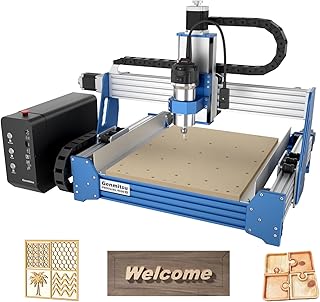
The closed-loop NEMA 23 motors and 400W spindle make this the most trustworthy mid-size machine for hardwood furniture parts — it recovers from load spikes that would stall a comparable open-loop rig. The 400 x 300 x 110mm envelope covers drawer components, joinery, and most decorative panels for a bed or nightstand.
NBS-6040
With a 610 x 410mm bed, linear rails on all three axes, and a 710W spindle, this is the one I’d choose for full headboard panels and wide slat templates without tiling. It’s a heavier, more demanding install, but the rigidity shows immediately in edge finish.
Genmitsu PROVerXL 4030S
Essentially the 4030 V2 with more spindle power and 130mm of Z-height, which matters when you’re surfacing thick stock or working with tall workholding. The wireless app control is a small luxury that becomes a real one during long jobs.
Twotrees TTC450 Pro
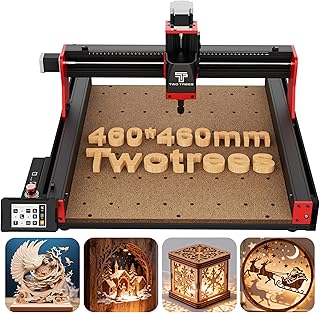
An all-metal build with a NEMA 57 stepper and a 3.5″ touchscreen — capable, self-contained, and pleasantly free of laptop dependency. A sensible middle path for someone graduating from a hobby kit into furniture-scale work.
FoxAlien Masuter Pro
The friendliest genuine all-metal machine on this list, and the one I recommend to people whose first project is a nightstand rather than a production run. It handles MDF, softwoods, and light hardwood passes with far less setup anxiety than its competitors.
Frequently Asked Questions
Can a desktop CNC cut hardwood like oak or walnut?
Yes, with shallow depths of cut and a rigid frame. Expect to take 1–2mm per pass on a mid-size machine; the machines with ball screws and linear rails tolerate more aggressive settings.
How loud are these machines?
Most sit between 70 and 85 dB at the operator position — comparable to a vacuum. Never run one adjacent to an occupied bedroom, and treat any late-night cutting as a sleep-hygiene decision, not just a courtesy one.
Do I need a dust collection setup?
For wood, absolutely. Fine wood dust is a respiratory irritant that lingers in air for hours and will follow you into the house on your clothes. Budget for a shoe and a shop vac from day one.
Is the 3018-PRO enough for furniture?
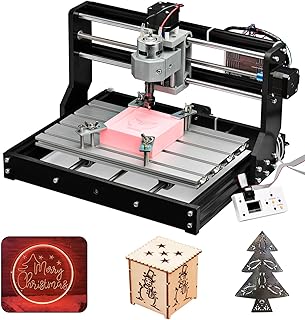
Not for structural parts, but it’s an excellent inexpensive way to learn CAM, cut templates, and produce inlay or engraved detail for pieces you build conventionally.
Final Thoughts
For most home furniture makers, the Genmitsu PROVerXL 4030S hits the best balance of spindle power, Z-height, and usable work area, with the 4030 V2 a smart step down if closed-loop reliability matters more to you than raw wattage. If you’re committed to full-width headboards and panels, the NBS-6040 is the machine that will stop limiting you — and the FoxAlien Masuter Pro remains the gentlest honest starting point.