Key takeaways
- Contour depth over raw softness: What matters is how far the shoulder can descend before it meets resistance. Look for a comfort layer of at least 2–3 inches above the coil unit — a thin quilted panel over firm springs feels plush for ten seconds and unforgiving by midnight.
- Medium to medium-plush firmness: Most side sleepers land best between 4 and 6.5 on the ten-point scale. Lighter frames (under about 130 lbs) should skew plusher to get any meaningful sink; heavier frames need a stiffer core underneath the pillow top to avoid bottoming out.
- Zoned or pocketed coil support: Individually wrapped coils flex locally rather than as a unit, which is what allows the hip to drop while the ribcage stays supported. Zoned systems that firm up through the lumbar region add another layer of alignment insurance.
- Heat management in the top layer: Deeper sinkage means more of your body is surrounded by foam, so side sleepers run warmer by default. Prioritize open-cell or gel-infused foams, breathable covers, and hybrid builds where air can move through the coil layer.
- Trial length and certification: Side sleepers often need three to four weeks of adaptation before a verdict is fair, so a 100-night minimum is sensible. CertiPUR-US certification and fiberglass-free construction should be treated as baseline requirements, not features.
What's inside
Side sleeping is the most popular position in the world, and it’s also the most demanding on a mattress. When you lie on your side, your body weight concentrates into two narrow zones — the shoulder and the hip — while your waist and knees hover above the surface. A bed that’s too firm forces those pressure points to absorb the load, which is why so many side sleepers wake with a numb arm, an aching hip, or a stiff lower back. A bed that’s too soft lets the hips sink past the shoulders, twisting the lumbar spine into a slow-motion strain that builds over months.
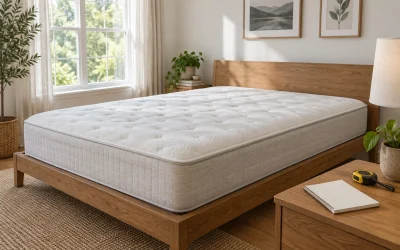
Pillow top construction exists precisely to solve this geometry problem: a stitched or quilted comfort layer that lets the shoulder and hip settle in, sitting above a support core that keeps the spine level. Below, I’ve assessed the strongest pillow top options available to side sleepers in 2026, judging each on contour depth, edge stability, heat behavior, and how well the surface layer holds its shape past the first year. You’ll also find a buying framework and answers to the questions I hear most often from side sleepers in consultations.
As an Amazon Associate we earn from qualifying purchases.


🛒 Best Price Today on Amazon
Prime members get fast, free shipping on everything above, plus member-only deals. New members get a 30-day free trial — cancel anytime.
How to Choose a Pillow Top Mattress For Side Sleepers (2026)
- Contour depth over raw softness: What matters is how far the shoulder can descend before it meets resistance. Look for a comfort layer of at least 2–3 inches above the coil unit — a thin quilted panel over firm springs feels plush for ten seconds and unforgiving by midnight.
- Medium to medium-plush firmness: Most side sleepers land best between 4 and 6.5 on the ten-point scale. Lighter frames (under about 130 lbs) should skew plusher to get any meaningful sink; heavier frames need a stiffer core underneath the pillow top to avoid bottoming out.
- Zoned or pocketed coil support: Individually wrapped coils flex locally rather than as a unit, which is what allows the hip to drop while the ribcage stays supported. Zoned systems that firm up through the lumbar region add another layer of alignment insurance.
- Heat management in the top layer: Deeper sinkage means more of your body is surrounded by foam, so side sleepers run warmer by default. Prioritize open-cell or gel-infused foams, breathable covers, and hybrid builds where air can move through the coil layer.
- Trial length and certification: Side sleepers often need three to four weeks of adaptation before a verdict is fair, so a 100-night minimum is sensible. CertiPUR-US certification and fiberglass-free construction should be treated as baseline requirements, not features.
The Best Pillow Top Mattress For Side Sleepers (2026)s Reviewed
Sweetnight CoolNest Hybrid 14″
The seven-zone coil layout here is genuinely useful for side sleeping, softening through the shoulder while stiffening under the hips to stop the pelvic dip that causes lumbar strain. Its layered cooling approach makes it my first suggestion for side sleepers who sink deep and overheat as a result.
Serta Perfect Sleeper X – Max 15″
At 15 inches with a plush quilted pillow top, this is the most generous comfort layer on the list — ideal for broad-shouldered sleepers who need real depth before hitting the support core. The heavier build also means better edge stability, which matters if you sleep near the perimeter.
Serta Perfect Sleeper Pro Valais 15″
The latex element gives this one a buoyant, responsive feel rather than the slow-sinking sensation of all-foam comfort layers, so changing positions overnight takes noticeably less effort. A strong pick for combination sleepers who spend most of the night on their side but rotate toward their back.
Sleepmax Hybrid 14″
Balanced enough to serve a couple with mismatched preferences, it delivers side-sleeper contouring without becoming too yielding for back sleeping. The unusually long 365-night trial removes most of the risk from buying a firmness feel you can’t test in person.
Novilla Hybrid 12″
A soft-but-supported surface at a modest price, with a pillow top that cushions the shoulder better than its 12-inch profile suggests. Best suited to lighter and average-weight side sleepers; those above roughly 230 lbs will want a thicker build.
Frequently Asked Questions
Are pillow top mattresses actually better for side sleepers?
Generally, yes — provided the pillow top sits on a responsive support core. The soft upper layer accommodates the shoulder and hip while the coils below preserve spinal alignment, which is exactly the combination side sleeping requires.
Will a plush pillow top make my back hurt?
Only if the support layer underneath is inadequate. Back pain in side sleepers usually stems from the hips sinking deeper than the shoulders, so pair a plush surface with a firm, zoned coil unit rather than choosing softness throughout.
Do pillow tops develop body impressions?
Some settling is normal and typically appears within the first year. Rotating the mattress head-to-foot every three to four months distributes wear evenly and meaningfully extends the comfort layer’s usable life.
What pillow height works with a pillow top mattress?
Because your shoulder descends further into the surface, you need a lower loft than you would on a firm bed. Aim for a pillow that fills the gap between ear and mattress without tilting the head toward either shoulder.
Final Thoughts
For most side sleepers, the Sweetnight CoolNest Hybrid offers the smartest balance of zoned support and temperature control, while the Serta Perfect Sleeper X – Max is the better choice if you need deeper shoulder relief from a thicker plush surface. If you’d rather buy with maximum flexibility, the Sleepmax Hybrid and its extended trial window let you evaluate alignment properly across a full sleep cycle before committing.