Key takeaways
- Wood species and density: Acacia, rubberwood, and oak are dense hardwoods that resist denting and hold screws through repeated disassembly. Pine and bamboo are lighter and more affordable — perfectly serviceable, but check that load ratings and slat thickness compensate.
- Slat spacing and thickness: Aim for gaps of 3 inches or less. Wider spacing voids most foam and hybrid mattress warranties and causes visible sagging between slats within a year or two.
- Center support and leg count: A queen or king needs a center rail with its own legs to the floor. Frames relying only on perimeter support will bow at the middle — the exact spot bearing the most weight.
- Height and clearance: Around 12 inches is the sweet spot for most sleepers: easy sit-to-stand transfers, decent airflow beneath the mattress, and enough clearance for flat storage. Go 14 inches if you want bins underneath or use a thinner mattress.
- Joinery and hardware quality: Look for barrel nuts, threaded inserts, or interlocking joints rather than raw screws driven into end grain. This single detail predicts whether the frame is silent at year five or squeaking by month eight.
What's inside
Most people troubleshoot bad sleep from the mattress up — new pillows, cooling sheets, a topper, magnesium before bed. What almost nobody audits is the platform underneath all of it. Yet a frame that flexes, creaks, or lets slats drift out of position quietly sabotages everything above it: your mattress develops soft spots years early, your spine loses the neutral alignment it needs during deep sleep, and every roll-over generates a small noise that fragments sleep architecture without ever fully waking you. Cheap engineered-wood and hollow-tube frames are the usual culprits, and they degrade fastest in exactly the places you can’t see.
Solid wood solves this differently than metal does. Hardwood and dense softwood absorb vibration instead of transmitting it, hold fasteners under repeated load, and stay dimensionally stable for a decade or more if the joinery is honest. This guide covers what actually separates a durable solid wood frame from one that’s marketed as such — slat span, leg placement, wood species, load rating — and reviews six frames worth considering in 2026, from minimalist bamboo platforms to acacia beds with real headboard presence.
As an Amazon Associate we earn from qualifying purchases.



🛒 Best Price Today on Amazon
Prime members get fast, free shipping on everything above, plus member-only deals. New members get a 30-day free trial — cancel anytime.
How to Choose a Solid Wood Bed Frame (2026)
- Wood species and density: Acacia, rubberwood, and oak are dense hardwoods that resist denting and hold screws through repeated disassembly. Pine and bamboo are lighter and more affordable — perfectly serviceable, but check that load ratings and slat thickness compensate.
- Slat spacing and thickness: Aim for gaps of 3 inches or less. Wider spacing voids most foam and hybrid mattress warranties and causes visible sagging between slats within a year or two.
- Center support and leg count: A queen or king needs a center rail with its own legs to the floor. Frames relying only on perimeter support will bow at the middle — the exact spot bearing the most weight.
- Height and clearance: Around 12 inches is the sweet spot for most sleepers: easy sit-to-stand transfers, decent airflow beneath the mattress, and enough clearance for flat storage. Go 14 inches if you want bins underneath or use a thinner mattress.
- Joinery and hardware quality: Look for barrel nuts, threaded inserts, or interlocking joints rather than raw screws driven into end grain. This single detail predicts whether the frame is silent at year five or squeaking by month eight.
The Best Solid Wood Bed Frames (2026) Reviewed
Nectar Bamboo Platform Bed Frame
Bamboo’s tensile strength is exceptional for its weight, and Nectar leverages it well here — the 800-pound capacity and floating center support legs mean no mid-bed dip even for two adults plus a heavy hybrid mattress. Tool-free assembly is genuinely tool-free, which matters more than it sounds when you eventually move.
Bme Georgina Solid Acacia Wood Bed Frame
This is the pick if you want a bed that reads as furniture rather than a mattress platform, and the handcrafted geometric headboard earns its keep visually without protruding into the room. Acacia is the standout here: dense, dimensionally stable, and forgiving of humidity swings that would warp lesser hardwoods.
NELYE Full Wood Platform Bed Frame
Rubberwood frame and legs paired with pine slats is a smart materials pairing — density where the load transfers, lighter wood where flex is acceptable. The 14-inch base gives you real under-bed storage without needing risers that compromise stability.
LIFEMENT Signature Wood Platform Bed Frame
LIFEMENT specifically engineers this one for silence, and in a twin configuration for a light sleeper, child, or guest room, that’s the feature that matters most. The integrated headboard and usable storage clearance make it unusually complete for its footprint.
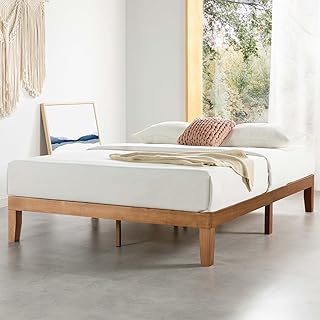
Mellow Naturalista Classic 12 Inch
A clean, unfussy solid pine platform at 12 inches — the most sensible entry point into real wood if you’re replacing a metal frame or box spring setup. Assembly is fast and the slat system supports foam, latex, and hybrid mattresses without a foundation.
Frequently Asked Questions
Do I still need a box spring with a solid wood platform bed?
No. A slatted platform with proper spacing is a complete foundation, and stacking a box spring on top only raises the bed awkwardly and adds a second layer that can compress unevenly.
Why does my wood bed frame creak, and can I fix it?
Creaking is almost always fastener loosening or wood-on-wood contact at joints. Retighten all hardware every six to twelve months, and add adhesive felt pads where slats meet the rails — that resolves the majority of noise complaints without new parts.
Is hardwood meaningfully better than pine or bamboo?
Hardwoods like acacia, oak, and rubberwood resist denting and hold hardware better over many years. But a well-designed pine or bamboo frame with adequate center support and a high load rating will outperform a poorly engineered hardwood one.
How long should a solid wood bed frame last?
Expect ten to twenty years from a properly supported hardwood frame, and roughly seven to ten from softwood or bamboo. Both figures assume you’re not disassembling and moving it frequently, which is what wears out joinery fastest.
Final Thoughts
For most sleepers, the Nectar Bamboo platform offers the best balance of load capacity, silent operation, and painless setup, while the Bme Georgina in acacia is the clear choice when you want a design-forward headboard and hardwood longevity in a king. If budget is the deciding factor, the Mellow Naturalista delivers legitimate solid pine construction and correct slat spacing for a fraction of the cost — a far better sleep investment than another mattress topper.