Key takeaways
- Working pressure, not max PSI: “Max PSI” is a peak figure measured at the moment the trigger closes. Look for the PWMA-rated or continuous number instead. For paint, 1,300–2,000 PSI at the nozzle is the sweet spot; more pressure just means you must stand farther back.
- Noise you can live with: Induction motors run noticeably quieter and smoother than universal motors, which matters if you wash early or share a driveway. Anything you can operate without raising your voice is a machine you’ll actually use.
- Weight and how it moves: A 30-pound unit with a real carry handle is easier to live with than a 45-pound unit on tiny wheels, especially if it has to come up steps or out of a basement. Lifting strain is the most common reason these machines end up in the corner.
- Hose and cord reach: Twenty feet of hose plus a 35-foot GFCI cord lets you circle a sedan without repositioning the base. Short hoses mean constant stopping, and constant stopping is what turns a 20-minute job into an hour.
- Soap delivery that works: An onboard detergent tank is convenient for driveways; a proper foam cannon is what you want for paintwork, because thick foam lifts grit rather than grinding it in. A model that offers both covers more ground.
What's inside
Most people don’t think of washing the car as a sleep issue, but the way we spend our Saturday mornings has more influence on Saturday night than we tend to admit. Chores that involve loud motors, awkward hauling, and forty minutes of frustration spike cortisol at exactly the hour your body is trying to set its rhythm for the day. Chores that go smoothly — outdoors, in daylight, with a little physical effort — do the opposite. The problem is that shopping for a pressure washer usually produces the first outcome, not the second: dozens of near-identical listings, PSI numbers that don’t mean what they appear to mean, and a real chance of buying something so heavy or so shrill that you avoid using it.
This guide narrows the field to electric models genuinely suited to car care, judged on the things that actually determine whether a machine becomes part of a pleasant routine or a source of low-grade dread: real working pressure, noise, weight, hose and cord length, and how well the soap system works. Electric units are the right category here — no engine noise carrying down the street, no fumes, no pull-start, and no ear protection required for a job you might do before your neighbors are awake.
As an Amazon Associate we earn from qualifying purchases.


How to Choose an Electric Car Pressure Washer (2026)
- Working pressure, not max PSI: “Max PSI” is a peak figure measured at the moment the trigger closes. Look for the PWMA-rated or continuous number instead. For paint, 1,300–2,000 PSI at the nozzle is the sweet spot; more pressure just means you must stand farther back.
- Noise you can live with: Induction motors run noticeably quieter and smoother than universal motors, which matters if you wash early or share a driveway. Anything you can operate without raising your voice is a machine you’ll actually use.
- Weight and how it moves: A 30-pound unit with a real carry handle is easier to live with than a 45-pound unit on tiny wheels, especially if it has to come up steps or out of a basement. Lifting strain is the most common reason these machines end up in the corner.
- Hose and cord reach: Twenty feet of hose plus a 35-foot GFCI cord lets you circle a sedan without repositioning the base. Short hoses mean constant stopping, and constant stopping is what turns a 20-minute job into an hour.
- Soap delivery that works: An onboard detergent tank is convenient for driveways; a proper foam cannon is what you want for paintwork, because thick foam lifts grit rather than grinding it in. A model that offers both covers more ground.
The Best Electric Car Pressure Washers (2026) Reviewed
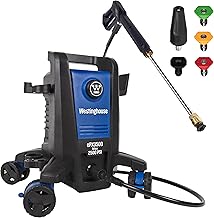
Westinghouse ePX3500
The most complete package here: a 2,500 max PSI motor, anti-tipping base, onboard soap tank, and a five-nozzle set that includes the low-pressure tip you’ll want for a first rinse. It’s the pick if you also have a fence, patio, or set of pavers to keep up with, and the steel wand feels considerably better in the hand than the plastic units at this price.
Sun Joe SPX3000
A long-running favorite for good reason — its 2,030 PSI PWMA rating is honest, and the dual detergent tanks let you keep wheel cleaner and body soap loaded at once. It’s louder and bulkier than the newer compact models, so choose it for capability rather than for a quiet early-morning routine.
Westinghouse ePX3100v
Essentially the ePX3500’s more sensible sibling: 2,100 max PSI, a built-in carry handle, and a detachable foam cannon that produces genuinely thick lather. For car-focused buyers who don’t need driveway-stripping power, this is the best balance of pressure, portability, and paint safety on the list.
Hiclean 2100 PSI
A compact, lightweight option that covers the essentials — foam cannon, turbo and fan nozzles, 2,100 PSI — without the storage footprint of larger units. Best suited to apartment dwellers, one-car households, and anyone who needs the machine to disappear into a closet between uses.
CRAFTSMAN CMEPW1700
At 1,700 PSI and 1.2 GPM this is the gentlest pick, and for car paint that’s a feature rather than a compromise. It’s the one to buy if you want something light, quiet, and nearly impossible to misuse on clear coat, though heavily soiled concrete will test its patience.
Frequently Asked Questions
Is 2,500 PSI too much for a car?
Not if you use the correct nozzle. Keep to a 25- or 40-degree tip, hold the wand 12–18 inches from the panel, and never use the zero-degree or turbo nozzle on paint or trim.
Can I wash my car early in the morning without disturbing anyone?
Electric units are far quieter than gas models, but they aren’t silent. A quieter induction-motor unit at a reasonable hour is usually fine; if you’re within a few feet of bedroom windows, wait until later in the morning.
Do I need a foam cannon, or is the soap tank enough?
Onboard tanks deliver thin soapy water that works well on hard surfaces. For paint, a foam cannon is worth it — the clinging foam loosens dirt before your mitt touches it, which is what prevents swirl marks.
Can these run from a water tank instead of a spigot?
Most of these are designed for pressurized household supply and won’t reliably self-prime from a bucket or barrel. If you need tank-fed operation, verify that specific capability before buying.
Final Thoughts
For most readers, the Westinghouse ePX3100v is the smartest buy — light enough to carry out one-handed, powerful enough for genuinely dirty paint, and paired with a foam cannon that does the heavy lifting so you don’t have to. Step up to the ePX3500 if driveways and fences are also on your list, or down to the CRAFTSMAN CMEPW1700 if you want the quietest, most forgiving machine and a job that leaves you refreshed rather than wrung out.