Key takeaways
- Pressure ceiling, not peak marketing PSI: Clearcoat is happiest between 1,200 and 1,900 PSI at the nozzle. A 2,300–2,500 PSI machine is fine because you control output through nozzle choice and standoff distance, but treat anything above 3,000 PSI as a driveway tool you occasionally point at a car with restraint.
- Flow rate does the rinsing: GPM carries grit off the panel; PSI only loosens it. Around 1.7–2.0 GPM is the practical range for cars, and higher flow shortens your rinse — which shortens the total time the motor is running near anyone’s bedroom window.
- Induction or brushless motors for acoustic comfort: Universal motors are cheaper and noticeably harsher, with a whine that sits right in the frequency band humans find most irritating. Induction and brushless designs run lower, steadier, and cooler, and they tolerate repeated on-off cycling without complaint.
- Stability and hose management: Anti-tipping geometry and a real onboard hose reel sound like minor conveniences until the unit clatters over mid-pass. Every tip-over is a startle response you didn’t need at 7 a.m.
- Foam delivery: An onboard soap tank or a detachable foam cannon lets you pre-soak and dwell, which means less mechanical scrubbing, less pressure, and fewer swirl marks. Contactless-first washing is the single best habit for both paint and patience.
What's inside
Most people don’t discover how loud their driveway is until they’re standing in it at 7 a.m. on a Saturday, trigger squeezed, wondering whether the neighbors are awake yet. Car washing has a timing problem: the light is best early, the temperature is kindest early, and early is precisely when noise carries furthest. Add a machine that screams at 95 decibels, rocks off its wheels every time you tug the hose, and demands three trips back to the spigot, and a twenty-minute job turns into an hour of low-grade stress — the kind that follows you inside and quietly taxes the rest of your day.
I spend most of my working life talking to people about rest architecture — noise floors, cortisol spikes, the small friction points that fragment a weekend. Pressure washers are an unlikely entry in that conversation, but they belong there. The right one lets you finish before the street wakes up, without a jolt of adrenaline every time the motor cycles. This guide covers what actually matters for automotive paint (pressure ceilings, flow rate, nozzle control), which 2026 models keep their composure at low throttle, and where the quiet-and-capable sweet spot sits for a home driveway rather than a commercial bay.
As an Amazon Associate we earn from qualifying purchases.


How to Choose an Electric Pressure Washer For Washing Cars (2026)
- Pressure ceiling, not peak marketing PSI: Clearcoat is happiest between 1,200 and 1,900 PSI at the nozzle. A 2,300–2,500 PSI machine is fine because you control output through nozzle choice and standoff distance, but treat anything above 3,000 PSI as a driveway tool you occasionally point at a car with restraint.
- Flow rate does the rinsing: GPM carries grit off the panel; PSI only loosens it. Around 1.7–2.0 GPM is the practical range for cars, and higher flow shortens your rinse — which shortens the total time the motor is running near anyone’s bedroom window.
- Induction or brushless motors for acoustic comfort: Universal motors are cheaper and noticeably harsher, with a whine that sits right in the frequency band humans find most irritating. Induction and brushless designs run lower, steadier, and cooler, and they tolerate repeated on-off cycling without complaint.
- Stability and hose management: Anti-tipping geometry and a real onboard hose reel sound like minor conveniences until the unit clatters over mid-pass. Every tip-over is a startle response you didn’t need at 7 a.m.
- Foam delivery: An onboard soap tank or a detachable foam cannon lets you pre-soak and dwell, which means less mechanical scrubbing, less pressure, and fewer swirl marks. Contactless-first washing is the single best habit for both paint and patience.
The Best Electric Pressure Washer For Washing Cars (2026)s Reviewed
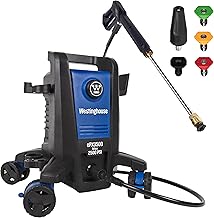
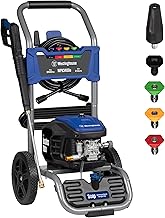
Westinghouse ePX3500
The most balanced pick here: 2,500 max PSI and 1.76 GPM is enough authority for wheel wells and lower rockers, while the five-nozzle set gives you the finesse to back off on paint. Anti-tipping construction and the onboard soap tank make it the model I’d hand to someone who wants a calm, repeatable routine rather than a project.
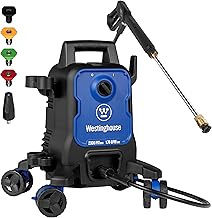
Westinghouse ePX3100
Effectively the ePX3500 with a slightly gentler 2,300 PSI ceiling and the same 1.76 GPM flow — which, for cars specifically, is arguably the better spec sheet. The pro-style steel wand feels far more composed in the hand than the plastic lances at this tier.
Westinghouse WPX3400e
A brushless 3,400 PSI, 2.0 GPM machine that runs smoother and quieter than its numbers suggest, and the extra flow makes rinsing genuinely fast. Buy it if you also have fencing, siding, and a stained driveway to manage — just commit to the wide-angle nozzles when the car comes out.
Sun Joe SPX3000
A long-running favorite for good reason: dual detergent tanks let you keep wheel cleaner and body soap loaded simultaneously, which removes a whole step from the workflow. Its 2,500 max PSI (2,030 PWMA-rated) is honest and appropriate, though the chassis is lighter and less planted than the Westinghouse units.
Westinghouse ePX3100v
At 2,100 max PSI with a detachable foam cannon and a built-in carry handle, this is the apartment-and-carport answer — light enough to move without a second thought and gentle enough that mistakes stay cosmetic. The three-nozzle set is the compromise, but it covers everything a car actually needs.
Frequently Asked Questions
Is 2,500 PSI too much for car paint?
Not if you use the machine correctly. Pair it with a 25- or 40-degree nozzle, keep roughly 12 inches of standoff, and never dwell on chipped paint, badges, or trim edges. Damage comes from concentrated streams held too close, not from the rating on the box.
How loud are these compared with gas models?
Substantially quieter — typically in the low-to-mid 70s at operator distance versus the mid-90s for gas engines. That’s the difference between a conversation-level appliance and one that requires hearing protection, and it’s why electric is the only sensible choice for early-morning or dense-neighborhood use.
Do I still need a foam cannon if there’s an onboard tank?
Onboard tanks are convenient but produce thinner suds via the low-pressure nozzle. If you want thick, clinging foam that lifts grit before you touch the paint, a dedicated cannon is a worthwhile upgrade on any of these.
Can I leave the unit outside?
Store it indoors and drain the pump before freezing weather. Trapped water expanding inside the pump head is the most common cause of premature failure in otherwise healthy electric washers.
Final Thoughts
For most drivers, the Westinghouse ePX3500 is the right amount of machine — stable, quiet, well-equipped, and forgiving of paint. Step down to the ePX3100 if you want a slightly softer pressure ceiling with identical flow, or up to the brushless WPX3400e if the car is only one item on a longer cleaning list. All three let you finish the job before the street stirs, which is really the point.