Key takeaways
- Low roll-out trundle: commonly accepts a 5–8 inch mattress. A thicker mattress may prevent the drawer from closing.
- Pop-up trundle: often accepts an 8–10 inch mattress, but verify the raised height and clearance beneath the main bed.
- Foam mattresses: compress more easily into a low cavity, but dense foam can make the trundle heavier to pull.
- Innerspring mattresses: offer familiar edge support, though some are too tall or rigid for a shallow compartment.
- Hybrid mattresses: may be comfortable for adults but are frequently thicker than the trundle allows.
The best trundle beds for small bedrooms are low-profile daybeds with a full-length pull-out, a solid or reinforced frame, at least 30 inches of operating clearance, and a trundle mattress that matches the manufacturer’s stated thickness and weight limits.
Our top picks


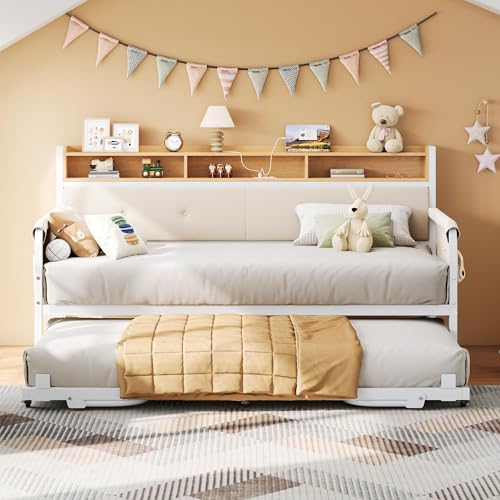
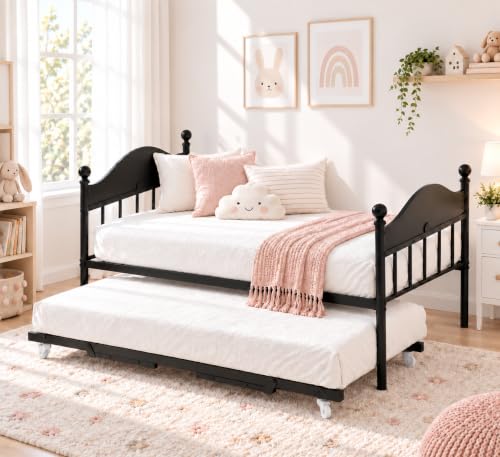
As an Amazon Associate we earn from qualifying purchases at no extra cost to you. Ratings are shown as listed on Amazon.
Best trundle bed choices by situation
| Situation | Best configuration | What to prioritize | Typical price range |
|---|---|---|---|
| Small apartment or studio | Twin daybed with a low twin trundle | Compact depth, smooth casters, vertical storage nearby | $300–$700 |
| Children sharing a room | Twin-over-twin trundle with guard rails | Rounded edges, secure slats, a published weight limit | $350–$900 |
| Occasional adult guests | Twin daybed with a reinforced pop-up trundle | Full-length mattress support, stronger hardware, 8–10 inch mattress compatibility | $600–$1,300 |
| Renters who move often | Knock-down metal or engineered-wood frame | Box dimensions, tool requirements, replaceable hardware | $250–$650 |
| Back-sensitive sleeper | Pop-up trundle at nearly equal height to the main bed | Even support, a medium-firm mattress, no floor-level sleeping surface | $700–$1,500 |
What makes a trundle bed suitable for everyday use?
A trundle is not automatically a second full-time bed. Many pull-out units use thin slats, small casters, and a mattress cavity limited to 6 inches. That can work for a child or a visitor for a few nights, but adults generally need better support and more usable mattress depth.
For everyday sleeping, look for closely spaced slats, a center support rail, and a stated load rating for both the main bed and the trundle. A practical target is at least 400 pounds for the main twin sleeping surface and at least 250–300 pounds for the pull-out bed, including the sleeper and bedding. Some heavy-duty designs support more, but the manufacturer’s published limit matters more than the appearance of thick wood or metal.
A pop-up trundle is usually the better choice for an adult guest because its frame rises beside the main bed. It reduces the awkward step down to floor level and can create a larger shared sleeping surface. However, it needs more vertical and side clearance, and the two mattresses may not align perfectly unless they have compatible heights.
Mattress compatibility: measure before buying
The most common mistake is choosing the frame first and assuming a standard mattress will fit. Confirm the required mattress length, width, and maximum height for both sleeping surfaces. A twin mattress is normally about 38 by 75 inches, while a twin XL is about 38 by 80 inches. They are not interchangeable in a fixed trundle compartment.
- Low roll-out trundle: commonly accepts a 5–8 inch mattress. A thicker mattress may prevent the drawer from closing.
- Pop-up trundle: often accepts an 8–10 inch mattress, but verify the raised height and clearance beneath the main bed.
- Foam mattresses: compress more easily into a low cavity, but dense foam can make the trundle heavier to pull.
- Innerspring mattresses: offer familiar edge support, though some are too tall or rigid for a shallow compartment.
- Hybrid mattresses: may be comfortable for adults but are frequently thicker than the trundle allows.
Leave enough room for sheets without forcing the drawer shut. If the mattress compartment is 8 inches high, an 8-inch mattress may still be impractical once a fitted sheet and protector are added. A 6-inch mattress is safer for a low trundle, provided its support is appropriate for the sleeper.
Pull-out clearance and room-size fit
Measure the open path, not only the footprint of the bed. A twin daybed may occupy roughly 80 inches by 40 inches when closed, but the trundle can extend another 75 inches into the room. Allow at least 30 inches of clear space in front of the pull-out for ordinary use; 36 inches is more comfortable for making the bed. A pop-up model may require about 80 inches of unobstructed width or length, depending on its orientation.
In a 10-by-12-foot bedroom, a twin daybed placed along the 12-foot wall can work well if the closed frame is approximately 80 inches long and 40 inches deep. Keep a 30–36 inch walkway on the opposite side and avoid placing a desk, dresser, or door swing in front of the trundle. In a 10-by-10-foot room, choose a compact twin frame and position it so the pull-out uses the room’s longest clear dimension.
For a shared children’s room, mark the open trundle footprint on the floor with painter’s tape. Include the bed’s handles and wheel path. This simple test exposes conflicts with closet doors, heating vents, bedside tables, and low windows before delivery.
Frame materials: which construction is the right compromise?
| Frame material | Advantages | Trade-offs | Best use |
|---|---|---|---|
| Solid wood | Good rigidity, repairable joints, warm appearance | Heavier; can split if repeatedly over-tightened or dragged | Everyday use and long-term ownership |
| Engineered wood | More uniform panels, often less expensive, easier to finish consistently | Fastener holes can wear if assembled and disassembled repeatedly | Budget bedrooms and occasional use |
| Metal | Strong for its weight, slim rails, often easier to move | May transmit squeaks; thin tubing can bend under misuse | Renters and minimalist rooms |
| Upholstered frame | Softens edges and adds visual comfort | Fabric collects dust and can show wear near handles and corners | Guest rooms and supervised family use |
Construction details matter more than a material label. Look for a center rail, corner blocks, metal-to-metal fasteners where appropriate, and slats that cannot slide sideways. For children or pets, avoid exposed sharp brackets and large gaps that could catch fingers, paws, or toys.
Assembly, moving, and durability realities
Most trundle beds arrive flat-packed in two or more cartons. A useful planning assumption is that the heaviest box may weigh 50–90 pounds, even when the assembled bed is manageable. Check the package dimensions against elevator doors, stair turns, and the narrowest doorway. A 30-inch doorway can accommodate many boxed frames, but a long carton may be difficult to rotate in a hallway.
Assembly commonly takes two adults between 60 and 150 minutes. Tighten every joint only after the frame is square; premature tightening can create misaligned slats and a trundle that rubs against the rails. After one week of use, recheck the bolts because wood components can settle and metal frames can loosen under repeated rolling.
The first parts to wear are usually casters, drawer stops, fabric at the pull handle, and slat supports. A trundle used every day should have larger, replaceable casters rather than tiny plastic wheels. Never drag the loaded bed sideways. Lift one end or remove the mattress first, since lateral force can twist the frame and loosen corner joints.
Features worth paying for—and features to question
- Worth paying for: a published weight limit, reinforced center support, quiet casters, a full-length pull handle, and a mattress-height specification.
- Useful in tight rooms: locking wheels, a pop-up mechanism with a positive safety stop, and rounded front corners.
- Question carefully: vague claims such as “heavy duty,” decorative slats that do not support the mattress, and a trundle described only as “guest size.”
- For pets: choose a washable cover and a frame with few inaccessible cavities where hair and toys can collect.
- For children: confirm that the top sleeping surface has suitable guard protection and that the lower bed cannot roll unexpectedly.
Bottom line
Choose a low roll-out twin trundle when space and price are the priorities, especially for children or occasional visitors. Choose a reinforced pop-up trundle when an adult guest needs better access and a more bed-like height. Before ordering, verify mattress dimensions and thickness, measure at least 30–36 inches of open clearance, confirm both weight limits, and check whether the frame can pass through your doors. Those practical measurements are more useful than appearance alone when selecting among the best trundle beds for a small bedroom.