Key takeaways
- Size for the volume, not the floor plan: Garages have high ceilings, uninsulated slabs, and constant infiltration from the main door. Choose coverage rated well above your square footage — a 4,500 sq. ft. class unit is a sensible floor for a two-car bay, and 5,000+ sq. ft. models earn their keep in three-car or workshop spaces.
- Insist on continuous drainage: Manual tank emptying fails the moment you forget for a weekend, and a full tank means hours of unchecked moisture. Gravity drain hoses work if you have a floor drain below the outlet; a built-in condensate pump is the better answer for slab-level garages, letting you push water upward to a sink or outside.
- Verify auto-defrost and low-temperature operation: Compressor coils frost over in cool air, and a unit without active defrost simply ices up and stops pulling water. This is non-negotiable in any garage that drops below 60°F for part of the year.
- Treat decibels as a sleep specification: Anything above roughly 50 dB will telegraph through a shared wall and disrupt the light stages of sleep, particularly if the compressor cycles on and off. Look for quoted output in the 45 dB range and a humidistat precise enough to avoid constant short-cycling.
- Check the humidistat range and recovery behavior: A target band of 30%–80% gives you real control; aim for a 50% setpoint to suppress mold and mites without over-drying stored wood. Auto-restart after a power interruption matters in a space you don’t check daily.
What's inside
A garage rarely gets blamed for a bad night’s sleep, but it should be a prime suspect. Attached garages share walls, ceilings, and air pathways with the rooms you sleep in, and when relative humidity in that concrete box climbs past 60%, you get the whole unwelcome cascade: mold spores on drywall seams, dust mite populations thriving in stored bedding and camping gear, and a musty odor that migrates through the connecting door every time the pressure balance shifts. Airway irritation, congestion, and fragmented sleep often trace back to an unconditioned space nobody thinks to measure. Add rust on tools, warped door tracks, and a swampy smell in July, and the case for control gets stronger.
This guide approaches garage dehumidifiers the way a sleep environment should be approached — as an air-quality system, not an appliance purchase. Below you’ll find the units worth your money in 2026, plus the specification details that actually matter for a space with poor insulation, wide temperature swings, and no returning airflow from your HVAC system. Coverage ratings, drainage strategy, decibel output, and low-temperature performance all get weighed, because a dehumidifier that stalls at 45°F or drones through your bedroom wall solves one problem and creates another.
As an Amazon Associate we earn from qualifying purchases.



How to Choose a Garage Dehumidifier (2026)
- Size for the volume, not the floor plan: Garages have high ceilings, uninsulated slabs, and constant infiltration from the main door. Choose coverage rated well above your square footage — a 4,500 sq. ft. class unit is a sensible floor for a two-car bay, and 5,000+ sq. ft. models earn their keep in three-car or workshop spaces.
- Insist on continuous drainage: Manual tank emptying fails the moment you forget for a weekend, and a full tank means hours of unchecked moisture. Gravity drain hoses work if you have a floor drain below the outlet; a built-in condensate pump is the better answer for slab-level garages, letting you push water upward to a sink or outside.
- Verify auto-defrost and low-temperature operation: Compressor coils frost over in cool air, and a unit without active defrost simply ices up and stops pulling water. This is non-negotiable in any garage that drops below 60°F for part of the year.
- Treat decibels as a sleep specification: Anything above roughly 50 dB will telegraph through a shared wall and disrupt the light stages of sleep, particularly if the compressor cycles on and off. Look for quoted output in the 45 dB range and a humidistat precise enough to avoid constant short-cycling.
- Check the humidistat range and recovery behavior: A target band of 30%–80% gives you real control; aim for a 50% setpoint to suppress mold and mites without over-drying stored wood. Auto-restart after a power interruption matters in a space you don’t check daily.
The Best Garage Dehumidifiers (2026) Reviewed
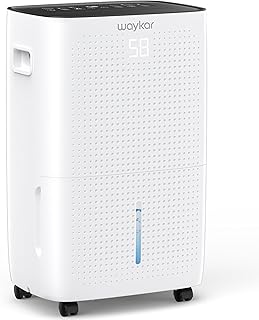
Waykar 150 Pint 7,000 Sq. Ft. Dehumidifier
The strongest choice for oversized, leaky, or workshop-attached garages, with a 90° auto-swing outlet that distributes dry air instead of creating a single dehumidified pocket. The 30%–80% humidity range plus auto-defrost and continuous drain support make it a genuine set-and-forget install.
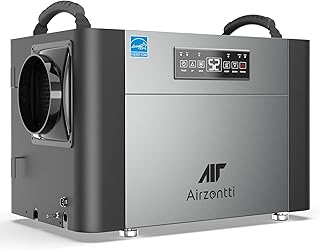
155 Pint Commercial Dehumidifier with Pump
This is the unit to buy when gravity drainage isn’t available or you’re also treating a crawl space or attic on the same run. Built-in pump, Energy Star certification, and heavy-duty capacity make it the right answer after water damage or in persistently damp climates.
5,000 Sq. Ft. 100 Pint Smart Dehumidifier
An Energy Star Most Efficient award-winner with three drainage configurations, so you can adapt to whatever your slab and outlet situation allows. Smart humidity control holds a tight setpoint, which reduces the compressor cycling that makes noise noticeable through shared walls.
4,500 Sq. Ft. 115 Pint Energy Star Dehumidifier
The pick for garages sharing a wall with a bedroom or nursery: a 45 dB compressor is quiet enough to disappear into background noise, and auto shut-off with auto-restart handles unattended operation. Strong extraction for a unit this restrained acoustically.
AEOCKY 4,500 Sq. Ft. 80 Pint Dehumidifier with Pump
An Energy Star Most Efficient 2025 model that pairs a pump with an intelligent humidistat, making it the most practical mid-capacity option for a standard two-car garage. Low running cost matters when the unit works year-round.
Frequently Asked Questions
What humidity level should I target in a garage?
Hold it between 45% and 55%. Below 60% you suppress mold germination and collapse dust mite reproduction; below 40% you risk cracking stored wood, leather, and instruments.
Can a garage dehumidifier really affect how I sleep?
Indirectly, yes. Attached garages leak air and odor into living space, and mold spores plus dust mite allergens are well-documented contributors to nighttime congestion and lighter, more fragmented sleep.
Should I run it with the garage door open?
No. Dehumidification only works in a reasonably sealed volume — an open door means the unit runs continuously against outdoor humidity, wasting energy and shortening compressor life.
Do I need a heated garage for this to work?
Not if you choose a model with auto-defrost, which clears coil frost and keeps extraction going in cool conditions. In unheated garages that fall below about 40°F, a desiccant-style unit becomes the better option.
Final Thoughts
For most two-car garages sharing a wall with sleeping space, the 4,500 Sq. Ft. 115 Pint Energy Star model offers the best balance of quiet operation and real extraction capacity. Choose the Waykar 150 Pint if your space is large, drafty, or doubles as a workshop, and the 155 Pint Commercial unit with pump when drainage has to travel uphill or you’re recovering from a moisture event.