Key takeaways
- Use the mattress thickness listed for the bed, usually 6 to 8 inches.
- Anchor the frame to wall studs at the top, especially on taller models.
- Choose ladders with flat treads rather than round rungs if you will climb down half-asleep; angled ladders are easier than vertical ones.
- Keep the bed away from windows with blind cords and from ceiling light fixtures.
A wood frame queen loft bed is worth choosing over metal if you want a quieter, more rigid bed that looks like furniture, and it works best in rooms with ceilings of at least 8 feet, used with a mattress of 8 inches or less. Metal queen lofts are lighter and cheaper but tend to sway and creak more as bolts loosen. Wood is also the only realistic option if you want to build your own. This guide compares wood and metal head-to-head, then covers ceiling math, safety dimensions, DIY realities and the queen-over-queen bunk variant.
Our top picks


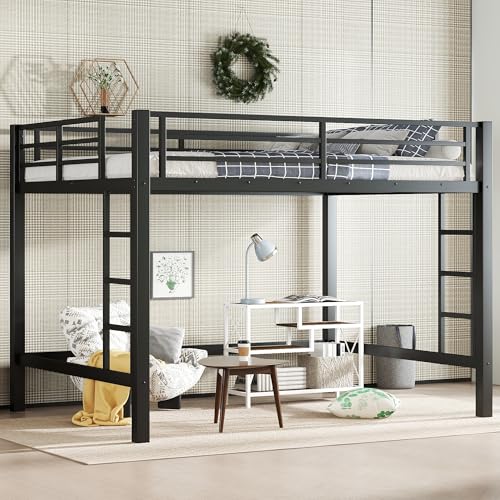

As an Amazon Associate we earn from qualifying purchases at no extra cost to you. Ratings are shown as listed on Amazon.
Wood vs Metal Queen Loft Beds
| Factor | Solid wood (pine, hardwood) | Metal (steel tube) |
|---|---|---|
| Typical price, queen loft | $700–$2,500 | $300–$900 |
| Assembled weight | 150–350 lb | 80–180 lb |
| Sway and noise | Low when bolted and wall-anchored | More common; joints loosen over time |
| Typical stated weight capacity (top bunk) | Often 400–800 lb on adult-rated models | Often 300–600 lb |
| Look | Warm, furniture-like, can be stained or painted | Industrial, minimal |
| Moving and reassembly | Heavy; holds up well to rebuilding with bolt hardware | Lighter; threads can strip after several rebuilds |
| DIY potential | High; standard lumber and bolts | Low without welding |
The weight capacity numbers vary widely by model. Treat any listed limit as a static load evenly spread across the deck. People climbing, sitting on the edge or two adults moving around create dynamic loads well above body weight, so look for adult-rated designs with margin to spare.
Ceiling Height Math
A queen loft only works if you can sit up in it and stand under it. Here is how a typical design breaks down.
| Element | Typical range |
|---|---|
| Floor to underside of the deck | 52–62 in |
| Deck and slat thickness | 3–6 in |
| Recommended mattress thickness | 6–8 in |
| Top of mattress from floor | about 62–76 in |
| Comfortable headroom to sit up | 30–36 in |
| Ceiling height needed | about 8 ft minimum, 9 ft ideal |
With a standard 8 ft (96 in) ceiling and the mattress top at about 68 inches, you get roughly 28 inches of headroom: enough to sleep and read on your elbows, but not to sit fully upright for most adults. If a ceiling fan is above the bed, the loft is not workable unless the fan is moved. Under the deck, 52 to 56 inches gives room for a desk and chair or a small sofa while seated; you will not be able to stand upright under it.
Safety Dimensions
US bunk bed safety rules for upper bunks call for guardrails on both long sides with the top of the rail at least 5 inches above the top of the mattress, and openings in the structure small enough (about 3.5 inches or less) that a child cannot slip through. These limits explain why loft beds specify a maximum mattress thickness: a 12 inch mattress on a rail designed for an 8 inch mattress leaves almost no guardrail above the sleeping surface.
- Use the mattress thickness listed for the bed, usually 6 to 8 inches.
- Anchor the frame to wall studs at the top, especially on taller models.
- Choose ladders with flat treads rather than round rungs if you will climb down half-asleep; angled ladders are easier than vertical ones.
- Keep the bed away from windows with blind cords and from ceiling light fixtures.
What to Look For in a Wood Queen Loft
Post size and joinery
Posts of around 3.5 inches square (a nominal 4×4) or laminated equivalents give much better rigidity than thin 2-inch posts. Look for bolt-through connections using barrel nuts or carriage bolts rather than wood screws into end grain. Corner gussets or diagonal bracing on at least one side dramatically reduce sway.
Slats and deck
Solid wood slats spaced no more than about 3 inches apart support foam mattresses properly. A center beam along the length of the queen deck is essential; without it, the slats sag over 60 inches of width.
Wood species
Solid pine is the most common and affordable, and it is strong enough when the posts are thick. Hardwoods such as rubberwood, birch or oak are stiffer and dent less but cost more. Avoid particleboard or MDF in any structural part of a loft; they lose holding strength each time screws are loosened and retightened.
DIY Wood Queen Loft Bed: What It Takes
Building a queen loft from lumber is one of the most common DIY bed projects because the parts are simple. A typical build uses four 4×4 posts, 2×6 or 2×8 rails, a 2×4 ledger for the slats, 1×4 slats, and 3/8 or 1/2 inch carriage bolts at the corners.
| DIY factor | Typical figure |
|---|---|
| Lumber and hardware cost | $250–$600, depending on wood grade and finish |
| Build time | One to two weekends including sanding and finishing |
| Tools | Circular or miter saw, drill, socket set, clamps, level |
| Interior deck dimensions | Allow at least 60.5 x 80.5 in so a queen mattress drops in |
Two rules make DIY lofts safe: brace the frame against racking (a sheet of plywood on one end, diagonal braces or anchoring to studs), and build the guardrails to the 5 inch above-mattress rule before anyone sleeps up there. Assemble the frame inside the room; a finished queen loft will not fit through a standard 30 to 36 inch doorway.
Queen Over Queen Bunk Beds
A wood frame queen over queen bunk is a heavier, taller structure that suits guest rooms and vacation homes with high ceilings. Because the lower bunk needs about 36 inches of sitting headroom under the upper deck, the top mattress usually ends up around 70 inches or higher, so a 9 ft ceiling or more is strongly preferred. Expect assembled weights of 250 pounds or more and prices typically between $1,000 and $3,000 for solid wood. Queen over queen is far less common than twin over full, so plan for longer lead times or a custom build.
Who Should Get a Wood Queen Loft
- Studio apartments: a desk, sofa or wardrobe underneath effectively adds a room.
- Adults sharing a small bedroom: a queen loft keeps a full bed for two while freeing the floor.
- Renters: choose bolt-together models that can be disassembled; anchor with removable screws into studs and patch the holes when moving out.
If your ceiling is below 8 feet, skip the full loft and look at mid-height or low-loft beds around 40 to 48 inches tall, which still leave room for storage underneath.