Key takeaways
- Heat type: Far infrared warms tissue gradually and suits long, calm sessions — the profile you want before bed. Near infrared and red light panels add surface-level benefits but are stimulating for some users, so favor cabins that let you run them independently.
- Warm-up time: A 1,000–1,500W cabin typically reaches working temperature in 10–20 minutes. Anything slower pushes your session later and erodes the wind-down window you’re trying to protect.
- EMF shielding: Look for shielded carbon or ceramic emitters and a manufacturer willing to publish measured figures at seat distance. Vague “low EMF” badges with no numbers deserve skepticism.
- Evening lighting: Chromotherapy is only useful if it dims and includes warm amber or red settings. Bright white interior LEDs an hour before bed work directly against melatonin release.
- Footprint and build: Measure ceiling clearance, not just floor space — most cabins run 70–73 inches tall. Canadian hemlock resists warping and stays close to odorless, which matters in a bedroom.
What's inside
Most people buy a sauna for recovery or detox and are surprised when the biggest change shows up overnight. Passive heating raises core temperature, and the rebound cooling that follows is one of the strongest non-pharmacological cues the body has for falling asleep quickly and holding deeper sleep in the first half of the night. The obstacle isn’t motivation — it’s the buying process. Listings blur near and far infrared, quote wattage without heat-up times, advertise “low EMF” with nothing to back it, and rarely mention whether the cabin lighting is gentle enough to sit in after dark.
This guide sorts current home infrared saunas by the criteria that actually affect a nightly routine: how fast the cabin reaches a usable temperature, how comfortable it is to sit in for 25 to 40 minutes, how much light and fan noise it throws off in the evening, and how realistically it fits a spare bedroom, garage gym, or apartment corner. Below you’ll find the models worth shortlisting for 2026, followed by a selection framework and answers to the questions that come up most often once a unit is in the room.
As an Amazon Associate we earn from qualifying purchases.


🛒 Best Price Today on Amazon
Prime members get fast, free shipping on everything above, plus member-only deals. New members get a 30-day free trial — cancel anytime.
How to Choose an At Home Infrared Sauna (2026)
- Heat type: Far infrared warms tissue gradually and suits long, calm sessions — the profile you want before bed. Near infrared and red light panels add surface-level benefits but are stimulating for some users, so favor cabins that let you run them independently.
- Warm-up time: A 1,000–1,500W cabin typically reaches working temperature in 10–20 minutes. Anything slower pushes your session later and erodes the wind-down window you’re trying to protect.
- EMF shielding: Look for shielded carbon or ceramic emitters and a manufacturer willing to publish measured figures at seat distance. Vague “low EMF” badges with no numbers deserve skepticism.
- Evening lighting: Chromotherapy is only useful if it dims and includes warm amber or red settings. Bright white interior LEDs an hour before bed work directly against melatonin release.
- Footprint and build: Measure ceiling clearance, not just floor space — most cabins run 70–73 inches tall. Canadian hemlock resists warping and stays close to odorless, which matters in a bedroom.
The Best At Home Infrared Saunas (2026), Reviewed
Ceramic 2-Person Infrared Sauna with Granite Backdrop
The combination of ceramic far and near infrared emitters produces the most even heat distribution in this group, and the granite backdrop retains warmth well past shutdown. It’s the pick for couples who want a genuine spa session rather than a solo box.
1–2 Person Infrared Sauna with Red Light Therapy
At 40 by 36 inches, this cabin gives one person room to stretch out or two people a companionable fit, with red light therapy and seven-color chromotherapy on separate controls. Bluetooth and radio are built in, though I’d keep audio to something slow-tempo if you’re using it as a pre-sleep ritual.
1-Person Far Infrared Sauna with Oxygen Ionizer
A 1,050W heater array gets this cabin usable inside 15 minutes, which makes it realistic for a nightly session rather than a weekend event. The ionizer and chromotherapy are pleasant extras, but the real strength is straightforward assembly and a footprint that fits most spare rooms.
OUTEXER Far Infrared Hemlock Sauna
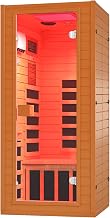
At 1,200W in a compact 35-inch-wide Canadian hemlock shell, this is the strongest heat-to-footprint ratio here — ideal for apartments and small home gyms. The tempered glass door keeps it from feeling claustrophobic during longer sessions.
Infrared Sauna Tent with 3L Steamer
Nine heat levels, a 99-minute timer, and five-layer insulated fabric make this a legitimate entry point rather than a compromise, and the head-out design suits anyone who finds enclosed cabins uncomfortable. It folds away between uses, which is the deciding factor in shared living spaces.
Frequently Asked Questions
When should I sauna if my goal is better sleep?
Finish 90 minutes to two hours before lights out. That window lets core temperature peak, then fall, and it’s the falling curve — not the heat itself — that signals sleep onset. Sessions ending 20 minutes before bed often backfire.
How long and how hot should a session be?
Start at 15 minutes around 110°F and build toward 25–40 minutes at 120–140°F. Infrared works at lower air temperatures than traditional saunas, so chasing extreme numbers adds strain without added benefit.
Do I need special electrical work?
Most one- and two-person units run on standard 110V but should have a dedicated 15- or 20-amp circuit. Skip extension cords entirely and confirm amperage draw before installing in an older home.
Is a sauna tent genuinely effective?
For the thermoregulatory effect that drives sleep benefits, yes — core temperature is what matters, and a well-insulated tent raises it reliably. Cabins win on comfort, longevity, and resale, not on physiology.
Final Thoughts
For a shared household with the space to commit, the Ceramic 2-Person Sauna with Granite Backdrop delivers the most consistent heat and the most convincing spa experience. Solo users should look hard at the 1-Person Far Infrared Sauna with Oxygen Ionizer for its fast warm-up and easy build, or the OUTEXER Hemlock Sauna if square footage is tight. If you’d rather test the habit before committing to a cabinet, the Infrared Sauna Tent with 3L Steamer is the low-risk way in.