Key takeaways
- Acoustic profile over headline decibels: A spec sheet quoting 45 dB usually describes the freeze phase only. Ask about the harvest — the moment ice releases into the bin — which is the loudest event and the one that wakes people. Insulated cabinets and metal bins with damping perform better than thin plastic.
- A genuine 24-hour timer: This is the single most useful sleep-protective feature on a modern unit. Being able to stop production at 9 p.m. and resume at 6 a.m. means the machine simply doesn’t exist during your sleep window. Confirm it schedules on and off times rather than merely running a countdown.
- Bin capacity relative to daily output: A 100 lb/day machine with a 30 lb bin fills up and idles quickly, which is good — a full bin is a silent bin. Undersized storage on a high-output unit forces near-constant cycling, so match the two.
- Drainless versus gravity drain: Drainless models recirculate meltwater and can be installed anywhere with a water line and an outlet, including rooms far from your bedroom wall. A gravity-drain unit ties you to plumbing, which often means the one cabinet you’d rather avoid.
- Ice format for evening use: Crescent and cube ice chill efficiently and dilute slowly, which suits an evening drink you’re sipping deliberately. Nugget ice is softer and pleasant to chew, though it melts faster — worth knowing if hydration timing before bed matters to you.
What's inside
Most people shop for an undercounter ice maker the way they shop for a dishwasher: capacity, finish, and whether it clears the 15-inch gap in the cabinet run. Then the machine goes into a butler’s pantry, a basement bar, or a kitchen island that happens to share a wall with a bedroom — and at 2:47 a.m. the compressor engages, the harvest cycle releases a sheet of ice, and forty cubes drop into a plastic bin. As someone who works with clients on sleep architecture, I can tell you that steady noise is far easier to habituate to than sudden, unpredictable noise. A refrigerator hum disappears into the background within a week. An ice drop never does, because your auditory system is built to flag the irregular.
This roundup evaluates the 2026 undercounter field on the specifications that actually govern whether a machine belongs near a sleeping space: acoustic behavior across the freeze and harvest phases, whether the timer is genuinely programmable, how bin capacity relates to total daily runtime, and whether the unit needs a floor drain (which dictates where it can live). Output, build quality, and cleaning cycles are covered too — you still want ice — but placement and scheduling come first.
As an Amazon Associate we earn from qualifying purchases.


How to Choose an Ice Maker Undercounter (2026)
- Acoustic profile over headline decibels: A spec sheet quoting 45 dB usually describes the freeze phase only. Ask about the harvest — the moment ice releases into the bin — which is the loudest event and the one that wakes people. Insulated cabinets and metal bins with damping perform better than thin plastic.
- A genuine 24-hour timer: This is the single most useful sleep-protective feature on a modern unit. Being able to stop production at 9 p.m. and resume at 6 a.m. means the machine simply doesn’t exist during your sleep window. Confirm it schedules on and off times rather than merely running a countdown.
- Bin capacity relative to daily output: A 100 lb/day machine with a 30 lb bin fills up and idles quickly, which is good — a full bin is a silent bin. Undersized storage on a high-output unit forces near-constant cycling, so match the two.
- Drainless versus gravity drain: Drainless models recirculate meltwater and can be installed anywhere with a water line and an outlet, including rooms far from your bedroom wall. A gravity-drain unit ties you to plumbing, which often means the one cabinet you’d rather avoid.
- Ice format for evening use: Crescent and cube ice chill efficiently and dilute slowly, which suits an evening drink you’re sipping deliberately. Nugget ice is softer and pleasant to chew, though it melts faster — worth knowing if hydration timing before bed matters to you.
The Best Ice Maker Undercounter (2026)s Reviewed
Mojgar 15″ Commercial Under Counter Ice Maker (100 lbs/Day)
The strongest all-round pick here: ETL-approved, 100 lb daily output paired with a 30 lb bin, so it front-loads production and then rests rather than trickling all night. The self-cleaning cycle is the practical highlight, since biofilm in the reservoir is the usual reason home units start smelling off.
Electactic Nugget Ice Machine (66 lbs/Day)
Nugget ice is the reason to buy this one, and the 24-hour timer is the reason it earns a spot near a quiet room. Output is lower than the cube machines, but nugget production is a continuous auger process — less clatter, more low-frequency whirr, which is generally easier to sleep through.
COTLIN 15″ Drainless Under Counter Ice Maker
The no-drain design makes this the most flexible unit for placement, which matters enormously if the only plumbed cabinet in the house backs onto a bedroom. A 22 lb bin and crescent ice make it a sensible fit for a home bar rather than a busy service counter.
Whynter UIM-155 Built-In Stainless Steel Ice Maker
Modest by design — roughly 12 lbs over 24 hours with 6 lbs of storage — and that restraint is its virtue in a bedroom-adjacent installation. One-button operation, automatic shut-off, and no drain requirement make it the low-intervention choice for households that use ice occasionally rather than constantly.
EUHOMY Commercial Under Counter Ice Machine (100 lbs/24H)
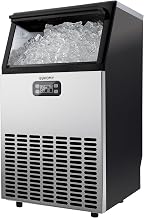
A well-built stainless workhorse with a generous 33 lb bin, best suited to entertaining spaces where demand comes in bursts. Treat it as a daytime appliance: run it hard in the evening, let it fill, and switch it off before you head upstairs.
Frequently Asked Questions
How loud is too loud for a machine near a bedroom?
The WHO night-noise guidance points to roughly 40 dB as a reasonable ceiling for outside-bedroom sound. Most undercounter units sit between 45 and 55 dB during harvest, so a closed cabinet door, a stud wall, or simply a different room is worth engineering into your layout.
Should I switch the machine off overnight?
If it’s within earshot, yes. A full bin holds ice perfectly well for several hours, and scheduling production to finish before bedtime eliminates the harvest noise entirely without any compromise in supply.
Does an undercounter unit need a floor drain?
Not always. Drainless models such as the COTLIN and the Whynter UIM-155 recirculate meltwater internally, requiring only a water supply and power — which is precisely what lets you site them away from sleeping areas.
Is a cold drink before bed a problem?
A modest one is fine and can even suit the natural drop in core temperature that accompanies sleep onset. The variable worth managing is volume, not temperature — large late-evening fluid intake is a reliable cause of nighttime waking.
Final Thoughts
For most homes, the Mojgar 100 lb unit offers the best balance of output, storage, and self-cleaning convenience. If your only viable cabinet sits close to a bedroom, choose the drainless COTLIN for placement freedom, or the compact Whynter UIM-155 if quiet, low-volume operation matters more than capacity.