Key takeaways
- Match CFM to the tool, not the tank size: Gallons determine how long you work between refills; CFM at 90 PSI determines whether the tool functions at all. Framing and roofing nailers want roughly 4 CFM, while brad guns and inflation duties sip a fraction of that.
- Read the decibel figure before the pressure figure: Anything above roughly 80 dB in an attached garage will carry into adjoining bedrooms, and intermittent noise disrupts sleep architecture far more reliably than steady sound. Schedule loud tank cycling for mid-morning, not dawn.
- Understand duty cycle: A 100% duty-cycle unit can run continuously without a mandatory cool-down, which matters enormously if you’re topping up four truck tires or a large inflatable in one session rather than one bicycle wheel.
- Stay inside one battery ecosystem: Bare-tool inflators are inexpensive precisely because you supply the pack. Committing to a single 18V or 20V platform saves money, shelf space, and the low-grade irritation of hunting for a charger.
- Consider weight, footprint, and storage: A six-gallon pancake stores flat under a workbench; a handheld inflator lives in a glovebox. Decide where the tool will physically rest before you decide what it costs.
What's inside
Most people shop for an air compressor the way they shop for a mattress: they scan the biggest number on the spec sheet, buy accordingly, and discover the real trade-offs at 6:30 on a Sunday morning. I spend my working life studying how households actually recover overnight, and the complaint I hear most often from people mid-renovation isn’t dust or budget — it’s a pancake tank cycling on through a shared wall while someone upstairs is in their deepest sleep window. A compressor is a tool, but inside a home it also behaves like acoustic furniture, and it deserves the same scrutiny you’d give a headboard or a creaking hallway board.
This guide evaluates portable compressors from both directions: whether the unit can genuinely drive the tool in your hand, and whether it can do so without dismantling the rest of the household’s night. Below you’ll find cordless inflators that run on battery platforms you likely already own, one true job-site pancake unit for framing and trim, and a plain explanation of the specifications — CFM, duty cycle, motor design, decibels — that separate a tool you keep for a decade from one you resent by spring.
As an Amazon Associate we earn from qualifying purchases.



How to Choose a Portable Air Compressor For Tools (2026)
- Match CFM to the tool, not the tank size: Gallons determine how long you work between refills; CFM at 90 PSI determines whether the tool functions at all. Framing and roofing nailers want roughly 4 CFM, while brad guns and inflation duties sip a fraction of that.
- Read the decibel figure before the pressure figure: Anything above roughly 80 dB in an attached garage will carry into adjoining bedrooms, and intermittent noise disrupts sleep architecture far more reliably than steady sound. Schedule loud tank cycling for mid-morning, not dawn.
- Understand duty cycle: A 100% duty-cycle unit can run continuously without a mandatory cool-down, which matters enormously if you’re topping up four truck tires or a large inflatable in one session rather than one bicycle wheel.
- Stay inside one battery ecosystem: Bare-tool inflators are inexpensive precisely because you supply the pack. Committing to a single 18V or 20V platform saves money, shelf space, and the low-grade irritation of hunting for a charger.
- Consider weight, footprint, and storage: A six-gallon pancake stores flat under a workbench; a handheld inflator lives in a glovebox. Decide where the tool will physically rest before you decide what it costs.
The Best Portable Air Compressors For Tools (2026) Reviewed
DEWALT 20V MAX Tire Inflator (DCC020IB)
The most refined cordless inflator here, with a genuinely reliable automatic shut-off that lets you set a target pressure and walk away instead of hovering over a gauge. The high-visibility LED makes it the obvious choice for roadside work after dark, and as a bare tool it’s a sensible addition to any existing DEWALT collection.
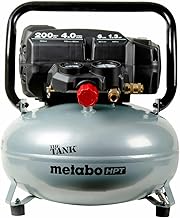
Metabo HPT EC914S 6-Gallon Pancake Compressor
This is the only unit in the roundup that will actually run framing, siding, and roofing nailers — several simultaneously — thanks to 4 CFM flow and a 200 PSI tank. Accept that it is a job-site machine: plan your loudest work for daylight hours, and it will outlast most of the tools you plug into it.
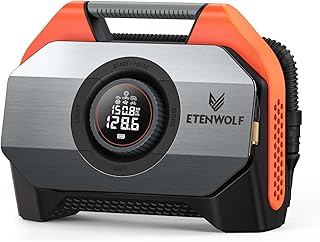
ETENWOLF VORTEX S6 Cordless Inflator
A dual-cylinder design with a 19,200mAh pack and a 100% duty cycle, meaning it keeps working when lighter inflators stop to cool down. It’s the one I’d recommend for heavy vehicle tires, campers, and anyone who inflates several items back-to-back.
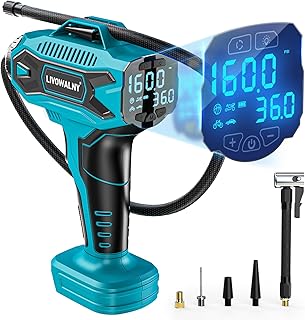
Makita 18V-Compatible 160 PSI Inflator
The highest pressure ceiling among the cordless options, with a clear digital gauge that removes guesswork from motorcycle and high-pressure automotive work. A cost-effective way to extend an existing Makita 18V battery collection without paying a premium for the brand badge.
DIYtoolifz 150 PSI Inflator for DEWALT 20V
A capable budget alternative that pairs a digital gauge with a work light and covers routine car, motorcycle, and sports-ball duties competently. Build quality trails the first-party DEWALT unit, but for occasional household use the value is difficult to argue with.
Frequently Asked Questions
Can a cordless tire inflator run a nail gun?
No. Inflators deliver high pressure at very low volume, while nailers need sustained CFM from a tank. For any nailing work, a pancake compressor like the EC914S is the minimum viable tool.
How loud is too loud for a home garage?
Sustained exposure above 85 dB warrants hearing protection, and anything above roughly 70 dB will be audible through a shared bedroom wall. Cordless inflators run intermittently and briefly; tank compressors cycle unpredictably, which is precisely the pattern that fragments sleep.
Do I need an oil-lubricated compressor?
For domestic use, no. Oil-free pumps require no maintenance, tolerate cold storage, and start reliably after months of disuse — worth the modest noise penalty for most homeowners.
Are bare-tool models worth it?
Only if you already own compatible batteries. Buying a bare tool plus a battery and charger separately usually costs more than a bundled kit.
Final Thoughts
For serious pneumatic work, the Metabo HPT EC914S remains the sensible investment — just be deliberate about when you run it. For everyday inflation, the DEWALT DCC020IB offers the best combination of accuracy and restraint, while the ETENWOLF VORTEX S6 is the one to choose if you need sustained, uninterrupted output without tethering yourself to a battery platform.