Key takeaways
- Seat height and hip angle: Aim for 10–12 inches of clearance between the seat top and the underside of your table. Too low and your knees rise above your hips, folding the abdomen and making a full meal genuinely uncomfortable to digest.
- Cushion density over cushion thickness: A plush seat that flattens by month two is worse than a firmer one that holds its shape. Press the foam and watch how quickly it rebounds — slow, complete recovery is the marker of high-resilience fill.
- Backrest contour: A gentle curve that meets the lower back does more for lingering comfort than sheer height. Flat, vertical backs push the shoulders forward and shorten how long anyone stays seated.
- Fabric breathability: Core temperature needs to fall in the evening for sleep to arrive on time. Linen blends and open-weave textures shed heat; dense synthetic velvets trap it, which is worth knowing if your dinners run long.
- Legs, noise, and footprint: Solid wood dampens the scrape that wakes a sleeping child down the hall; metal frames resist wobble over years of dragging. Check the leg splay too — flared legs eat floor space in tight rooms.
What's inside
Most dining chairs are chosen from a photograph and judged three weeks later by the small of the back. The details that actually determine comfort — seat depth, foam resilience, the angle where the backrest meets the spine — are rarely the ones a listing image communicates. I work in sleep and recovery, and I’ve come to treat the dinner table as the opening act of the night: it is where the body either settles into an unhurried, upright, well-digested evening, or hunches over a plate with the ribcage compressed and the meal finished in eleven minutes. A chair that quietly encourages you to leave the table early is doing more damage to your wind-down than most people realize.
This guide looks at upholstered dining sets through that lens. Each pick below was assessed on seat geometry, cushion recovery, backrest contour, fabric breathability, frame stability, and how much of your Saturday assembly will cost you. All are sets of four or six, priced for ordinary households rather than showrooms — chairs meant to be sat in nightly, not admired.
As an Amazon Associate we earn from qualifying purchases.




How to Choose Dining Room Chairs (2026)
- Seat height and hip angle: Aim for 10–12 inches of clearance between the seat top and the underside of your table. Too low and your knees rise above your hips, folding the abdomen and making a full meal genuinely uncomfortable to digest.
- Cushion density over cushion thickness: A plush seat that flattens by month two is worse than a firmer one that holds its shape. Press the foam and watch how quickly it rebounds — slow, complete recovery is the marker of high-resilience fill.
- Backrest contour: A gentle curve that meets the lower back does more for lingering comfort than sheer height. Flat, vertical backs push the shoulders forward and shorten how long anyone stays seated.
- Fabric breathability: Core temperature needs to fall in the evening for sleep to arrive on time. Linen blends and open-weave textures shed heat; dense synthetic velvets trap it, which is worth knowing if your dinners run long.
- Legs, noise, and footprint: Solid wood dampens the scrape that wakes a sleeping child down the hall; metal frames resist wobble over years of dragging. Check the leg splay too — flared legs eat floor space in tight rooms.
The Best Dining Room Chairs (2026), Reviewed
COLAMY Upholstered Dining Chairs, Set of 4
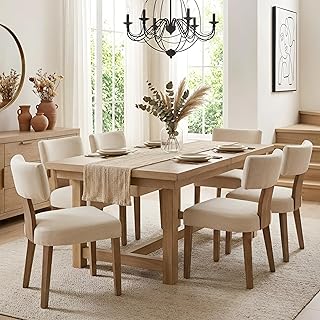
The tall back is the reason to buy these: it supports the thoracic spine rather than stopping at the waist, which is exactly what long, conversational dinners require. The linen-look beige and compact footprint make them a natural fit for round tables and smaller dining rooms where bulk becomes obvious fast.
HNY Mid-Century Modern Dining Chairs, Set of 6
An ergonomically curved backrest and solid wood legs, sold as a six — a rare and welcome combination for larger households who don’t want to buy two mismatched sets. The lumbar curve is shallow but well placed, and the wood legs keep floor noise down in open-plan spaces.
VIRRMO Boucle Dining Chairs, Set of 4
The corduroy-boucle upholstery is the standout, offering real texture and better airflow than the flat velvets crowding this category, so you won’t overheat halfway through a second course. Slim metal legs keep the visual weight low, though they suit hard floors and rugs better than deep carpet.
UVV Dining Chairs, Set of 4
Metal-framed and unfussy, these are the pragmatist’s option: no joint loosening after a year of being dragged in and out, and upholstery clean enough to pass in a modern dining room. A sensible choice for rentals, home offices doubling as dining spaces, or households with enthusiastic children.
VKNOW Dining Chairs, Set of 4
The muted green is the draw — a colour that reads warm under low evening light, which matters more than people think when you’re trying to signal to the nervous system that the day is winding down. Assembly is genuinely quick, and the mid-century silhouette works with both farmhouse and contemporary tables. If you prefer the same shape in neutral beige on wooden legs, the CHUN YI set covers very similar ground.
Frequently Asked Questions
What seat height suits a standard dining table?
Standard tables sit around 29–30 inches high, which pairs with a seat height of roughly 18 inches. Every set above falls within that range, but measure your own table before ordering, particularly if it’s reclaimed or custom.
Are upholstered chairs practical with children?
Increasingly, yes. Most fabrics in this bracket carry a stain-resistant treatment, and beige and cream tones hide crumbs better than true white. Vacuum the seams monthly and blot spills rather than rubbing them.
Can a dining chair really affect how I sleep?
Indirectly, but meaningfully. Comfortable seating extends the evening meal, and slower eating improves digestion and reduces the reflux that fragments early-night sleep. A chair that keeps you upright and cool supports both.
How much space should each chair have?
Allow 24 inches of table edge per person and at least 36 inches of clearance behind each chair for pushing back. Armless designs like these are the correct call in rooms where that clearance is tight.
Final Thoughts
For small dining rooms and posture-conscious buyers, the COLAMY set’s high back is the most complete design here. Larger households should look first at the HNY six-piece, which delivers genuine lumbar shaping without forcing a second purchase, while the VIRRMO boucle chairs are the pick for anyone who wants texture and breathability over conventional velvet.