Key takeaways
- Target 1,200–2,000 PSI, not more: Automotive paint is happiest in this band. Higher-rated machines aren’t disqualified — you simply throttle down with a wider nozzle — but raw PSI is the most oversold number in this category.
- Prioritise GPM for rinsing: Flow rate does the actual cleaning. Anything around 1.5–1.8 GPM sheets water off panels quickly and cuts your drying time, which is where swirl marks are usually born.
- Insist on a real foam cannon: A proper cannon with an adjustable orifice produces clinging, shaving-cream foam that lifts grit before contact. Thin, watery “soap applicators” are close to useless.
- Check the nozzle set: You want a 40° white tip for panels and a 65° soap tip. Treat red 0° tips as strictly off-limits anywhere near bodywork, wheels, or badges.
- Weigh noise, weight and reach: Consider decibel output, hose length, cord length, and how the unit tracks behind you. Anti-tipping designs and carry handles prevent the constant stooping that leaves you sore the next morning.
What's inside
Car washing occupies a strange middle ground among household chores. Push too hard — 3,000 PSI held six inches from a door panel — and you can lift trim tape, force water past window seals, and haze a clear coat that took a factory robot two minutes and you two years of payments to protect. Go too soft and you end up leaning on a sponge, dragging embedded grit across the paint in slow circles. The right machine removes that tension entirely: enough flow to float dirt off the surface, enough control to keep the nozzle honest, and quiet enough that a Saturday morning wash doesn’t wake the entire street.
That last point matters more than most buying guides admit. Gas units routinely run in the 85–95 dB range, which is genuinely disruptive at 7 a.m. and fatiguing to operate for forty minutes straight. Electric and cordless washers have closed the performance gap for automotive work, and they do it at conversational volume. Below, we’ve assessed six popular 2026 models on pressure, water flow, foam quality, ergonomics, and noise — the practical variables that decide whether detailing your car feels restorative or like a second job.
As an Amazon Associate we earn from qualifying purchases.



How to Choose a Pressure Washer For Washing Cars (2026)
- Target 1,200–2,000 PSI, not more: Automotive paint is happiest in this band. Higher-rated machines aren’t disqualified — you simply throttle down with a wider nozzle — but raw PSI is the most oversold number in this category.
- Prioritise GPM for rinsing: Flow rate does the actual cleaning. Anything around 1.5–1.8 GPM sheets water off panels quickly and cuts your drying time, which is where swirl marks are usually born.
- Insist on a real foam cannon: A proper cannon with an adjustable orifice produces clinging, shaving-cream foam that lifts grit before contact. Thin, watery “soap applicators” are close to useless.
- Check the nozzle set: You want a 40° white tip for panels and a 65° soap tip. Treat red 0° tips as strictly off-limits anywhere near bodywork, wheels, or badges.
- Weigh noise, weight and reach: Consider decibel output, hose length, cord length, and how the unit tracks behind you. Anti-tipping designs and carry handles prevent the constant stooping that leaves you sore the next morning.
The Best Pressure Washers For Washing Cars (2026), Reviewed
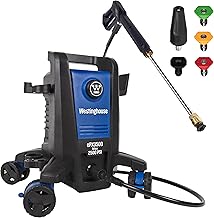
Westinghouse ePX3500
The most complete electric package here: 2,500 max PSI and 1.76 GPM, a pro-style steel wand that resists the flex cheap plastic lances develop, and a five-nozzle set that covers everything from wheel arches to patio slabs. The onboard soap tank and anti-tipping base make one-person washes genuinely effortless.
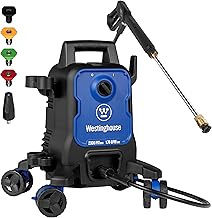
Westinghouse ePX3100
Essentially the ePX3500’s sensible sibling — same 1.76 GPM flow, same steel wand and tank, with peak pressure trimmed to 2,300 PSI. For car work that difference is academic, and the reduced pressure arguably suits paint better.
Westinghouse ePX3100v
At 2,100 max PSI with a detachable foam cannon and built-in carry handle, this is the model we’d hand to a nervous first-timer. Three nozzles keep the decision-making simple, and it’s the easiest of the Westinghouse trio to carry up steps.
1450 PSI Cordless Portable Washer
Two 4.0Ah batteries, a 6-in-1 nozzle, and no cord or spigot required — it draws from a bucket, lake, or barrel. Ideal for apartment dwellers, campervans, and anyone whose parking space is nowhere near an outdoor tap.
Bright Green Pressure Washer with Foam Cannon
A well-priced entry point with four quick-connect nozzles and an included foam cannon. Pressure is modest and the build is plainly budget-tier, but for fortnightly maintenance washes it does the job without fuss.
Frequently Asked Questions
Is a 5,000 PSI washer better for cars?
No. Ratings like the one on the 5000 PSI, 2.8 GPM model are peak, unloaded figures rather than sustained working pressure, and even the real output far exceeds what paint needs. Its 33ft hose reel is genuinely useful; the headline number isn’t.
Will a pressure washer damage my paint?
Not if you use a 40° tip, keep the nozzle 12–18 inches from the panel, and never linger over chips, peeling clear coat, or vinyl wrap edges.
Do I still need to touch the car?
For a full clean, yes. Pre-rinse, apply foam, dwell two minutes, then use a two-bucket wash mitt method. Foam alone handles light dust between proper washes.
How early can I realistically wash?
Electric units typically sit around 70–78 dB — comparable to a vacuum cleaner. That’s neighbour-tolerable from about 8 a.m.; a cordless model is quieter still if you’re an early riser.
Final Thoughts
The Westinghouse ePX3500 is our overall pick for its flow rate, steel wand, and stable footprint, while the ePX3100v delivers nearly the same experience for less money and less lifting. If you have no outdoor outlet — or simply value a near-silent Sunday morning — the 1450 PSI cordless washer is the smartest buy on this list.