Key takeaways
What's inside
Sore muscles after a long run, a desk marathon, or a weekend of yard work send most people to the same two options: a full-body massage chair that lives in the corner of a room, or a handheld percussion gun that lives in a drawer. They solve the same complaint in completely different ways. The chair is a piece of furniture that works on your whole back, glutes, and calves at once while you sit still. The gun is a tool you aim at one spot for two minutes, then move. Choosing between them is really a decision about space, budget, and whether you want passive relaxation or targeted recovery.
Quick Verdict
Buy a percussion massage gun if your soreness is localized (tight calves, a knotted trap, a stiff hip), you exercise regularly, or you live in less than about 800 square feet. At $35-$60 for a solid brushless model, it is the lowest-risk recovery purchase you can make. Buy a massage chair if you want a daily 15-minute session for your entire back and legs, you have chronic tension rather than sport-specific soreness, and you can dedicate a 3 x 5 foot footprint plus $500-$1,500. Many households end up with both: the chair for the evening wind-down and the gun for post-workout spot work.
As an Amazon Associate we earn from qualifying purchases at no extra cost to you. Product prices and availability are accurate as of the date shown and are subject to change.


Side by Side
| Factor | Massage chair | Percussion massage gun |
|---|---|---|
| Comfort | Hands-free, full-body, heat and zero-gravity recline on most models | Effective but requires effort; hard to reach mid-back alone |
| Coverage | Neck to calves in one program; 14-plus rollers on mid-range units | One spot at a time, roughly a 2-inch head contact area |
| Durability | Typically 7-10 years; motors and tracks are repairable | Typically 2-4 years; battery degrades, rarely repaired |
| Price range | $500-$1,500 mainstream; $2,500+ for 4D track models | $30-$70 mainstream; $150-$400 for premium brands |
| Maintenance | Wipe upholstery, keep tracks clear, occasional remote batteries | Charge every 1-3 weeks, wipe heads, replace after battery fades |
| Space needed | About 30 x 55 inches upright; 30 x 70 inches reclined | Fits in a 9 x 7 x 3 inch case |
| Weight | 150-250 lb; two-person delivery and setup | 1.5-2.5 lb; one-handed |
| Power | Wall outlet, roughly 100-200 W while running | Rechargeable battery, 2-6 hours per charge |
| Look | Dominant furniture piece; leather-look finishes in black or brown | Invisible when stored |
| Best for | Chronic back tension, daily relaxation, shared households | Athletes, targeted knots, travel, small spaces |
Where Massage Chair Wins
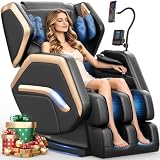
The chair wins on coverage and consistency. A model like the NAGLIFOR full-body chair at $539.99 runs 14 fixed rollers along the spine while airbags compress the calves and arms, and five automatic modes mean you press one button and get the same 15-minute routine every night. No gun can work your lower back, glutes, and hamstrings at the same time, and none can do it while you sit with your feet above your heart in zero-gravity recline, which takes pressure off the lumbar discs.
It also wins for people who cannot or will not do the work. Percussion guns demand that you hold 2 lb at arm’s length and angle it correctly for several minutes per muscle group. Anyone with shoulder impingement, arthritis in the hands, or simply low motivation after a long day gets more actual use out of a chair. Heat is the other separator: most chairs in the $500-$600 range, including the FURNIMAT zero-gravity recliner at $569.99, include lumbar heating that loosens tissue before the rollers reach it, whereas heated gun heads are small and warm only the contact point.
Finally, a chair is shared infrastructure. In a household of three or four adults, everyone uses it, and it doubles as a recliner for reading or watching TV even with the motors off.
Where Percussion Massage Gun for Sore Muscles Wins
The gun wins on precision, price, and portability. A percussion head oscillating at 1,800-3,200 strokes per minute with 10-12 mm of amplitude delivers pressure a rolling chair track cannot match on a single knot. For a tight calf after a run or a locked-up forearm from typing, two minutes with a bullet head does more than a 20-minute chair program that spends most of its time elsewhere.
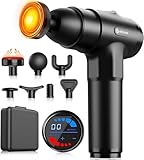
Cost is the obvious advantage. The TOLOCO gun at $39.98 ships with 10 interchangeable heads and a brushless motor rated to run quietly enough for use during a TV show; a heated deep-tissue model sells for $39.99. That is roughly 7% of a mid-range chair. You can put one in a gym bag, a suitcase, or a desk drawer at the office, and it works on legs, feet, and arms, areas chairs reach only partially.
Guns also win on adjustability. Speed settings, head shape, and how hard you press let you dial intensity from a light flush to deep work in a way most chairs under $1,500 cannot. And there is no assembly, no delivery appointment, and no rearranging the living room. If you rent, move often, or share a small space, the gun is the only realistic option.
Cost Over 5 Years
Assume one adult using the device four times a week.
| Cost item | Massage chair | Percussion gun |
|---|---|---|
| Purchase | $540-$600 (mid-range zero-gravity) | $40-$60 |
| Delivery / setup | $0-$150 depending on stairs and assembly | $0 |
| Electricity (15 min, 4x/week) | Roughly $2-$4 per year | Under $1 per year |
| Replacement or repair | Typically none in 5 years; remote or airbag repair $50-$150 if needed | 1 replacement as battery fades ($40-$60) |
| Consumables | Upholstery cleaner, about $10/year | Replacement heads, about $10-$15 once |
| Approximate 5-year total | $600-$900 | $95-$140 |
Per session, the chair works out to roughly $0.60-$0.90 over five years while the gun lands near $0.10-$0.15. The chair, however, holds resale value: a working mid-range unit typically sells for 30-40% of its price after five years, while a used gun is nearly worthless. If you would otherwise pay for monthly professional massage at $80-$120, either device pays for itself within the first year, but the chair replaces that experience more closely.
Which One for Your Home
Small Apartment
Percussion gun, without hesitation. A chair needs a 30 x 55 inch footprint plus 15-20 inches of clearance behind it to recline, which in a studio or one-bedroom means giving up a sofa or a desk. The gun stores in a shoebox-sized case. If you truly want seated full-back coverage, a chair-pad massager that straps onto an existing chair is the compromise, but a gun remains the better recovery tool.
Family With Kids or Pets
Chair, if you have the room and can secure it. Multiple adults using it nightly justifies the cost, and it becomes the household’s favorite seat. Look for a child-lock feature on the remote and keep pets off the moving track area; most chairs pause when the seat sensor detects no one is sitting. Keep a gun as well for the athlete in the family, and store it out of reach, since a 3,000-stroke-per-minute head is not a toy.
Rental
Gun. A 150-250 lb chair is a moving-day problem and can dent or scuff floors on the way in and out. Guns move with you in a backpack. If your lease is longer than two years and the unit fits, a chair is still workable, but factor in $100-$200 for two movers at each end of the lease.
Long-Term Home
Both, if the budget allows; the chair first if you must choose. In a home you plan to stay in through 2026 and well beyond, a chair amortizes over a decade and earns a permanent spot in a den or bedroom corner. Run a dedicated outlet, leave 20 inches behind for recline, and add the gun later for legs and arms the chair does not fully cover.
FAQ
Can a massage gun replace a massage chair for lower back pain?
Partly. A gun can work the glutes and the muscles beside the spine, which often drive lower back tension, but you should never run a percussion head directly over the spine or kidneys. A chair’s rollers stay to either side of the spine automatically and add heat and recline, which most people with chronic lower back tightness find more effective for daily maintenance.
How loud are they?
A brushless gun runs about 40-55 dB, similar to a quiet conversation, though it gets louder when pressed hard into muscle. A chair produces a mix of motor hum and airbag hiss around 50-60 dB. Neither will disturb someone in the next room with the door closed.
How much does a massage chair weigh, and will it fit through my door?
Most mid-range chairs weigh 150-250 lb and ship in one or two boxes. Assembled, they are typically 30-34 inches wide, so a standard 32-inch interior door works if you remove the door or tilt the chair; a 30-inch door is a tight fit and may require detaching the armrests. Check the shipping dimensions before ordering.
How long should a session last?
For a gun, 1-2 minutes per muscle group and no more than 15 minutes total; longer sessions on one spot can bruise. For a chair, 15-20 minutes per session is standard, and most chairs auto-shut off at that point. Daily use of either is fine for healthy adults; check with a clinician if you have osteoporosis, a pacemaker, or a recent injury.