Our Short List of 3
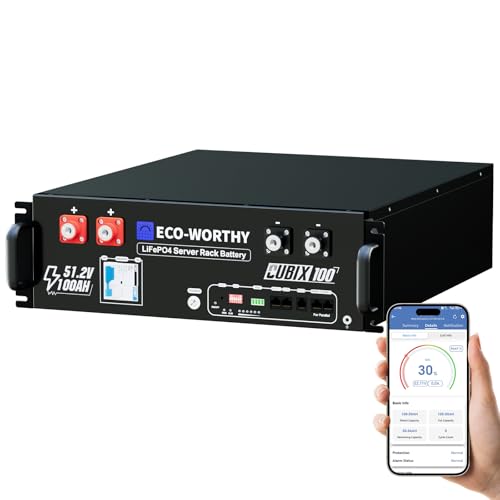
- Best for: A permitted indoor home backup install that needs UL listings on the battery itself.
- Brand: ECO-WORTHY
- Model number: L13080202121-1
- Voltage: 51.2V (48V system)
- Capacity: 100Ah

- Best for: A cabin or off-grid bank where BYD cells and active balancing matter more than a UL listing.
- Brand: WattCycle
- Manufacturer part number: 011
- Voltage: 48V (51.2V nominal)
- Capacity: 100Ah

- Best for: A solar bank you monitor at a glance, where a front touchscreen and strong surge headroom matter.
- Brand: LiTime
- Model number: L51.2V100-100-COM-16-S3U
- Voltage: 51.2V (48V system)
- Capacity: 100Ah
All 3 Picks at a Glance
| Product | Specs | Action |
|---|---|---|
| ECO-WORTHY Cubix100 48V 100Ah |
| Check price on Amazon |
| WattCycle 48V 100Ah |
| Check price on Amazon |
| LiTime 48V 100Ah ComFlex |
| Check price on Amazon |
Key takeaways
- Compare 48V 100Ah LiFePO4 server rack batteries for solar and home backup, from the ECO-WORTHY Cubix100 to the WattCycle and LiTime ComFlex modules.
The real decision behind a server rack battery is not how many kilowatt-hours fit in one box. It is whether that box talks to your inverter, fits your rack, and survives the way your household actually uses stored energy. A 48V 100Ah LiFePO4 module stores about 5.12 kilowatt-hours, and most solar and backup systems stack several of them, so a small mismatch in voltage, communication protocol, or physical depth repeats itself across every module you add. Getting the first module right matters more than squeezing the most capacity into a single purchase.
This guide is for homeowners building or expanding a 48V solar bank, off-grid cabin owners, and anyone replacing a worn storage bank for home backup. Every pick below is a 48V 100Ah LiFePO4 module in a rack-mount chassis, chosen from its Amazon listing name and stated specifications. Uninterruptible power supplies are a different product, so none appear here; check your inverter voltage window and rack depth against each listing before ordering.
Quick Picks
As an Amazon Associate we earn from qualifying purchases
| Product | Best for | Key spec from title |
|---|---|---|
| ECO-WORTHY Cubix100 | A permitted indoor install that needs UL listings | 48V 100Ah LiFePO4 with UL1973, UL9540A and CEC listings |
| WattCycle 48V 100Ah | A tighter budget that still wants BYD cells and active balancing | 5120Wh 3U server rack battery with 3A active balancing |
| LiTime 48V 100Ah ComFlex | A bank you check at a glance, where a touchscreen and surge headroom matter | 51.2V 100Ah with 3.5-inch touch screen and 3U chassis |
How to Choose
Match the Voltage Before Anything Else
Every battery in this guide is a 48V-class module, which means 51.2 volts nominal on a lithium iron phosphate bank, and that number has to line up with your inverter before anything else does. A 48V hybrid inverter expects that voltage window, while a 12V or 24V module simply cannot join the same bank, however similar the listing looks. Read the voltage range in the battery listing and compare it with the battery voltage range printed in your inverter manual, not with a headline on a sales page. Mixing voltages across modules in one bank is not a configuration choice; it is a fault waiting for the first charge cycle.
Measure the Rack, Not Just the Battery
A server rack battery earns its name by sliding into a standard 19-inch rack, and the three modules here all stand 3U tall, yet their depths and weights still differ enough to matter. The ECO-WORTHY unit measures over 20 inches deep, while the LiTime and WattCycle units sit closer to 19, so a shallow wall cabinet can reject one module and accept another. Each module weighs close to 100 pounds, which means rack rails rated for the load, a second pair of hands, and enough clearance to slide the unit home without pinching cables. Measure depth, rail rating, and front clearance before ordering, because a battery that cannot slide into its rack is a battery you cannot wire safely.
Check Inverter Communication, Not Just Bluetooth
A phone app that shows state of charge is convenient, and several of these modules offer Bluetooth monitoring, but that is not the same job as closed-loop communication with your inverter. Closed-loop links over CAN or RS485 let the inverter read the battery management system directly, follow its charge limits, and stop charging when a cell drifts out of range. Before ordering, find your inverter model on the battery maker’s compatibility list, or confirm the protocol in the listing itself, because a module that only talks to its own app leaves the inverter guessing from voltage alone. That guesswork is how banks get overcharged or cut off early.
Read Cycle Life and Cold Limits Honestly
All three modules quote 6,000 or more cycles, and that figure only means something next to the depth of discharge it was measured at, usually 80 percent. A bank cycled gently between high and low states lasts longer than one drained to empty every night, so treat the headline number as a comparison tool rather than a calendar promise. Temperature matters just as much: standard lithium iron phosphate cells refuse to charge below freezing, and the ECO-WORTHY Cubix100 is a standard-cell module, so an unheated garage or shed needs the heated Pro variant or a warmer location. Check the minimum charge temperature in the listing before you choose where the bank lives.
The 3 Best Options
ECO-WORTHY Cubix100 48V 100Ah
- Best for: A permitted indoor home backup install that needs UL listings on the battery itself.
- Brand: ECO-WORTHY
- Model number: L13080202121-1
- Voltage: 51.2V (48V system)
- Capacity: 100Ah
A permitted indoor home backup install that needs UL listings on the battery itself.
Standard cells will not charge below freezing, so plan a heated location or step up to the heated Pro variant.
The Cubix100 is the module to start with when the installation has to satisfy an inspector or a permit. Its listing carries UL1973, UL9540A, and CEC listings, a combination the other two modules here do not match, and it pairs those listings with Bluetooth monitoring and a 10-year warranty. With 5.12 kilowatt-hours per module and parallel expansion for a growing bank, it fits a home backup system that starts with one or two modules and adds more as the load grows. The trade-off is cold weather: standard cells will not charge below freezing, so a heated space or the Pro variant is part of the plan for unheated installs.
WattCycle 48V 100Ah
- Best for: A cabin or off-grid bank where BYD cells and active balancing matter more than a UL listing.
- Brand: WattCycle
- Manufacturer part number: 011
- Voltage: 48V (51.2V nominal)
- Capacity: 100Ah
A cabin or off-grid bank where BYD cells and active balancing matter more than a UL listing.
The same brand sells two-packs and inverter kits under similar names, so confirm the listing quantity is one battery before ordering.
The WattCycle module is the budget-conscious pick that still names its cells and its balancing hardware on the listing. It uses BYD Grade A prismatic cells, a 100A battery management system, and 3A active balancing, which keeps cell voltages closer together across hundreds of cycles than passive balancing manages. The listing also includes a 50A PPS expansion adapter cable, a small detail that saves a separate purchase when the bank grows. For a cabin or backup bank where the budget is real but the hardware still has to be honest, this is the module that stretches furthest, provided the inverter compatibility check comes first.
LiTime 48V 100Ah ComFlex
- Best for: A solar bank you monitor at a glance, where a front touchscreen and strong surge headroom matter.
- Brand: LiTime
- Model number: L51.2V100-100-COM-16-S3U
- Voltage: 51.2V (48V system)
- Capacity: 100Ah
A solar bank you monitor at a glance, where a front touchscreen and strong surge headroom matter.
Confirm CAN/RS485 closed-loop support for your inverter model, and arrange two people or a lift for the 99-pound module.
The LiTime ComFlex suits buyers who want to see what the bank is doing without opening an app. Its 3.5-inch touch screen sits on the front of the module, next to a smart LED display and capacity indicator, and the unit carries EV-grade cells in a 3U chassis that drops into a standard rack. The headline figures are strong: 100A continuous charge and discharge, a 500A peak for one second, and parallel expansion to 16 modules. That surge headroom helps when a well pump or compressor starts, but the module still weighs close to 100 pounds, so plan the lift and the rails before the delivery arrives.
Which One Fits Your Situation
Your Install Needs a Permit or an Inspection
Choose the ECO-WORTHY Cubix100. Its UL1973, UL9540A, and CEC listings are the paperwork an inspector asks for first, and they are the clearest difference between this module and the other two. Keep the bank in a heated indoor space, since the standard cells will not charge below freezing, and add modules in matching pairs as the load grows.
Your Budget Is Tight but the Cells Still Matter
Choose the WattCycle. BYD Grade A cells with 3A active balancing give this module a stronger cell story than its price suggests, and the included expansion cable removes one hidden cost from the first order. Double-check the listing quantity, since two-packs and inverter bundles share similar names, and confirm your inverter appears on the compatibility list.
You Want to Read the Bank at a Glance
Choose the LiTime ComFlex. The 3.5-inch touch screen puts state of charge and cell information on the front of the module, so a quick look at the rack answers most questions before anyone opens an app. Its 500A one-second peak also covers motor starts that would trip a weaker module, though the 99-pound weight still calls for rails and a second pair of hands.
You Plan to Grow Past 10 Kilowatt-Hours
Buy two identical modules from the start rather than one now and a different brand later. Matching model, age, and firmware keeps parallel charging balanced, and a single-brand bank is easier to expand when the household adds an electric vehicle charger or a heat pump. Whichever brand you pick, leave one spare rack slot and check the parallel limit in the listing before the second order.
Common Mistakes
- Ordering a 12V or 24V module for a 48V inverter, then discovering the voltage mismatch only after the delivery arrives.
- Mixing brands, ages, or firmware versions in one parallel bank, which leaves the modules charging unevenly and ageing at different rates.
- Skipping the rack depth and rail rating, so a 100-pound module arrives with nowhere safe to slide into.
- Treating a Bluetooth phone app as closed-loop inverter communication, when only CAN or RS485 lets the inverter follow the battery management system.
- Installing standard lithium iron phosphate cells in an unheated space and expecting them to charge through a freezing night.
Frequently Asked Questions
How Much Energy Does One 48V 100Ah Server Rack Battery Hold?
One module holds about 5.12 kilowatt-hours, because 51.2 volts times 100 amp-hours equals 5,120 watt-hours. Usable energy is a little less once the battery management system reserves its margins and the inverter’s efficiency is counted. Size the bank from daily consumption, not from a single module, and add modules in matching pairs.
Can a Server Rack Battery Replace My UPS?
No. A rack UPS is a self-contained unit with its own inverter, transfer switch, and outlets, built to carry a load for minutes. These modules are raw 48V storage that need a separate hybrid inverter or charger to do anything useful. If the goal is keeping a computer or network rack alive through a short outage, the site’s rack UPS guide is the right starting point instead.
How Many Batteries Do I Need for Home Backup?
It depends on the loads and how long they must run. One module covers about 5.12 kilowatt-hours, which suits a fridge, lights, and small electronics overnight, while whole-home backup through an outage usually needs three or more modules plus a suitably sized inverter. List the essential loads, add their daily energy use, and size the bank with a margin for cloudy days.
Do All the Batteries in One Bank Have to Be the Same Brand?
They do not have to be, but matching modules are the safe default. Identical model, capacity, and firmware keep charge and discharge balanced across the bank, and the battery management systems can communicate as one group. Mixing brands is possible only when the inverter and both battery makers confirm the combination, and it usually costs more setup time than it saves.
More from Amazon
Programs that pair well with the guide above. Offers and eligibility are set by Amazon and may change.
Collect the home and kitchen items you want in one registry that guests can shop from.
Create a wedding registrySet up recurring deliveries of everyday items on eligible products. Terms and savings are set by Amazon.
Explore Subscribe & SaveFree shipping on eligible items, Prime Video and more. Eligible new members can start with a free trial.
Start a Prime free trialAudiobooks and podcasts to listen to on the go. Eligible new members can start with a free trial.
Try Audible freeAs an Amazon Associate we earn from qualifying purchases.