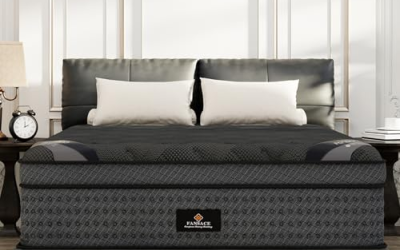
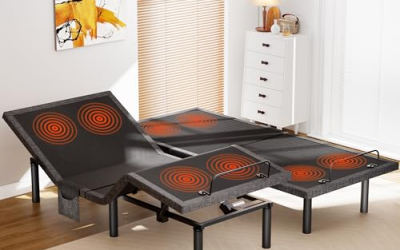
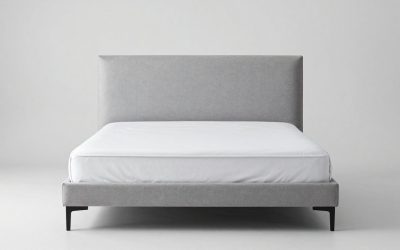
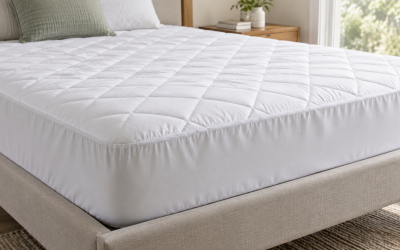
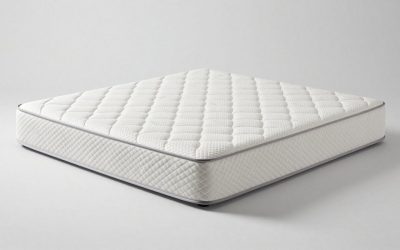
Every foam, hybrid, and latex mattress sold today ships with the same instruction: put it on a firm, flat, well-ventilated base with no gaps wider than about 3 inches. Two kinds of bed frame meet that requirement, and they do it differently. A platform bed gives the mattress a solid or near-solid deck, often with drawers or a box-like frame underneath. A slatted frame gives it a series of wood or metal slats running side to side, with air moving freely between them. Both hold the mattress up. The decision a buyer faces is about airflow versus uniformity, storage versus simplicity, and how much of the $60-$400 budget should go to the frame itself versus an add-on support board.
Quick Verdict
For most people with a foam or hybrid mattress, a slatted frame with slats spaced 2.5-3 inches apart and a center support rail is the better everyday choice: it breathes, it costs less, and it is easy to move. Choose a solid-deck platform bed if you need under-bed storage, you have an older innerspring that sags between slats, or your bedroom is very dry and mold is not a concern. If you already own a frame with wide or thin slats, a bunkie board for $80-$90 turns it into a platform-style base without replacing anything.
Our top picks


As an Amazon Associate we earn from qualifying purchases at no extra cost to you.
Side by Side
| Factor | Platform bed (solid or near-solid deck) | Slatted bed frame |
|---|---|---|
| Mattress support | Uniform, no gaps; best for thin or soft mattresses | Even if slats are 3 inches apart or less; sag risk with wide gaps |
| Airflow under mattress | Low; foam can trap moisture on a solid deck | High; slats leave 30-50% of the surface open |
| Durability | 10-20 years; solid wood or steel deck rarely fails | 7-15 years; individual slats can crack but are cheap to replace |
| Price range (queen) | $150-$500 wood; $200-$800 with drawers | $60-$120 metal; $130-$300 wood |
| Maintenance | Vacuum deck twice a year; check for moisture under foam | Tighten slat screws yearly; check center leg on carpet |
| Weight (queen) | 80-150 lb; heavier with storage | 35-70 lb metal; 60-100 lb wood |
| Space needed | Same footprint; drawers need 18-24 inches of side clearance to open | Same footprint; 10-14 inches of under-bed height for bins |
| Look | Low, boxy, modern or Japanese-inspired | Open, airy, works with most styles |
| Resale | Moderate; heavy to move, storage models sell well | Low for metal, moderate for solid wood |
| Best for | Storage needs, low-profile look, older innerspring mattresses | Foam and hybrid mattresses, humid climates, renters |
Where Platform Bed Wins
A platform bed wins on uniform support and on what fits underneath. A solid deck presents one continuous surface, so a soft memory foam mattress or a thin 8-inch mattress cannot dip between supports or develop ridges. That is the reason mattress makers approve solid platforms alongside slats: there is nothing to space incorrectly. Older innerspring mattresses without a rigid border benefit most, since coils near the edge can push down into slat gaps over time.
Storage is the second win. A platform with drawers or a high frame like the NEW JETO 14-inch metal queen frame at $59.99 converts the roughly 10-13 inches under a mattress into usable space: four under-bed bins at 6 x 16 x 24 inches each swallow off-season bedding or a second set of pillows. In a bedroom under 120 square feet, that can replace a dresser.
Platforms also eliminate noise. Slats shift in their pockets and creak as the wood dries; a screwed-down deck or a bunkie board sitting on a metal frame does not. And a low platform, typically 10-14 inches to the top of the deck, gives a modern room the grounded look that a tall slatted frame cannot match.
Where Slatted Bed Frame Mattress Support Wins
Slats win on airflow, and airflow is what keeps a foam mattress from growing mold from underneath. Body heat pushes moisture down through the foam every night; a slatted deck lets it evaporate, while a solid deck in a humid room can trap it. Slats spaced 2.5-3 inches on a frame like the Mellow Naturalista 12-inch solid pine platform bed at $149.99 leave enough open surface for that moisture to clear while still meeting the 3-inch maximum most mattress warranties specify.
Slatted frames also win on price and portability. A metal queen frame with 14-18 steel slats weighs 35-70 lb, breaks down into a box small enough to fit in a compact car, and assembles with a single wrench in 20-40 minutes. Wood slat frames cost more but can still be carried up a staircase by one person in pieces, which no 120-lb storage platform can claim.
Repairability is the third advantage. If a slat cracks, a replacement 1 x 3 pine board costs a few dollars. If a solid platform deck warps or a drawer runner breaks, you are replacing a major component. Slats also let you tune the feel slightly: adding a bunkie board firms up a bed that feels too soft, while removing it restores bounce, so a slatted frame is the more adaptable long-term base.
Cost Over 5 Years
Assume a queen bed in a home with normal humidity.
| Cost item | Platform bed | Slatted frame |
|---|---|---|
| Frame purchase | $150-$500 | $60-$300 |
| Support board | Usually not needed ($0) | Optional bunkie board $80-$90 if slats exceed 3 inches apart |
| Assembly | 60-120 minutes DIY, or $80-$150 for a service | 20-60 minutes DIY |
| Repairs | Drawer hardware $10-$30 if applicable | Replacement slats $5-$20; center leg glide $5 |
| Moving cost impact | Adds one heavy item; $50-$100 in mover time | Negligible |
| Approximate 5-year total | $160-$680 | $65-$410 |
The slatted frame is cheaper in nearly every scenario, and adding a queen bunkie board like the BedBro 10 mm board at $89.98 still leaves it under most platform beds. The exception is storage: if a platform with drawers lets you skip a $200-$400 dresser, the platform comes out ahead on total bedroom cost.
Which One for Your Home
Small Apartment
Platform bed with storage if you are short on closet space; slatted metal frame if you are short on cash or expect to move within two years. In a studio, the four drawers or the 12-14 inches of under-bed clearance a storage platform provides are often the only place for luggage and linens. If you go with slats, choose a 14-inch-high frame so standard 6-inch bins slide underneath.
Family With Kids or Pets
Slatted frame with a bunkie board. Kids jumping on a bed load individual slats unevenly, and a 10 mm board spreads that force across the whole deck while keeping some airflow. A full-size board like the DFAN 54 x 75 inch double-sided board at $79.99 does the same job on a child’s bed. Pets shedding under the bed favor a frame you can vacuum beneath, which rules out a drawer platform that sits flush to the floor.
Rental
Slatted metal frame. It weighs under 70 lb, disassembles to a flat box, and does not scuff floors the way a 120-lb platform dragged across a room will. Use felt pads under the legs and, if the unit has carpet, a small plywood square under the center leg so it does not sink. Everything fits in a car at lease end.
Long-Term Home
Solid wood platform or a heavy-duty wood slatted frame, depending on whether you want storage. In a home you plan to keep through 2026 and well beyond, spend $250-$500 on a solid hardwood frame with slats of at least 0.75 inch thickness and a center rail with two or more legs. It will outlast two or three mattresses, and you can add or remove a bunkie board as your mattress changes.
FAQ
How far apart should bed slats be for a foam mattress?
No more than 3 inches, and 2.5 inches is safer for memory foam. Wider gaps let the foam sag into the space, which voids many warranties and creates ridges you can feel. If your frame has gaps of 4-6 inches, add a bunkie board or lay 0.75-inch plywood cut to size across the slats.
Can a memory foam mattress go directly on a solid platform?
Yes, and most manufacturers approve it. The trade-off is airflow: lift the mattress every few months to check for moisture on the deck, especially in humid climates or basement bedrooms. A breathable mattress protector and a small gap between the bed and the wall help.
Do I need a box spring with either frame?
No. Both a platform bed and a properly slatted frame replace the box spring entirely. Adding one raises the bed 8-9 inches and offers no benefit to a foam or hybrid mattress. Only very old innerspring mattresses designed for a box spring pair well with one.
What is a bunkie board and when do I need one?
A bunkie board is a thin, rigid panel, typically 1-3 inches thick in wood or 10 mm in reinforced fabric-covered steel or composite, that sits between the frame and the mattress. You need one when slats are too far apart, when a metal frame’s slats are thin and flex, or when you want a slatted frame to feel like a solid platform. It adds about 1 inch to bed height and $80-$120 to cost.