Key takeaways
- Exceptional lifespan. Natural latex resists body impressions far better than polyurethane foam; 15 to 25 years of use is realistic, and warranties of 20 to 25 years are common.
- Responsive support. The foam springs back instantly, which makes changing positions easy and keeps the spine aligned without a stuck-in-the-bed feeling.
- Sleeps cool. Open cells and ventilation holes move heat away far better than memory foam, and there is no gel required to do it.
- Naturally resistant to dust mites and mold. Latex is inhospitable to mites and dries quickly, a real benefit for allergy sufferers.
- Low off-gassing. Certified natural latex has a faint sweet rubber smell for a few days rather than the chemical odor of new polyurethane.
- Repairable and adjustable. Many latex mattresses have zippered covers with individual layers; you can swap a single layer for $200 to $500 instead of replacing the whole bed.
- Quiet and motion-isolating. No coils to creak, and movement transfer is low despite the bounce.
What's inside
The Short Answer
Yes, on one condition: you plan to keep the mattress for at least 10 years. A natural latex mattress costs roughly two to three times what a comparable memory foam or hybrid does, $1,500 to $4,000 for a queen versus $600 to $1,500, but it also lasts two to three times as long, typically 15 to 25 years against 6 to 10 for foam. If you are settled in a home, know how you like to sleep, and are tired of replacing a sagging mattress every seven or eight years, the math works out in latex’s favor and the sleeping experience is better along the way. If you move often, expect your needs to change, or simply cannot spend more than $1,000 right now, buy something cheaper and revisit latex later, possibly by way of a topper.
What You Actually Get
Natural latex is foam made from the sap of rubber trees, processed by either the Dunlop method, which produces a denser, firmer foam, or the Talalay method, which produces a lighter, more uniform, slightly bouncier foam. A full latex mattress is usually built from two to four layers of 2- to 3-inch latex of different firmnesses, totaling 8 to 12 inches, wrapped in an organic cotton cover often quilted with wool as a natural fire barrier. A queen weighs 100 to 160 pounds, which is one of the first surprises for new owners. Firmness is expressed in ILD numbers, roughly 20 to 24 for soft, 28 to 32 for medium, and 36 to 44 for firm. Certifications matter in this category because “latex” on a label can mean a blend with synthetic rubber; look for GOLS for organic latex and GOTS for the cotton and wool cover. The feel is distinct from memory foam. Latex pushes back instantly, so you sleep on it rather than in it, with a buoyant, springy support that contours to the hips and shoulders without the slow sinking sensation. It also sleeps noticeably cooler because the open cell structure and pinhole ventilation let air move through. Expect prices in 2026 of roughly $1,500 to $2,500 for a solid queen from direct-to-consumer brands and $2,500 to $4,000 for premium or fully customizable models with swappable layers.
As an Amazon Associate we earn from qualifying purchases at no extra cost to you. Product prices and availability are accurate as of the date shown and are subject to change.

Pros
- Exceptional lifespan. Natural latex resists body impressions far better than polyurethane foam; 15 to 25 years of use is realistic, and warranties of 20 to 25 years are common.
- Responsive support. The foam springs back instantly, which makes changing positions easy and keeps the spine aligned without a stuck-in-the-bed feeling.
- Sleeps cool. Open cells and ventilation holes move heat away far better than memory foam, and there is no gel required to do it.
- Naturally resistant to dust mites and mold. Latex is inhospitable to mites and dries quickly, a real benefit for allergy sufferers.
- Low off-gassing. Certified natural latex has a faint sweet rubber smell for a few days rather than the chemical odor of new polyurethane.
- Repairable and adjustable. Many latex mattresses have zippered covers with individual layers; you can swap a single layer for $200 to $500 instead of replacing the whole bed.
- Quiet and motion-isolating. No coils to creak, and movement transfer is low despite the bounce.
Cons
- High upfront cost. $1,500 to $4,000 is a significant outlay, and financing adds interest that erodes the long-term savings.
- Very heavy. A 130-pound queen is a two-person job to move, rotate, or flip, and it needs a foundation rated for the weight.
- Distinct feel that not everyone likes. The springy, buoyant surface can feel too bouncy for people who love the deep hug of memory foam.
- Needs a proper base. Slats must be no more than 3 inches apart, or the latex will sag between them; a box spring designed for innersprings is a poor match.
- Latex allergy risk. Rare with modern washed latex and a cover between you and the foam, but people with a known latex allergy should be cautious.
- Edge support is softer. All-foam latex edges compress more than a hybrid with a reinforced coil perimeter, which matters if you sit on the bed edge often.
- Confusing labeling. “Natural” and “organic” are used loosely; only GOLS certification guarantees a high natural content.
Who Should Buy It
Homeowners and long-term renters who expect to keep the same mattress for a decade or more. Hot sleepers who have given up on memory foam. Back and side sleepers who want pressure relief with quick response rather than deep sink. Allergy sufferers looking for a mattress that resists dust mites and mold without chemical treatments. Couples with different firmness preferences who want a split-layer or customizable design. Anyone who has replaced two or three mid-priced mattresses in the last 15 years and is ready to buy once.
Who Should Skip It
Anyone whose budget tops out around $1,000; a good hybrid at that price will serve well and the latex decision can wait. People who love the slow-melt feel of memory foam and dislike bounce. Frequent movers, since a 130-pound mattress is a burden every time. Those sleeping on an older box spring or a frame with widely spaced slats who do not want to replace the foundation. Anyone with a diagnosed latex allergy. Stomach sleepers over about 250 pounds who need very firm, reinforced edge support, who are often better served by a firm hybrid.
Cheaper Alternatives
| Option | Cost | Trade-off |
|---|---|---|
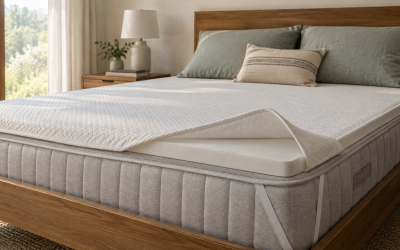
| Natural latex topper, 2 to 3 inches, on your existing mattress | $200 to $350 queen | Gives the latex feel and cooling for a fraction of the price, but cannot fix a sagging mattress underneath; the Pure Green Natural Latex Mattress Topper in 3-inch Soft (GOLS certified) is about $269 and the 2-inch Firm version about $249 |
| Latex hybrid (latex comfort layer over pocketed coils) | $1,000 to $1,800 queen | Much of the latex feel with better edge support and lower weight; comfort layer is thinner and lifespan closer to 10 to 12 years |
| Blended or synthetic latex mattress | $700 to $1,400 queen | Similar bounce and cooling at first; less durable than natural latex and lacks organic certifications |
| High-density memory foam mattress | $600 to $1,200 queen | Deeper contouring and lower price; sleeps warmer and typically softens noticeably by year 6 to 8 |
| Quality innerspring hybrid | $800 to $1,500 queen | Familiar feel, strong edges, good airflow; coils and foam comfort layers wear out in 7 to 10 years |
| Floor-model or last-season latex clearance | $900 to $1,800 queen | Same product at 30 to 50 percent off; limited selection and sometimes shorter warranty |
FAQ
How long does a natural latex mattress really last?
Fifteen to twenty years is typical for a well-made Dunlop or Talalay mattress that is rotated a few times a year and kept on a supportive base. Many owners report 20-plus years. Compare that to 6 to 10 years for most memory foam and hybrid mattresses before sagging becomes noticeable.
Is Dunlop or Talalay better?
Neither is better across the board. Dunlop is denser, firmer, and slightly less expensive, and it makes an excellent support core. Talalay is softer, more consistent, and more breathable, and it shines as a comfort layer. Many mattresses use Dunlop on the bottom and Talalay on top to get both.
Does natural latex sleep hot?
No, and it is one of the coolest foam options available. The open cell structure and molded ventilation holes move air, and latex does not trap heat the way closed-cell polyurethane does. Pairing it with a wool-quilted cover and breathable sheets keeps it cooler still.
Can I try latex before spending thousands?
Yes. A 2- or 3-inch natural latex topper on your current mattress costs $200 to $350 and gives an accurate sense of the feel, bounce, and cooling. If you love it, you know a full latex mattress is a safe purchase. If you do not, you have lost a few hundred dollars instead of a few thousand.