Key takeaways
- Compare built-in wine coolers for dining room wine storage, with dual-zone options, bottle counts, dimensions and placement tips for daily serving at home.
Disclosure: As an Amazon Associate, we may earn from qualifying purchases made through links on this page, at no additional cost to you.
A dining room wine cooler solves a specific problem: bottles kept in a kitchen refrigerator are too cold for reds, too jostled by daily food storage, and too far from the table when guests are seated. A built-in unit slides into a sideboard run, a dining room cabinet bay, or an undercounter opening near the serving area, so reds, whites, and sparkling wines rest at steady temperatures steps from where they are poured. For dining room use, front ventilation matters most, because the unit exhausts heat forward rather than into enclosed cabinetry. Dual-zone models let you hold reds in one section and whites in another, while wooden racks, low-vibration compressors, and tinted glass doors protect corks and labels. Measure your opening width, depth, and height first, confirm door swing clearance beside dining chairs, and match bottle capacity to how many bottles you realistically keep at home rather than the largest number a listing mentions.
Quick Picks### Kalamera 24-Inch Wine Cooler KRC-150DZB (ASIN: B0B9K9CSH4)
The Kalamera KRC-150DZB is a 24-inch wine cooler listed for built-in or freestanding installation, with a stated capacity of 37 bottles and two temperature zones for separating reds from whites. Manufacturer specifications list dimensions of 22.4 by 23.4 by 33 inches, five racks, automatic defrost, and a stainless steel reversible glass door. The reversible door is genuinely useful in dining rooms, where hinge side often depends on which side the serving surface sits.
Highlights
- Dual-zone layout dedicated entirely to wine bottles
- Reversible stainless steel glass door for flexible hinge placement
- Listed for built-in or freestanding installation
- Automatic defrost reduces routine upkeep
Considerations
- Capacity assumes standard Bordeaux bottles; wider bottles reduce the count
- Freestanding placement needs side clearance described in the manual
- Confirm the 33-inch height against your counter or cabinet opening
Best for: Homes that want a dedicated wine-only column in the dining room and regularly serve both reds and whites at the same meal.
FoMup 24-Inch Wine and Beverage Refrigerator (ASIN: B0CBWXS3N4)

The FoMup 24-inch model combines wine and beverage storage in one dual-zone cabinet, listed at 18 bottles plus 88 cans across two doors, with a 4.2 cubic foot capacity. The manufacturer lists a left zone range of 35 to 50 degrees Fahrenheit and a right zone range of 41 to 64 degrees, front ventilation, touch control, a door lock, and an activated carbon system intended to reduce odors inside the cabinet. Installation is listed as built-in undercounter or freestanding.
Highlights
- Separate doors for wine and beverage zones
- Front ventilation supports undercounter built-in placement
- Touch controls with a door lock included
- Carbon system aimed at limiting interior odors
Considerations
- Wine capacity is modest if your collection grows beyond the stated bottle count
- Shelf layout must be checked for taller bottles and cans
- Two doors need clear swing space in front of the unit
Best for: Hosts whose dining room serving routinely mixes wine with chilled soft drinks, mixers, and sparkling water for guests.
EUHOMY 24-Inch Wine and Beverage Refrigerator (ASIN: B0CL7G9XSF)

The EUHOMY 24-inch dual-zone refrigerator is listed at 21 bottles and 88 cans, with seven wooden shelves and three wire shelves that can be removed to adjust spacing. The manufacturer lists a beverage zone of 35 to 50 degrees Fahrenheit and a wine zone of 41 to 64 degrees, a compressor described at 40 decibels, a low-emissivity glass door, blue LED lighting, and a temperature memory function that restores the prior setting after a power interruption. Front vents support built-in or freestanding placement.
Highlights
- Wooden shelves for bottle storage plus removable wire shelves
- Temperature memory restores settings after power returns
- Low-emissivity glass door helps limit heat transfer
- Front venting for built-in or standalone placement
Considerations
- Mixed layout means wine space is shared with beverage storage
- LED lighting is blue only, which may not suit every dining scheme
- Shelf removal is needed for oversized bottles
Best for: Dining rooms that host larger gatherings and need both wine and canned drinks chilled in a single built-in bay.
Velieta 24-Inch Wine and Beverage Refrigerator (ASIN: B09H4QC6R9)
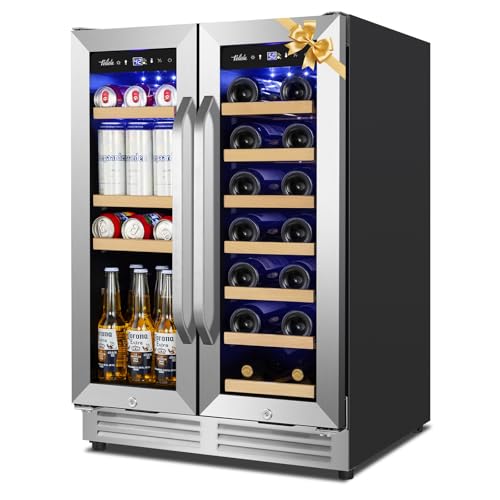
The Velieta 24-inch dual-zone model is listed at 20 bottles and 90 cans, with a beverage zone of 35 to 50 degrees Fahrenheit and a wine zone of 41 to 64 degrees, removable shelves, and a safety lock. Manufacturer details list dimensions of 23.42 by 22.63 by 34.25 inches, a front vent design for built-in undercounter or freestanding installation, a carbon purification system, and double-layer glass intended to limit light exposure for stored wine.
Highlights
- Removable shelves adapt to taller bottles or cans
- Safety lock included for shared household spaces
- Double-layer glass door for light protection
- Front vent design for undercounter installation
Considerations
- Taller body needs careful height measurement before ordering
- Shared interior limits dedicated wine capacity
- Glass door shows interior contents, so arrangement stays visible
Best for: Smaller dining rooms that need one built-in unit to cover both wine service and everyday guest beverages.
How to Choose
Start with the opening, not the bottle count. Measure width, height, and depth of the cabinet bay, then compare against the manufacturer dimensions and the ventilation method. Front-venting models are designed for enclosed installation, while units that vent at the rear need open space behind them and do not belong inside a closed dining room cabinet. Leave the door swing fully clear of chair backs and sideboard handles, and confirm the hinge side works with your serving flow, choosing a reversible door when the layout is tight.
Decide next whether you need wine-only or mixed storage. A wine-only dual-zone cooler devotes every rack to bottles and suits households that pour wine at most dinners. A split wine and beverage model serves gatherings better, holding mixers and soft drinks beside bottles, but its wine capacity is always the smaller number in the listing. In both cases, treat headline capacity as a maximum based on standard Bordeaux bottles, and expect wider sparkling, Burgundy, or Riesling bottles to reduce the real count.
Setup and Placement Tips
Place the cooler on the serving side of the dining room, close to where glasses are stored, so bottles travel the shortest distance during a meal. Keep the unit out of direct afternoon sun where possible, since a glass door in full sun works the compressor harder and exposes labels to light. Level the feet before sliding the unit into the bay, because a slight tilt can affect door sealing and shelf alignment.
FAQ
Do built-in wine coolers need a dedicated cabinet opening?
Most 24-inch models are sized for a standard undercounter bay and vent at the front, so they can slide into an existing opening. Measure the exact width, height, and depth, and compare with the manufacturer dimensions for the specific model, including door thickness and handle projection.
What temperatures suit dining room wine storage?
A common approach is a cooler zone for whites and sparkling wines and a warmer zone for reds, within the ranges each manufacturer lists. Dual-zone models let both settings run at once, so a bottle is ready to pour without last-minute chilling or warming at the table.
How many bottles should a dining room cooler hold?
Count the bottles you keep at home across a typical month, including spares for guests, rather than a special occasion maximum. Remember that stated capacities assume standard Bordeaux bottles, and wider bottles reduce the count, so a modest margin above your usual stock is sensible.
Final Verdict
For most dining rooms, the Kalamera KRC-150DZB is the clearest fit when wine is the whole point, with dual zones devoted to bottles and a reversible door that adapts to the room. Households that serve mixed drinks alongside wine will get more daily use from the FoMup or EUHOMY split layouts, while the Velieta suits a tighter bay that still needs a lock and flexible shelves. Measure the opening first, then choose by how you actually serve.
More from Amazon
Programs that pair well with the guide above. Offers and eligibility are set by Amazon and may change.
Collect the home and kitchen items you want in one registry that guests can shop from.
Create a wedding registrySet up recurring deliveries of everyday items on eligible products. Terms and savings are set by Amazon.
Explore Subscribe & SaveFree shipping on eligible items, Prime Video and more. Eligible new members can start with a free trial.
Start a Prime free trialAudiobooks and podcasts to listen to on the go. Eligible new members can start with a free trial.
Try Audible freeAs an Amazon Associate we earn from qualifying purchases.