Mattresses and upholstered sofas are the two hardest-working surfaces in any home, and they’re also the two we clean least. Every night, a sleeping adult sheds skin cells and releases roughly half a pint of moisture into the layers beneath them — ideal conditions for dust mite colonies, whose droppings are among the most common indoor allergy triggers. A standard upright vacuum with a crevice tool skims the surface, but it can’t agitate debris out of a quilted mattress top or a woven sofa cushion, and it certainly can’t address the humidity that keeps mites comfortable. That’s the gap purpose-built bed vacuums are designed to close.
This guide looks at the current crop of corded mattress and upholstery vacuums through a sleep-hygiene lens rather than a spec-sheet one. I’ve focused on the three mechanisms that actually matter — mechanical agitation, sealed filtration, and heat or UV-C treatment — and flagged where marketing claims outrun the physics. Below you’ll find the models worth considering in 2026, a buying framework you can apply to any unit, and answers to the questions readers ask most often about how frequently this kind of cleaning is really needed.
Our top picks


As an Amazon Associate we earn from qualifying purchases at no extra cost to you.
🛒 Best Price Today on Amazon
Prime members get fast, free shipping on everything above, plus member-only deals. New members get a 30-day free trial — cancel anytime.
How to Choose a Vacuum Cleaner For Sofa And Bed (2026)
- Agitation before suction: Numbers like 16kPa or 20kPa only describe pull at the nozzle. What lifts embedded debris out of fabric is high-frequency tapping (30,000+ RPM on the better units) or motorised roller brushes that loosen material so the airflow can carry it away. Prioritise a model that has one of these, not raw suction alone.
- A genuinely sealed HEPA system: Capturing mite allergen is pointless if it leaks past the filter housing and back into your bedroom air. Look for a full HEPA cartridge with a washable pre-filter, and check that the dust cup latches flush — cheap gaskets are the usual failure point.
- Heat and UV-C, understood correctly: Warm airflow around 140–149°F helps dry out surface moisture that mites depend on, and 253.7nm UV-C is the germicidal wavelength. Both work slowly and only where they make contact, so treat them as useful adjuncts to slow, overlapping passes — not instant sterilisation.
- Corded power, deliberately: Nearly every serious mattress vacuum is corded, and that’s the right trade-off. Sustained 500–650W output keeps tapping frequency and airflow constant through a full bed, whereas cordless units fade partway. A 16-foot cable is the practical minimum for reaching both sides of a king.
- Head geometry and weight: You’ll be pushing this across a soft, uneven surface. A wide double- or triple-cup head covers a mattress faster, but a narrower profile handles sofa seams, headboards and crib mattresses better. Anything above roughly four pounds becomes tiring on vertical upholstery.
The Best Vacuum Cleaner For Sofa And Bed (2026)s Reviewed
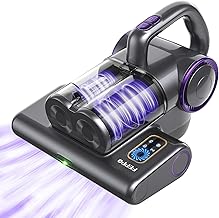
FEPPO Mattress Vacuum Cleaner (16Kpa, 500W)
FEPPO combines every mechanism worth having — ultrasonic agitation, 140°F heated airflow, 253.7nm UV-C and HEPA filtration — into a well-balanced handheld that’s easy to steer one-handed across a sofa back. It’s the most sensible all-rounder here for a household without pets, and the filter is straightforward to rinse and reseat.
CFBF Double-Cup Bed Vacuum (16Kpa, 500W)
The twin-cup head is the draw: it separates coarse debris from fines, which keeps airflow from choking halfway through a mattress and means fewer mid-session emptyings. The 16.4-foot cord comfortably reaches around a king bed from a single outlet.
Triple-Cup Bed Vacuum with Pet Hair Brush (20kPa, 650W)
At 20kPa and 650W this is the strongest unit on the list, and the dedicated pet-hair brush earns its place on sofas where fur has worked itself into the weave. The trade-off is a bulkier head — excellent on flat mattresses, less nimble in cushion crevices.
Dual Roller Brush Mattress Vacuum (18kPa, 650W)
Two counter-rotating brushes give this model the most aggressive mechanical agitation in the group, which is exactly what heavily used pillow-top mattresses and tightly woven upholstery need. Pair that with 145°F heat and sealed HEPA filtration and it’s the choice for allergy-focused deep cleaning.
Teant MV-Blue Mattress Vacuum (16 kPa)
Teant’s 33,000 RPM tapping and two-speed control make it the most adaptable unit here — full power for the mattress, a gentler setting for delicate sofa fabric or a crib. The anion output is a minor extra rather than a reason to buy, but the fundamentals are strong.
Frequently Asked Questions
How often should I vacuum my mattress?
Every two to four weeks is a realistic cadence for most households, moving to fortnightly if you have diagnosed dust mite allergies, pets on the bed, or live somewhere humid. Strip the bedding first and give each section three or four slow overlapping passes.
Does UV-C light actually kill dust mites?
Not reliably on its own. UV-C at 253.7nm inactivates bacteria and viruses on exposed surfaces with sufficient dwell time, but live mites shelter deep in the fibres where light doesn’t penetrate. The real benefit comes from physically removing mites and their allergen-carrying waste, with UV-C and heat reducing surface microbial load as a bonus.
Can I use these on a leather or velvet sofa?
On leather, skip the roller brushes and use suction only with a soft attachment. Velvet and other delicate pile fabrics should be cleaned on the lowest speed setting, working with the nap direction — one reason two-speed models like the Teant are worth the small premium.
Will a mattress vacuum help with bed bugs?
It can remove some adults and eggs from seams and tufting, which is a helpful part of a wider strategy, but no handheld vacuum eliminates an infestation. If you suspect bed bugs, bring in professional treatment and use the vacuum only as supporting maintenance.
Final Thoughts
For most readers the FEPPO is the balanced pick — it covers every meaningful cleaning mechanism in a package that’s genuinely pleasant to use on both beds and sofas. Households dealing with pet hair and heavy allergen loads should step up to the Dual Roller Brush model for its superior agitation, while the Teant MV-Blue is the smart choice if you’re cleaning a mix of surfaces and want variable-speed control over delicate upholstery.