Key takeaways
- Seat height and cushioning: Aim for roughly 17–19 inches of seat height so your feet rest flat and your knees sit near hip level — that posture makes removing boots effortless rather than a balancing act. Padded seats are worth it if you sit daily; bare wood tops are fine if the bench is mostly decorative.
- Closed doors vs. open shelves: Doors hide mess and reduce visual noise, which is the real win for evening decompression. Open bamboo or slatted racks, however, let damp shoes dry and keep odor from concentrating — better for runners, hikers, and rainy climates.
- Honest capacity math: Manufacturers count children’s flats. Assume a listed 15-compartment unit holds eight to ten adult pairs, and that chunky sneakers or boots will halve any tier. Measure your largest pair before trusting a spec sheet.
- Weight rating and joinery: Anything you sit on nightly should be rated well above your body weight. Solid wood or rubberwood frames with 300–550 lb ratings will outlast particleboard, which tends to sag at the seat’s center after a year or two of use.
- Footprint and depth: Depth is the sneaky dimension. An 11.8-inch-deep bench keeps narrow hallways walkable; 13.8 inches and up gives a genuinely comfortable perch but can crowd a door swing. Sketch it on the floor with tape first.
What's inside
Most people think of sleep hygiene as something that happens in the bedroom, but as a sleep-wellness practitioner I spend a surprising amount of time talking to clients about their front doors. The first ninety seconds after you walk into your home set the tone for the rest of your evening. If those ninety seconds involve kicking shoes into a pile, stepping over them later, and carrying that low-grade irritation into dinner, you are quietly stacking arousal onto a nervous system that needs to be winding down. Visual clutter at the threshold keeps the brain in scanning mode, and scanning mode is the enemy of a smooth transition into rest.
A shoe storage bench is one of the cheapest structural fixes for this. It gives you a place to sit and physically shed the outside world, plus a closed home for footwear so your entryway reads as calm rather than unfinished. This guide covers what actually matters when choosing one — seat comfort, ventilation, footprint, weight rating, and whether hidden storage suits your habits — and reviews the models worth your money in 2026, from slim apartment-friendly racks to wide farmhouse cabinets.
As an Amazon Associate we earn from qualifying purchases.



How to Choose a Shoe Storage Bench (2026)
- Seat height and cushioning: Aim for roughly 17–19 inches of seat height so your feet rest flat and your knees sit near hip level — that posture makes removing boots effortless rather than a balancing act. Padded seats are worth it if you sit daily; bare wood tops are fine if the bench is mostly decorative.
- Closed doors vs. open shelves: Doors hide mess and reduce visual noise, which is the real win for evening decompression. Open bamboo or slatted racks, however, let damp shoes dry and keep odor from concentrating — better for runners, hikers, and rainy climates.
- Honest capacity math: Manufacturers count children’s flats. Assume a listed 15-compartment unit holds eight to ten adult pairs, and that chunky sneakers or boots will halve any tier. Measure your largest pair before trusting a spec sheet.
- Weight rating and joinery: Anything you sit on nightly should be rated well above your body weight. Solid wood or rubberwood frames with 300–550 lb ratings will outlast particleboard, which tends to sag at the seat’s center after a year or two of use.
- Footprint and depth: Depth is the sneaky dimension. An 11.8-inch-deep bench keeps narrow hallways walkable; 13.8 inches and up gives a genuinely comfortable perch but can crowd a door swing. Sketch it on the floor with tape first.
The Best Shoe Storage Benches of 2026, Reviewed
Homleke 4-Door Shoe Storage Bench
At 45.3 inches wide with a thickened padded cushion and 13.8 inches of depth, this is the most genuinely sit-on-able option here — the extra depth means you’re not perched on an edge while wrestling with laces. Four doors and an adjustable shelf keep everything out of sight, making it my default recommendation for anyone whose entryway doubles as a visual entry point to the living room.
VASAGLE CUSTOS Shoe Bench
Fifteen compartments in a 41.3-inch frame that’s only 11.8 inches deep, which makes it the smartest pick for apartments and tight hallways. The cloud white and dove gray palette is deliberately low-contrast — a small detail that matters, since high-contrast furniture near a doorway pulls the eye and keeps the brain alert.
Solid Wood Flip-Top Shoe Bench
A 550 lb weight capacity and real solid wood construction put this in a different durability class, and the flip-top compartment plus side hooks handle the small chaos — keys, leashes, dog treats — that usually ends up on a kitchen counter. At 31.5 inches wide it’s compact, so treat it as a one- or two-person landing zone rather than a family solution.
HOMSHO Farmhouse Shoe Storage Bench
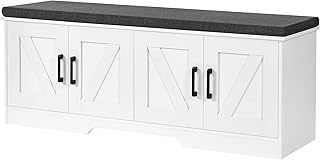
The widest hidden-storage option at 47.2 inches, with four barn doors, adjustable shelves, and a padded seat that comfortably takes two people. If your household regularly has more than eight pairs in circulation, this is the one that will actually absorb them instead of overflowing by week two.
Pipishell Bamboo Shoe Rack Bench
Three open bamboo tiers, a 300 lb rating, and excellent airflow make this the healthiest choice for shoes that come home damp — trapped moisture is what turns a closed cabinet into an odor problem. It’s also the most breathable-looking piece here, which suits balconies, mudrooms, and smaller-scale minimalist entryways.
Frequently Asked Questions
Does entryway clutter really affect sleep?
Not directly, but it affects the wind-down window. A tidy, functional threshold shortens the time between arriving home and feeling settled, and a longer calm period before bed correlates with faster sleep onset. Think of it as removing friction, not as a sleep aid.
Open shelves or closed doors for odor control?
Open shelves win on ventilation; closed doors win on appearance. If you choose doors, leave them ajar for an hour after wearing shoes, or drop in a small activated charcoal or cedar sachet and replace it seasonally.
How wide a bench do I need?
Roughly 30 inches serves one person, 40–45 inches serves a couple, and 47 inches or more suits families or households with heavy footwear rotation. Always leave at least 30 inches of clear walking space in front of it.
Should I anchor a shoe bench to the wall?
Tall cabinet-style units, yes — especially with children or pets in the home. Low benches under about 20 inches with a wide base are inherently stable, though checking hardware once a year is a reasonable habit.
Final Thoughts
For most homes, the Homleke 4-door bench offers the best balance of comfortable seating depth, concealed storage, and price. Larger households should size up to the HOMSHO farmhouse bench for its 47.2-inch span and adjustable shelving, while small apartments and damp climates are better served by the slim VASAGLE CUSTOS or the ventilated Pipishell bamboo rack. Any of the four will do the real job here: turning your doorway from a daily friction point into the first step of a calmer evening.