Key takeaways
- Match capacity to cubic feet, not guesswork: A 200g silica canister is sized for a pistol case or tool box; a 450g unit covers roughly 60 cubic feet, and rechargeable bricks like the E-500 are rated near 500 cubic feet each. Undersizing is the most common mistake, and it shows up as a saturated indicator within weeks.
- Decide between desiccant and electric before anything else: Silica gel needs no power and can’t leak, which makes it the safer choice inside a sealed cabinet. Electric warming rods and compressor units move more moisture but require a cord pass-through and a nearby outlet.
- Insist on a visible saturation indicator: Colour-changing beads or a window that shifts from orange to green take the guessing out of maintenance. Without one you’re relying on memory, which is how corrosion starts.
- Weigh noise against placement — especially in a bedroom: Anything running while you sleep should sit at or below a soft-conversation level, and any status light should be dimmable or amber rather than bright blue, which is the wavelength most likely to suppress melatonin.
- Check the renewal cycle and lifespan: Reusable desiccants are recharged in an oven or by plugging them in for a few hours, and quality units survive hundreds of cycles across a decade. Disposable tubs are cheaper up front and far more expensive over five years.
What's inside
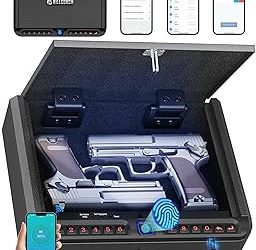
Damp air is one of the quietest saboteurs of a good night’s sleep. Most people trace their 3 a.m. wake-ups to stress or caffeine, when the real culprit is a bedroom sitting at 65% relative humidity — enough to slow the body’s overnight cooling process, keep dust mites thriving in the mattress, and leave the room smelling faintly of a basement. The same excess moisture that stiffens a wooden dresser drawer or spots the mirror on a vanity is also settling into your bedding, your closet, and the safe where you keep documents, heirloom jewelry, or firearms.
This guide looks at moisture control from both angles: the enclosed-space desiccants that protect valuables inside a safe or wardrobe, and the compact room units that pull water out of the air where you actually sleep. Below you’ll find selection criteria worth applying before you buy, short reviews of five standouts, and answers to the questions that come up most often once a unit is home and running.
As an Amazon Associate we earn from qualifying purchases.


🛒 Best Price Today on Amazon
Prime members get fast, free shipping on everything above, plus member-only deals. New members get a 30-day free trial — cancel anytime.
How to Choose a Safe Dehumidifier (2026)
- Match capacity to cubic feet, not guesswork: A 200g silica canister is sized for a pistol case or tool box; a 450g unit covers roughly 60 cubic feet, and rechargeable bricks like the E-500 are rated near 500 cubic feet each. Undersizing is the most common mistake, and it shows up as a saturated indicator within weeks.
- Decide between desiccant and electric before anything else: Silica gel needs no power and can’t leak, which makes it the safer choice inside a sealed cabinet. Electric warming rods and compressor units move more moisture but require a cord pass-through and a nearby outlet.
- Insist on a visible saturation indicator: Colour-changing beads or a window that shifts from orange to green take the guessing out of maintenance. Without one you’re relying on memory, which is how corrosion starts.
- Weigh noise against placement — especially in a bedroom: Anything running while you sleep should sit at or below a soft-conversation level, and any status light should be dimmable or amber rather than bright blue, which is the wavelength most likely to suppress melatonin.
- Check the renewal cycle and lifespan: Reusable desiccants are recharged in an oven or by plugging them in for a few hours, and quality units survive hundreds of cycles across a decade. Disposable tubs are cheaper up front and far more expensive over five years.
The Best Safe Dehumidifiers (2026) Reviewed
XL 450g Reusable Silica Gel Canister
The most capable passive option here, with enough silica to condition roughly 60 cubic feet and a clear indicator that tells you exactly when to recharge it. It’s the one I’d put in a full-height safe or a deep cedar wardrobe where clothing and leather are at stake.
Eva-Dry E-500 Renewable Dehumidifier, 2-Pack
Cordless in use, plug-in to renew, and rated for around 500 cubic feet apiece — the two-pack lets you protect a safe and a bedroom closet without buying twice. Build quality is why these have stayed the reference point for renewable desiccants for years.
Eva-Dry E-333 Wireless Mini
Palm-sized, entirely silent, and ideal for a nightstand drawer, jewellery box, or handgun case. Treat it as a spot solution rather than a room fix, and renew it every four to six weeks in humid climates.
Electric Gun Safe Dehumidifier with 360° Circulation
A low-wattage warming unit with a built-in fan, which is the meaningful upgrade over a plain rod — moving air prevents the cold pockets where condensation actually forms. Best for a safe you can route a cord to and leave powered continuously.
95oz Quiet Room Dehumidifier, 1,000 sq ft
This is the sleep-relevant pick: a genuinely quiet compressor unit with auto shut-off, a nearly three-litre tank, and an ambient light you can set to a warm tone or switch off entirely. Run it for a few hours before bed to bring a bedroom into the 40–50% range, and you’ll notice the difference in how easily you settle.
Frequently Asked Questions
What humidity level should a bedroom hold?
Aim for 40–50%. Below 30% you get dry airways and static; above 55% dust mites and mould flourish, and the body struggles to shed heat efficiently during the night.
How often do silica canisters need recharging?
Typically every three to eight weeks, depending on climate and how well the space is sealed. Follow the indicator rather than the calendar.
Are electric units safe to leave in a closed safe?
Purpose-built low-wattage rods and fan units are designed for it, but only use products rated for enclosed storage, keep them clear of fabric and paper, and check the cord seal periodically.
Can one dehumidifier handle a whole floor?
Rarely. Air doesn’t circulate freely between rooms, so a 1,000 sq ft rating assumes an open layout. Doors and hallways mean you’ll want a second unit or a desiccant in each closed space.
Final Thoughts
For most homes, the sensible combination is the Eva-Dry E-500 two-pack for safes and closets, the 450g XL canister where you need serious passive capacity, and the 95oz quiet room unit in the bedroom itself. Get the air right and everything downstream — your furniture, your bedding, and your sleep — holds up better for it.