Key takeaways
- Reach, not height: Add roughly four feet to the top standing step to estimate your working reach. A four-step model handles most 8-foot ceilings; a six-step is what you want for 9- to 12-foot ceilings, stairwell fixtures, or high storage lofts.
- Tread depth and texture: Wide, deep, non-skid pedals let you stand flat-footed rather than balancing on the ball of your foot. This matters enormously for stability, and it’s the single feature most worth paying for.
- Load rating with margin: Don’t buy to your body weight — buy well above it, because you’ll be carrying boxes, paint, or a bulky mattress topper. A 330 lb rating is a sensible floor; 800 lb ratings buy you noticeable rigidity underfoot.
- Locking mechanism: A positive safety lock or spreader bar that clicks audibly into place is non-negotiable. If you can fold the ladder without deliberately releasing something, it can fold while you’re on it.
- Where it will live: Measure your storage gap before you buy. A ladder that ends up in the garage instead of the hall closet is a ladder you won’t use, and that defeats the entire purpose.
What's inside
Most household injuries don’t happen during dramatic projects. They happen at 10 p.m., when someone decides the spare duvet on the top closet shelf can be reached from the arm of a chair. As someone who spends most of my working life talking to people about rest, recovery, and the physical environment of the home, I’ve come to see the humble step ladder as a genuine wellness item. Seasonal bedding, blackout curtain rods, smoke alarm batteries, the burnt-out bulb in the bedroom fixture that’s been dimming your evenings for a month — all of it lives above shoulder height, and all of it gets postponed until someone improvises. Improvising is where wrists get sprained and hips get broken.
This guide covers the ladders I’d actually recommend for ordinary domestic use in 2026: four- to six-step models built for kitchens, closets, laundry rooms, and bedrooms, plus one multi-position option for people who also need to reach a gutter. I’ve weighted stability, tread width, storage footprint, and how the thing behaves when you’re tired and only half paying attention — because that’s when most of us climb.
As an Amazon Associate we earn from qualifying purchases.




🛒 Best Price Today on Amazon
Prime members get fast, free shipping on everything above, plus member-only deals. New members get a 30-day free trial — cancel anytime.
How to Choose a Ladder For Home Use (2026)
- Reach, not height: Add roughly four feet to the top standing step to estimate your working reach. A four-step model handles most 8-foot ceilings; a six-step is what you want for 9- to 12-foot ceilings, stairwell fixtures, or high storage lofts.
- Tread depth and texture: Wide, deep, non-skid pedals let you stand flat-footed rather than balancing on the ball of your foot. This matters enormously for stability, and it’s the single feature most worth paying for.
- Load rating with margin: Don’t buy to your body weight — buy well above it, because you’ll be carrying boxes, paint, or a bulky mattress topper. A 330 lb rating is a sensible floor; 800 lb ratings buy you noticeable rigidity underfoot.
- Locking mechanism: A positive safety lock or spreader bar that clicks audibly into place is non-negotiable. If you can fold the ladder without deliberately releasing something, it can fold while you’re on it.
- Where it will live: Measure your storage gap before you buy. A ladder that ends up in the garage instead of the hall closet is a ladder you won’t use, and that defeats the entire purpose.
The Best Ladder For Home Use (2026)s Reviewed
KINGRACK 4 Step Folding Ladder
The 800 lb capacity is the headline, and it translates into a reassuring absence of flex when you shift your weight — the quality that separates a ladder you trust from one you tolerate. The full handrail and safety lock make it my default recommendation for older adults or anyone who wants something to hold while reaching overhead.
5-Step Folding Ladder, Heavy-Duty with Anti-Slip Wide Steps
Five steps hits a sweet spot for standard homes: enough reach for ceiling fixtures and top-shelf storage without the storage penalty of a taller frame. The wide anti-slip treads are generous enough to stand comfortably on while you work with both hands, which is exactly what you want when wrestling a curtain rod into brackets.
HBTower 4 Step Ladder with Wide Anti-Slip Pedal
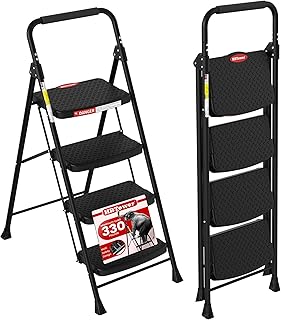
A no-drama steel four-step that folds slim and sets up in seconds — the sort of ladder that actually gets used because it isn’t a chore to retrieve. Sensible pick for kitchens, pantries, and closet reorganizations.
6 Step Ladder, 12 Feet High Ceiling, Lightweight Aluminum
If you have vaulted ceilings, a stairwell fixture, or a high storage loft, this is the practical choice: real reach in an aluminum frame light enough to carry one-handed between rooms. The handgrip at the top is a small detail that pays off on the last two steps.
LANBITOU A-Frame 4 Step Multi-Position Ladder
The most versatile option here, converting between A-frame, extension, and stair configurations for indoor and outdoor jobs alike. Choose it if one ladder has to cover both the bedroom light fixture and the gutters; skip it if you only ever need a stool.
Frequently Asked Questions
How tall a ladder do I need for an 8-foot ceiling?
A four-step ladder is generally sufficient. Standing on the third or fourth step puts your hands comfortably at ceiling level for bulbs, smoke alarms, and vent covers without overreaching.
Is steel or aluminum better for home use?
Steel feels more planted and usually costs less; aluminum is far easier to carry upstairs and won’t corrode in a damp garage. For taller ladders, the weight savings of aluminum matter more than you’d expect.
Can I safely stand on the very top step?
Only if the manufacturer designates it a standing platform. On most step ladders the top cap is not a step, and using it removes the handhold that keeps you balanced.
How should I store a folding ladder?
Flat against a wall in a closet, utility room, or behind a door — somewhere you pass daily. Convenience is a safety feature, since an inaccessible ladder is what leads people to climb furniture instead.
Final Thoughts
For most homes, the KINGRACK 4 Step Folding Ladder is the one I’d buy first — exceptionally rigid, easy to store, and equipped with the handrail that makes overhead work feel controlled rather than precarious. If your ceilings run high, step up to the 6 Step Aluminum Ladder for genuine 12-foot reach at a manageable weight, and if a single ladder has to serve both indoors and out, the LANBITOU multi-position model earns its keep. Whichever you choose, keep it somewhere you’ll actually reach for it: the safest ladder is the one that’s closer than the nearest chair.