Key takeaways
- An infrared thermometer is one of those tools that earns its drawer space the first time a pizza stone.
An infrared thermometer is one of those tools that earns its drawer space the first time a pizza stone, an oven rack or a supply vent needs a quick surface reading from across the room. With a ceiling of under 150 dollars, you are well above the entry point for this category, which means the useful question is not how to find one that works but how to match its range, laser aiming and extra features to the jobs you actually have.
This guide is written for home cooks, DIY owners and anyone who wants a non-contact surface reading around the house, garage or kitchen. It relies on the specs in the listings, and since a few titles are cut off, confirm the details on the product page. One thing to know upfront: the forehead thermometers that show up in this search are designed for people, not for cooking or HVAC, so they are left out of the reviews below. In 2026 the practical difference between models comes down to range, aiming and whether you want a built-in probe.
Quick Picks
Our top picks




As an Amazon Associate we earn from qualifying purchases at no extra cost to you.
| Product | Best for | Key spec from the title |
|---|---|---|
| Etekcity Infrared Thermometer 774 | Kitchen and workshop crossover | Adjustable emissivity, MAX display |
| Digital Infrared Thermometer Gun | Pizza oven and grill surfaces | Backlight, -58 to 932 degrees Fahrenheit |
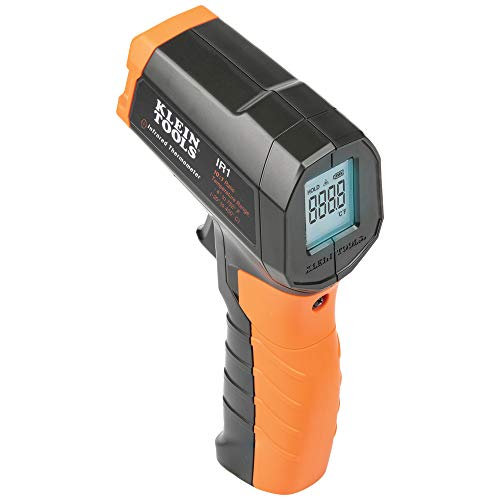
| Klein Tools IR1 | Tradespeople and HVAC checks | Targeting laser, auto-hold |
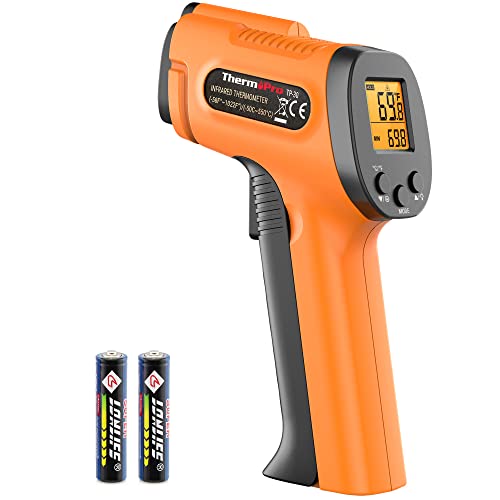
| TempPro TempScan with 2 Lasers | Better aiming on small targets | 2 lasers, 16:1 distance-to-spot ratio |
| TempPro TempScan 2-in-1 with Probe | Cooks who want both surface and internal readings | Infrared plus meat probe |
| Laser Infrared Thermometer Gun | Wide-range general use | -58 to 1112 degrees Fahrenheit |
How to Choose
Start with the temperature range
A range from about -58 to 932 degrees Fahrenheit covers cold storage checks up through pizza oven floors. A top end near 1112 degrees opens up forge, fireplace and kiln-like surfaces. Many everyday jobs never exceed 500 degrees, so do not pay extra for range you will not use. If you do plan to measure very hot surfaces, make sure the specification on the listing covers it.
Understand distance-to-spot ratio
The 16:1 ratio on one title means the measured spot grows as you move away: at 16 inches, it reads roughly a one-inch circle. A bigger ratio lets you stay further from a hot surface and still read a small target. If you measure small items close up, any ratio works. For distant targets, such as a wall vent across a room, a higher ratio matters more than a longer list of features.
Know what emissivity does
Shiny metal and glossy surfaces confuse infrared readings. Several models list adjustable emissivity, which lets you set a value for different materials. If you only ever measure matte surfaces such as pizza stones or painted walls, a fixed setting is usually fine. Adjustable emissivity helps when you switch among metal pans, glass and painted surfaces. Check whether the unit provides a reference chart in the manual, and sanity-check your setup by comparing a reading against a known surface such as a pan of simmering water, if the manufacturer allows it.
Check the practical details
Backlight, hold or MAX display, auto shut-off and a visible laser all affect everyday use. A laser dot only marks the aiming point, not the exact measuring area, which is a common misunderstanding. Budget models cut corners on enclosure toughness and battery access, so look for a holster or case if you plan to keep it in a toolbox. Never point the laser at eyes, and keep it away from children. Also remember that infrared readings drift if you move from a cold garage into a warm kitchen, so give the unit a few minutes to adjust to the room.
The 6 Best Options
Etekcity Infrared Thermometer 774
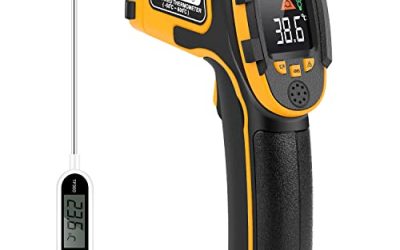
This model is aimed at cooks who also dabble in repairs. The title lists a laser, cooking and pizza oven uses, griddle and BBQ, meat, HVAC and engine, along with adjustable emissivity and a MAX display.
- Strength: adjustable emissivity gives you more control when reading different materials.
- Strength: a MAX display lets you capture the highest reading during a scan.
- Trade-off: the title is cut off before the range figure, so confirm the temperature span on the listing.
Skip it if you need to read food internals, since infrared only measures the surface. It suits a household that wants one tool for the grill, the oven and a quick check of a vent, with a familiar brand name on the label. Confirm the range figure and battery type on the listing before you buy, since both are missing from the visible title.
Digital Infrared Thermometer Gun
Targeting pizza ovens, BBQ and cooking tasks, this unbranded gun lists a backlight and a range of -58 to 932 degrees Fahrenheit, or -50 to 500 degrees Celsius, in a handheld non-contact format with a laser.
- Strength: the range figures are printed in the title in both units.
- Strength: the backlight helps in dim spaces such as a garage or an evening cookout.
- Trade-off: no brand or emissivity detail is given, so check the listing for adjustability and warranty information.
Skip it if you need very high readings, since the upper limit is lower than some competitors. It is a practical option for a backyard cook who wants a simple point-and-read device and will not be switching among reflective materials. Check the listing for the battery type and for a carrying pouch, because small accessories often decide how long a tool like this lasts in a drawer.
Klein Tools IR1
For people who work around heating and cooling equipment, the title mentions a targeting laser, auto-hold and a digital laser gun that is non-contact, with the temperature range starting at -4 degrees and the rest truncated.
- Strength: a trade-focused brand name signals the audience it was built for.
- Strength: auto-hold keeps the reading on screen after you release the trigger.
- Trade-off: the title is cut off, so confirm the upper range and the spot ratio on the listing.
Skip it if you want a cooking-specific tool for pizza ovens or very hot surfaces. It is a good fit for a homeowner who occasionally checks vents, ductwork or breaker panels, and who would rather buy from a tool maker than an anonymous seller. Look for a case or holster on the listing, because a tool that rides in a toolbox needs some protection.
TempPro TempScan with 2 Lasers
Two lasers and a 16:1 distance-to-spot ratio are the headline here. The title lists use on a pizza oven and grill, cooking, HVAC and engine work, and describes a temperature gun with a laser design.
- Strength: two lasers help bracket the measured area for easier aiming.
- Strength: the 16:1 ratio is listed, so you can plan your measuring distance.
- Trade-off: the title does not state the full temperature range, so verify it before buying.
Skip it if you want a single-dot design or a probe for food internals. It suits people who find it hard to line up a single dot with a small target, such as a pan edge or a hot spot on a grill grate. Confirm the range on the listing so you know how far up the scale it can go. Confirm the range on the listing so you know how far up the scale it can go.
TempPro TempScan 2-in-1 with Probe
This is a hybrid. The title lists an infrared thermometer gun with a meat probe, an instant read function for grilling and a non-contact infrared reading for cooking.
- Strength: the probe adds an internal reading that infrared alone cannot provide.
- Strength: one device covers both surface and instant-read jobs in the kitchen.
- Trade-off: combining two functions may mean compromises in range or ergonomics, so check dimensions and storage.
Skip it if you only need non-contact readings for HVAC or workshop jobs. It makes the most sense for a grill-focused household that wants a surface check on the cooking grate and an internal check on the meat from one tool, with the caveat that the probe length and cable details need checking on the product page. A fold-away probe is easier to store, so look for that detail and for the battery type.
Laser Infrared Thermometer Gun
The widest range in the group appears here: -58 to 1112 degrees Fahrenheit, or -50 to 600 degrees Celsius. The title lists use in industrial, kitchen, automotive and HVAC settings with a non-contact digital reading.
- Strength: the high upper limit covers hotter surfaces than most rivals.
- Strength: it is positioned across several fields, so it works as a general-purpose tool.
- Trade-off: no brand, emissivity or ratio details are shown in the title.
Skip it if you want a recognized tool-brand name or a cooking-oriented feature set. It is a good fit for a hobbyist who needs a broad range, for example someone who works on engines and also fires up a grill. Without a stated brand, read the seller details and warranty terms first, and look for the battery type before ordering. Without a stated brand, read the seller details and warranty terms first.
Which One Fits Your Situation
You cook on a pizza oven or griddle
The Digital Infrared Thermometer Gun is a sensible choice for simple surface checks, and the Etekcity 774 adds adjustable emissivity if you also measure metal pans. Confirm the top temperature on the listing, and aim at the stone or the cooking floor instead of the glowing flame.
You want to check vents and ducts
The Klein Tools IR1 fits this scenario with its targeting laser and auto-hold. The trade-focused name also helps if you prefer a recognized tool brand, and auto-hold means you can read the screen after stepping away from a hot register.
You struggle to aim at small things
Try the TempPro TempScan with 2 Lasers. The double beam and stated 16:1 ratio help you frame small targets from a safe distance.
You grill and also want an internal reading
The TempPro 2-in-1 with Probe covers both. For a broad range at this budget, the Laser Infrared Thermometer Gun is the wide-range alternative.
Common Mistakes
- Expecting internal temperatures. Infrared reads surfaces only, so use a probe for the inside of food.
- Measuring shiny metal without adjustment. Reflective surfaces can read lower than reality unless emissivity is set or the surface is covered.
- Standing too far away. The spot grows with distance, so get closer for small targets, and keep the sensor clean because fingerprints and grease can interfere with the reading.
- Buying a forehead thermometer by accident. Body thermometers are a different category and do not suit cooking or HVAC.
- Pointing the laser at eyes. Treat the laser as a safety hazard and keep it away from people and pets.
Related guides
- Pillows For Sleeping On Back And Side
- Memory Foam Pillows For Side Sleepers
- Recliner Chairs With Massage And Heat
Frequently Asked Questions
Can an infrared thermometer measure food temperature?
Only the surface. For internal temperatures, use a probe thermometer, such as the one included in the TempPro 2-in-1.
Why do readings look wrong on shiny pans?
Reflective surfaces reflect heat from their surroundings, which confuses the sensor. Adjust emissivity if the model allows it, or measure a matte spot.
What does a 16:1 ratio mean?
It describes how the measured area grows with distance. At 16 inches away, the spot is about one inch wide, according to the ratio.
Is the laser dot the exact measurement area?
No. The dot helps with aiming, while the sensor reads a larger area that grows with distance.
More from Amazon
Programs that pair well with the guide above. Offers and eligibility are set by Amazon and may change.
Collect the home and kitchen items you want in one registry that guests can shop from.
Create a wedding registrySet up recurring deliveries of everyday items on eligible products. Terms and savings are set by Amazon.
Explore Subscribe & SaveFree shipping on eligible items, Prime Video and more. Eligible new members can start with a free trial.
Start a Prime free trialAudiobooks and podcasts to listen to on the go. Eligible new members can start with a free trial.
Try Audible freeAs an Amazon Associate we earn from qualifying purchases.