Key takeaways
- Noise floor under 30 dB: Anything louder competes with your baby’s sleep pressure rather than supporting it. Units rated 24–28 dB sit below the ambient hum of most homes, so the sound disappears instead of becoming a stimulus.
- Cool mist, always: Warm-mist models involve a heating element and hot water inside a room where a toddler will eventually be mobile. Cool ultrasonic misting delivers identical humidity benefits without the burn risk.
- Real humidity control, not just fan speeds: A built-in hygrometer with a target setting lets the unit idle once the room hits 50%, which prevents the damp-window overshoot that plagues timer-only models.
- Top-fill tank and wide openings: You will refill this thing half-asleep. Top-fill designs let you pour from a pitcher without disassembly, and a hand-width opening is the difference between a unit you scrub weekly and one you never clean.
- Runtime that clears a full night plus naps: Aim for 24 hours or more at low output. Anything shorter means a mid-night silence — and mist stopping is often what wakes a baby who has adapted to it.
What's inside
Ask any parent what derails a night in the first year, and humidity rarely makes the list — yet it shows up in the symptoms constantly. Dry indoor air thickens nasal mucus, and because infants breathe primarily through their noses, even mild congestion turns a smooth sleep cycle into a series of micro-awakenings. Winter heating systems are the usual culprit, dragging relative humidity down into the teens and twenties, well below the 40–60% band that keeps airways comfortable and skin barriers intact. The result is a baby who fights sleep onset, wakes fragmented, and coughs at 4 a.m. for no obvious reason.
The complication is that the fix can create its own problems. An oversized unit left running unattended will push a small nursery past 65%, encouraging dust mites and mildew on window frames. A noisy motor sits right in the frequency range that stirs light sleepers. And a tank designed by someone who has never refilled anything in the dark will quietly go unused by week three. This guide evaluates nursery humidifiers on the criteria that actually determine whether they help sleep: acoustic output, humidity regulation, runtime against tank size, and how forgiving they are to clean.
As an Amazon Associate we earn from qualifying purchases.




🛒 Best Price Today on Amazon
Prime members get fast, free shipping on everything above, plus member-only deals. New members get a 30-day free trial — cancel anytime.
How to Choose a Nursery Humidifier (2026)
- Noise floor under 30 dB: Anything louder competes with your baby’s sleep pressure rather than supporting it. Units rated 24–28 dB sit below the ambient hum of most homes, so the sound disappears instead of becoming a stimulus.
- Cool mist, always: Warm-mist models involve a heating element and hot water inside a room where a toddler will eventually be mobile. Cool ultrasonic misting delivers identical humidity benefits without the burn risk.
- Real humidity control, not just fan speeds: A built-in hygrometer with a target setting lets the unit idle once the room hits 50%, which prevents the damp-window overshoot that plagues timer-only models.
- Top-fill tank and wide openings: You will refill this thing half-asleep. Top-fill designs let you pour from a pitcher without disassembly, and a hand-width opening is the difference between a unit you scrub weekly and one you never clean.
- Runtime that clears a full night plus naps: Aim for 24 hours or more at low output. Anything shorter means a mid-night silence — and mist stopping is often what wakes a baby who has adapted to it.
The Best Nursery Humidifiers (2026) Reviewed
Levoit Top Fill 2.5L Humidifier
The 28 dB rating and 25-hour runtime make this a reliable set-and-forget option for a standard nursery, and the top-fill design genuinely lives up to its name — no inverting a sloshing tank over the sink. Auto shut-off on empty is the safety feature that matters most for overnight use.
DREO 4L HM311
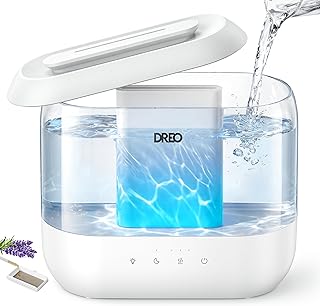
With 36 hours of runtime, this is the pick for larger nurseries or shared rooms where you would rather refill every other day than nightly. The wide tank mouth makes descaling straightforward, and the dimmable nightlight is low enough not to interfere with melatonin onset.
DREO 3L Humidifier (New Edition)
The precise humidity control is the standout here: set a target, and the unit modulates output rather than blasting continuously, which keeps you comfortably inside the 40–60% window. At 26 dB with 30 hours of capacity, it is the best-balanced mid-size option on this list.
Vicks 3-in-1 SleepyTime
Built for the congestion nights specifically, this pairs cool mist with optional SleepyTime Vapopads and a color-changing nightlight. Skip the scent pads for newborns and very young infants, but for toddlers with a seasonal cold it is a genuinely useful three-in-one.
Clarston 2L Cool Mist Humidifier
At 24 dB, this is the quietest unit reviewed here, and the 360° nozzle lets you angle mist away from the crib and toward open floor for better room-wide distribution. The 25-hour runtime from a compact 2L tank makes it well suited to smaller nurseries.
Frequently Asked Questions
What humidity level should a nursery be?
Target 40–60%, with 45–50% as the practical sweet spot. Below 40% you get dry airways and static; above 60% you invite dust mites and condensation. An inexpensive standalone hygrometer placed away from the unit is worth buying, since built-in sensors read the mist plume rather than the room.
How far from the crib should it sit?
At least three feet away, on a hard surface rather than carpet, with the nozzle directed away from bedding. Mist settling on a mattress or sheets creates damp spots and defeats the purpose.
Do I need distilled water?
Ultrasonic units aerosolize whatever is in the tank, including dissolved minerals, which appear as fine white dust. Distilled or filtered water eliminates this and dramatically slows scale buildup inside the reservoir.
How often does it need cleaning?
Rinse and dry the tank daily, and descale with white vinegar weekly. Standing water in a warm room grows biofilm fast, and a neglected humidifier moves that into the air your baby breathes.
Final Thoughts
For most nurseries, the Levoit Top Fill 2.5L is the sensible default — quiet, easy to maintain, and safe to run overnight without supervision. Choose the DREO 4L HM311 if the room is large or you want to refill less often, and the Vicks 3-in-1 SleepyTime if congestion and cold season are the specific problem you are solving.