Key takeaways
- Mattress depth and support: Cabinet-style beds typically accept mattresses up to roughly 6–8 inches, while wall-mounted frames often handle 10–12 inches. Check the stated limit before you fall in love with a plush hybrid, and prioritize a slat platform that keeps your spine neutral rather than a thin pad that bottoms out at the hips.
- Lift mechanism and daily effort: Gas struts or a spring-assisted piston should let one adult raise and lower the bed with controlled, unhurried motion. If deploying the bed feels like a workout, you’ll delay bedtime — a small friction point that compounds into a later, less consistent sleep schedule.
- Wall anchoring versus freestanding: Vertical wall beds require secure attachment to studs and are best suited to permanent installs. Cabinet-style Murphy beds sit on the floor and suit renters, upper-floor rooms, and anyone who may rearrange later.
- Footprint when closed and open: Measure the projection from the wall in both states, plus at least 24 inches of walking clearance on the open side. Cramped clearance leads to nighttime bumps and disrupted sleep for anyone sharing the room.
- Integrated extras, chosen deliberately: USB ports and drawers add real convenience, but position charging within arm’s reach only if you’re disciplined about screens. Warm, dimmable LED lighting is a genuine sleep-wellness asset; bright white task lighting near the pillow is not.
A spare room that doubles as an office, a studio apartment where the bed dominates the floor plan, a basement that hosts relatives twice a year — the modern home asks a single space to do several jobs, and sleep is usually the function that gets compromised. From a sleep-wellness standpoint that trade-off matters more than most buyers realize: fragmented, uncomfortable sleep on a thin fold-out surface affects mood, appetite regulation, and next-day cognition, and a room that never fully signals “rest” makes it harder for the brain to associate the space with winding down. A full size Murphy bed solves both problems at once by giving you a genuine mattress that disappears when you need the floor back.
This guide evaluates the best full size Murphy beds you can buy in 2026, with attention to the details that actually influence sleep quality: mattress clearance and support, lift-mechanism smoothness and safety, wall-anchoring requirements, and whether the built-in extras (charging ports, drawers, lighting) support good sleep hygiene or quietly undermine it. Below you’ll find our current picks, followed by a buyer’s checklist, hands-on assessments of the top models, and answers to the questions we hear most often.
Our top picks



As an Amazon Associate we earn from qualifying purchases at no extra cost to you. Ratings are shown as listed on Amazon.
🛒 Best Price Today on Amazon
Prime members get fast, free shipping on everything above, plus member-only deals. New members get a 30-day free trial — cancel anytime.
How to Choose a Full Size Murphy Bed (2026)
- Mattress depth and support: Cabinet-style beds typically accept mattresses up to roughly 6–8 inches, while wall-mounted frames often handle 10–12 inches. Check the stated limit before you fall in love with a plush hybrid, and prioritize a slat platform that keeps your spine neutral rather than a thin pad that bottoms out at the hips.
- Lift mechanism and daily effort: Gas struts or a spring-assisted piston should let one adult raise and lower the bed with controlled, unhurried motion. If deploying the bed feels like a workout, you’ll delay bedtime — a small friction point that compounds into a later, less consistent sleep schedule.
- Wall anchoring versus freestanding: Vertical wall beds require secure attachment to studs and are best suited to permanent installs. Cabinet-style Murphy beds sit on the floor and suit renters, upper-floor rooms, and anyone who may rearrange later.
- Footprint when closed and open: Measure the projection from the wall in both states, plus at least 24 inches of walking clearance on the open side. Cramped clearance leads to nighttime bumps and disrupted sleep for anyone sharing the room.
- Integrated extras, chosen deliberately: USB ports and drawers add real convenience, but position charging within arm’s reach only if you’re disciplined about screens. Warm, dimmable LED lighting is a genuine sleep-wellness asset; bright white task lighting near the pillow is not.
The Best Full Size Murphy Bed (2026)s Reviewed
LIVAUVEAD Full Size Murphy Bed with Charging Station & Drawer
A clean white vertical wall bed that pairs a foldable frame with a built-in charging station and a single storage drawer, making it a strong fit for guest rooms that spend most of the year as home offices. The slat platform accommodates standard full mattresses without a box spring, and the minimal cabinet face keeps a small room feeling visually quiet — a subtle but real advantage for pre-sleep relaxation.
ROOMTEC Full Size Murphy Wall Bed
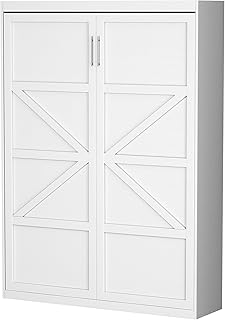
The purist’s choice: no drawers, no ports, just a sturdy white wall-bed frame focused on doing the essential job well. If you already own a full mattress you sleep well on and simply want to reclaim the floor between uses, this is the most straightforward path there.
BALUS 57″ Full Size Murphy Cabinet Bed with Mattress (White-Brown)
Our top pick for renters and anyone unwilling to drill into studs. At 57 inches wide when closed it reads as a credenza, the included mattress removes the guesswork on depth compatibility, and the storage drawer plus USB charging make it a self-contained guest solution. Two-tone white and brown suits transitional interiors particularly well.
BALUS Full Size Murphy Cabinet Bed with Mattress (White)
Mechanically the same well-executed cabinet platform in an all-white finish that recedes in small apartments and living rooms. Choose this version if your palette leans bright and modern; the tri-fold mattress unfolds to a supportive full-size sleeping surface without a separate foundation.
Hlivelood Full Size Murphy Bed with 2 LED Lights
The best-designed option for sleep environment specifically: gas struts deliver smooth, controlled operation, and the two integrated LED lights let you read or navigate the room without the harsh overhead lighting that suppresses melatonin. The farmhouse-style brown wood and cabinet storage make it look intentional even when closed.
Frequently Asked Questions
Can you sleep on a Murphy bed every night?
Yes, provided the mattress is appropriate. A Murphy bed with a proper slat platform and a quality full mattress supports the body no differently than a conventional frame; the limiting factor is mattress thickness, not the mechanism.
Do Murphy beds need to be bolted to the wall?
Vertical wall-mounted models must be anchored into studs for safety and should never be used freestanding. Cabinet-style beds, including the BALUS and Hlivelood chest models, rest on the floor and require no wall attachment.
How much clearance does a full size Murphy bed need?
Plan for roughly 80 inches of projection when open and at least two feet of walkway beside it. Verify ceiling height for vertical models, since the frame must clear the arc as it lowers.
Is assembly difficult?
Most models arrive flat-packed and take two people two to four hours. Do not shortcut the lift-mechanism and anchoring steps — those are the components that determine long-term safety.
Final Thoughts
For most buyers, the BALUS 57″ Full Size Murphy Cabinet Bed with Mattress is the best overall value: no wall anchoring, a mattress included, and storage plus charging built in. If sleep environment is your priority, the Hlivelood Full Size Murphy Bed with 2 LED Lights earns its place with smooth gas struts and gentle integrated lighting, while the LIVAUVEAD Full Size Murphy Bed with Charging Station & Drawer is the cleanest fit for a dual-purpose office guest room.