Key takeaways
- Low-end spindle speed: Steel wants slow. Look for a bottom speed near 500 RPM or lower — a press that only descends to 1,100 RPM will burn bits in mild steel and glaze hardened stock before it cuts.
- Mass and frame material: Cast iron heads, tables, and bases absorb the harmonics that cause bit chatter. Stamped-steel construction transmits them instead, which means rougher holes and far more airborne noise in an attached garage.
- Quill travel and swing: Quill stroke determines how thick a workpiece you can bore in one pass; swing determines how far from the edge you can reach. Two to three inches of travel and a 10–12″ swing covers most bracket, plate, and tube work.
- Speed-change mechanism: Variable-speed dials let you adjust mid-cut without touching a belt. Stepped pulleys are cheaper and perfectly serviceable, but you’ll be opening the head cover every time material changes.
- Portability versus fixed capacity: If your steel is bolted to a structure — beams, trailer frames, railings — a magnetic drill goes to the work. If the work comes to you, a benchtop column press is more versatile and far less expensive per hole.
What's inside
Drilling steel is where a lot of home workshops hit a wall. A handheld drill wanders the moment the bit bites, the flutes load up with swarf, and what should have been a clean 3/8″ hole in a bracket turns into an oversized oval that no fastener will ever sit flush in. Metal punishes imprecision in a way that softwood forgives, and the culprit is almost never the operator — it’s the lack of a rigid column, a properly slow spindle speed, and steady downward pressure. Add the fact that many of us are working in a garage attached to a house full of sleeping people, and the calculus changes again: a screaming, rattling machine is a machine you will quietly stop using after 9 p.m.
This guide looks at benchtop and magnetic drill presses through that dual lens — cutting performance in steel first, but also the vibration, chatter, and noise that make a tool livable in a domestic space. Below you’ll find the specifications that actually matter when you’re boring metal rather than pine, honest notes on five machines at very different price points, and answers to the questions that come up most often once the box is open and the bench is cleared.
As an Amazon Associate we earn from qualifying purchases.



How to Choose a/an Drill Press For Metal (2026)
- Low-end spindle speed: Steel wants slow. Look for a bottom speed near 500 RPM or lower — a press that only descends to 1,100 RPM will burn bits in mild steel and glaze hardened stock before it cuts.
- Mass and frame material: Cast iron heads, tables, and bases absorb the harmonics that cause bit chatter. Stamped-steel construction transmits them instead, which means rougher holes and far more airborne noise in an attached garage.
- Quill travel and swing: Quill stroke determines how thick a workpiece you can bore in one pass; swing determines how far from the edge you can reach. Two to three inches of travel and a 10–12″ swing covers most bracket, plate, and tube work.
- Speed-change mechanism: Variable-speed dials let you adjust mid-cut without touching a belt. Stepped pulleys are cheaper and perfectly serviceable, but you’ll be opening the head cover every time material changes.
- Portability versus fixed capacity: If your steel is bolted to a structure — beams, trailer frames, railings — a magnetic drill goes to the work. If the work comes to you, a benchtop column press is more versatile and far less expensive per hole.
The Best Drill Press For Metal (2026)s Reviewed
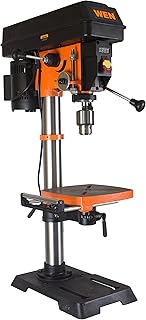
WEN 12-Inch Benchtop Drill Press (DP1263V)
The 6.2-amp variable-speed motor and full cast iron construction make this the most complete metalworking benchtop option here, letting you dial speed down for steel without stopping to reposition a belt. The laser crosshair and LED work light are genuinely useful for centering a punch mark, and the machine’s mass keeps vibration — and the accompanying racket — impressively contained.
VEVOR Mag Drill Press, 1300W
A 2,922 lbf magnetic base and 1.57″ boring capacity put this in a different category entirely: it clamps to vertical or overhead steel and cuts where a benchtop press simply cannot go. At 810 RPM it’s aimed squarely at annular cutters in structural stock, so treat it as a specialist tool rather than a general-purpose shop press.
WEN 8-Inch 5-Speed Benchtop Drill Press (4206T)
The 2.3-amp motor and 8″ swing limit you to smaller stock, but the cast iron frame delivers a surprisingly composed cut in thin steel and aluminum for the money. It’s the sensible entry point for someone drilling hardware and light brackets on a crowded bench.
VEVOR Benchtop Drill Press, 3.2 Amp 10-Inch
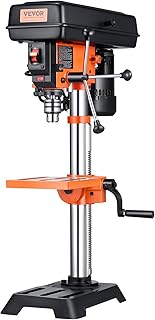
A cast iron frame, 10″ swing, and a table that tilts a full 0–45° make this a strong middle-ground machine for mixed wood and metal work. Five belt-driven speeds mean a little manual fiddling, but the range reaches low enough to be honest about steel.
Upgrade Mini Benchtop Drill Press, 340W
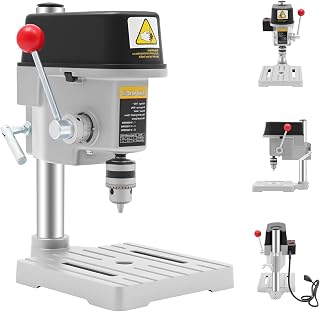
This compact three-speed unit is built for jewelry, model work, and thin non-ferrous sheet rather than structural steel — expect delicate accuracy, not brute torque. Its small footprint and modest noise output make it the natural choice for an apartment bench or spare-room craft table.
Frequently Asked Questions
What speed should I use for drilling steel?
As a rough rule, slower and larger go together: a 1/4″ bit in mild steel is happy around 900–1,000 RPM, while a 1/2″ bit wants closer to 450–500. Hardened or stainless stock demands slower still, plus firm, continuous feed pressure.
Do I really need cutting fluid?
Yes — for anything beyond token holes in thin sheet. A few drops of cutting oil flushes chips, reduces work-hardening, and can easily triple bit life; dark, smoking swarf is a sign you skipped it.
Can a drill press meant for wood handle metal?
Sometimes, but the limiting factor is minimum spindle speed rather than motor power. If the slowest setting is well above 1,000 RPM, you’ll struggle with anything thicker than sheet metal regardless of amperage.
How loud are these machines in a home garage?
Cast iron benchtop presses running at metal-appropriate low speeds are relatively subdued — the noise you notice is usually chatter from an unsecured workpiece, not the motor. Clamp your stock properly, and late-evening drilling becomes far less antisocial.
Final Thoughts
For most home workshops tackling steel, the WEN DP1263V is the clear all-rounder — variable speed, real cast iron mass, and a 12″ swing cover almost everything a furniture or fabrication project will throw at you. Step down to the WEN 4206T if your budget and bench space are tight and your holes are small, or reach for the VEVOR 1300W mag drill when the steel is too big to bring indoors and the work has to travel to it.