Key takeaways
- Best rack and pinion for go kart: complete steering kits with 340mm and 490mm racks, tie rods and shafts, plus measuring and fitment checks before you buy.
As an Amazon Associate we earn from qualifying purchases.
Affiliate disclosure: This article contains affiliate links. If you buy through a link on this page, we may earn a commission at no extra cost to you.

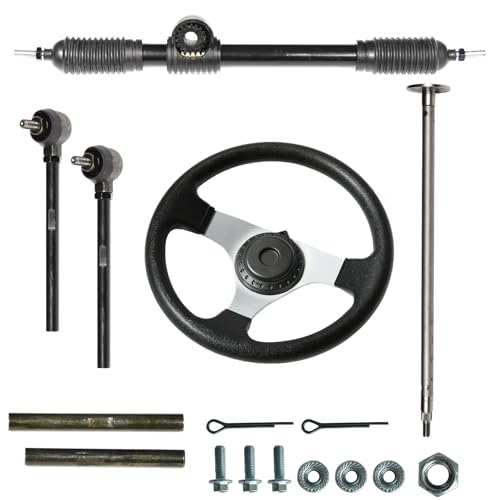
A rack and pinion for a go kart is a small steering gearbox built for kart-sized frames: a pinion gear on the end of the steering shaft meshes with a toothed rack bar, and turning the wheel slides the rack left or right, pushing and pulling the tie rods that steer the front wheels. It is not a car steering rack. Automotive racks are far longer, far heavier, built for power assistance and for tie rod geometry that no kart frame shares, and bolting one to a kart produces slow, heavy, badly angled steering. Every pick in this guide is a kart-scale rack sold as part of a complete steering kit for go karts, buggies and small off-road builds, with the shaft, column, tie rods and hardware matched to the rack in the same box.
That completeness matters more than any single specification. A rack on its own is only useful if your existing shaft, column bearings, sleeve and tie rods happen to match its pinion and its mounting points, which on a home-built or older kart they often do not. The kits below replace the whole chain from steering wheel to tie rod ends, so the parts are known to work together, and the only real question left is the one this guide spends most of its time on: whether the kit’s dimensions fit your frame.
Why Karts Use Rack and Pinion at All
Many basic karts steer through a simpler direct linkage: the steering shaft carries an arm or a small plate, and tie rods run from that arm to the steering arms on the spindles. It works, it is cheap, and on a yard kart it is usually good enough. Its weaknesses show up as speed and grip rise. The linkage geometry changes its leverage through the turn, worn joints add free play exactly where you feel it most, and there is no enclosed gear mesh to keep the connection between wheel and tyres consistent.
A rack and pinion fixes the geometry in a housing. The pinion turns, the rack slides in a straight line, and the tie rods take their input from the ends of that bar. The result is steering that feels the same at small corrections as it does near full lock, with play limited to the gear mesh and the tie rod ends rather than a stack of loose linkages. That is why rack kits are the standard upgrade for buggies, off-road karts and DIY builds that have outgrown a basic shaft-and-arm setup, and why a worn rack is worth replacing as a complete kit rather than patching joint by joint.
How to Choose a Rack and Pinion for a Go Kart
Measure the rack length your frame can accept
Rack length is the headline dimension in every kit listing, and it is measured on the rack assembly itself. The two picks below sit at opposite ends of the common range: a 340mm rack for compact frames and a rack listed at 19.3 inches, roughly 490mm, for a specific wider production kart. Neither is better in the abstract. The rack has to mount to your frame’s front structure, and its ends have to land where tie rods can run to the spindle arms at sensible angles. A rack that is too long for the frame forces the tie rods into steep angles that change toe as the suspension or the steering moves; a rack that is too short can leave the tie rods too short to reach with adjustment to spare. Measure the width between your intended mounting points and the distance from the rack’s mounting face to each spindle arm before ordering, and compare against the kit’s stated rack length and tie rod length, not against the kart’s overall width.
Shaft, column and sleeve: the forgotten half of the kit
The rack is only the bottom half of the system. The steering shaft runs from the pinion up to the wheel, supported by the column and sleeve, and its length decides where the wheel sits relative to the seat. The compact kit below uses a 380mm shaft with a 150mm column and an 80mm sleeve; the direct-fit kit uses a 17.7-inch shaft. On a DIY frame, shaft length is a seating-position decision: too short and the wheel crowds your chest, too long and you are reaching for it with straight arms. Because these kits include the shaft, column, sleeve and bearings together, the support geometry is solved for you, but the total reach still has to suit your frame’s seat-to-front-end distance. Sit in the kart, or measure from the seat back to the rack mounting point, before choosing between a compact and a long-shaft kit.
Tie rods and adjustment
Tie rods connect the rack ends to the spindles, and their length and adjustment range set your front toe. The compact kit lists 240mm tie rods; the direct-fit kit lists 6.9-inch tie rod ends. What matters practically is that the rods reach both spindles with thread engagement to spare on each end, so toe can be set and later corrected as ends wear. A kit whose tie rods only just reach, with the ends wound almost out of their threads, is the wrong kit for that frame even if the rack itself bolts up. Check this on paper before ordering: rack length plus twice the usable tie rod length should comfortably cover the distance between your spindle steering arms at straight-ahead.
Steering wheel size is a leverage choice
Both kits include a steering wheel, at 300mm diameter on the compact kit and 11.8 inches, effectively the same class, on the direct-fit kit. Wheel diameter is leverage: a larger wheel lightens steering effort and slows the response at the rim, a smaller wheel quickens response and increases effort. Kart wheels cluster around this size because it balances the two for unassisted steering. If you already own a wheel you intend to keep, check its hub pattern against the shaft in the kit before assuming it will carry over; included wheels remove that question entirely.
Housing, dust protection and materials
A kart rack lives low, in the path of dust, grit and water thrown up by the front tyres. Listings for the compact kit describe a rack built with steel gearing in a housing with a rubber dust cover over the internals, which is the detail that decides how long the gear mesh stays clean and play-free in off-road use. Whatever kit you choose, treat the dust cover as a wear item: inspect it when you check tie rod ends, because a split cover lets abrasive grit into exactly the mesh you bought the rack to keep precise.
Direct-fit versus universal kits
This is the real fork in the range. A universal kit, like the compact pick below, is dimensioned for builders: it suits a range of go kart, buggy, quad and UTV frames, and in exchange it asks you to verify every dimension and to drill or adapt mounting points to your frame. A direct-fit kit, like the Coleman pick below, is dimensioned for named models and bolts to their existing points, and in exchange it fits a short list of karts properly and everything else not at all. Neither approach is superior. Universal kits reward careful measuring; direct-fit kits reward owning the right kart. Buying a direct-fit kit for a different kart because the rack length looks close is the most common way these purchases go wrong.
The Picks
1. JNDO Go Kart Steering Kit 380mm (340mm Rack) — Best Universal Complete Kit
For a DIY frame, a buggy build, or an older kart with no named replacement parts, this JNDO kit is the sensible default because it replaces the entire steering chain in one box at compact-kart dimensions. The listing describes a 340mm rack and pinion, a 380mm steering shaft, a 300mm steering wheel, a 150mm steering column, 240mm tie rods and an 80mm sleeve, with two bearings and a mounting kit of bolts and clamps included, and the vehicle service types listed are go kart, golf cart and UTV.
The 340mm rack is the dimension that defines the kit. It suits narrower front ends and tighter frames where a longer rack would push the tie rods into bad angles, and the 380mm shaft keeps the wheel position in the range most compact and mid-size frames are built around. Review coverage of this kit describes steel rack gearing with a housing and a rubber dust cover protecting the internals, which matches how the kit will actually be used: low on the frame, in the dust, on karts that live outdoors. Because the wheel, column, sleeve and bearings are all in the box, there is no separate hunt for a column bearing that matches the shaft or a sleeve that matches the column, which is where piecemeal steering builds usually stall.
Be honest about the work involved, though. Universal means the mounting points are yours to solve: expect to position the rack, drill or clamp to your frame, and set toe from scratch once the tie rods are on. That is normal for this class of kit and reasonable for anyone building or rebuilding a kart, but it is not a bolt-on replacement for a specific production model. If your kart is a named Coleman model covered by the second pick, that kit is the easier path; if your kart is anything else, this is the one designed for you.
Best for: DIY, buggy and off-road kart builders who need a complete rack and pinion steering system at compact dimensions and are prepared to fit and align it themselves.
2. JNDO Steering Gear Assembly for Coleman KT196 / CK196 — Best Direct-Fit Replacement
If your kart is a Coleman KT196 or CK196 with a 196cc engine, or one of the Kandi 110cc variants this assembly is listed for, a universal kit is the hard way to do a simple job. This JNDO assembly is the direct-fit route: the listing describes a 17.7-inch steering shaft with a 19.3-inch rack and pinion, 6.9-inch tie rod ends and an 11.8-inch steering wheel, under model number JNDOF6-21, at 8.6 pounds in the package, positioned at the front centre of the kart.
Those dimensions are the point. The roughly 490mm rack is far longer than the universal kit’s 340mm rack because the Coleman frame it serves is built around exactly that width and those mounting points, and the shaft and tie rod ends are likewise the lengths that kart left the factory with. Fitting this assembly is a replacement job rather than a fabrication job: the old, worn or bent steering gear comes off and this goes on in its place, restoring the original geometry instead of asking you to invent new geometry and then align it. For an owner whose steering has developed play, stiffness or damage, that is worth more than any universal kit’s flexibility.
The discipline with a direct-fit part is verifying that your kart really is one of the named models, in the named configuration, before ordering. Coleman model names cover variants, and steering dimensions are exactly the sort of detail that changes between them. Check the model plate on your kart against the listing’s stated compatibility, and if your kart is not a KT196, CK196 or the listed Kandi variant, do not stretch this kit to fit it; the universal pick above exists for your case.
Best for: Coleman KT196 and CK196 owners, and owners of the listed Kandi 110cc variants, replacing worn or damaged steering gear with factory-dimension parts.
What Was Left Out, and Why
Standalone racks without shaft, column or tie rods were excluded from the picks. They have a place for builders replacing one failed component in a known system, but for the reader searching for the best rack and pinion for a go kart, a bare rack usually starts a second round of parts matching that a complete kit avoids. Large automotive rack and pinion units were also excluded as main picks: their length, weight and power-steering design assumptions do not transfer to kart frames, and adapting one costs more fabrication than a kart kit costs outright. Finally, steering wheels, shafts and column parts sold on their own were excluded because they are not rack and pinion systems at all, however often they appear in the same search results.
Fitting and Alignment Basics
Whichever kit you fit, three checks decide whether the steering feels right afterwards. First, mount the rack centrally: with the rack at its centre position, both tie rods should be at equal adjustment, and the wheel should sit straight. A rack mounted off-centre gives you more lock one way than the other. Second, set toe with the kart at ride height and the driver weight problem in mind; a kart’s front geometry is light enough that measuring on a stand and driving on the ground can give different answers. Third, work the steering from lock to lock before the first drive and watch the tie rods through their travel for binding, steep angles or contact with the frame, pedals or brake linkage. Play that remains after fitting is usually at the tie rod ends or the column bearings, both of which are in these kits, so a correctly fitted kit should feel tight; if it does not, find the loose point on the stand rather than on the track.
Frequently Asked Questions
Can I fit a car rack and pinion to a go kart?
Physically, with enough fabrication, almost anything can be fitted to anything, but it is a poor idea. Car racks are much longer and heavier, are designed around power assistance and car spindle geometry, and on a kart they give slow, heavy steering with tie rod angles that change toe badly through the turn. Kart-scale kits like the ones above are built for kart frames and cost less effort in every direction.
How do I know which rack length I need?
Measure your frame, not your kart’s brochure width. You need the distance between the rack mounting points you intend to use, and the distance from the rack to each spindle steering arm, so you can check that the kit’s rack length and tie rod length cover the span with adjustment to spare. Compare those numbers against the kit listing’s stated rack and tie rod dimensions before ordering.
Is a complete kit better than buying the rack alone?
For most owners, yes. The rack, shaft, column, sleeve, bearings and tie rods have to match each other, and a complete kit guarantees that they do. Buy a rack alone only when you know the rest of your existing system is sound and dimensionally compatible with it.
Will the Coleman kit fit other 196cc karts?
Not by assumption. It is a direct-fit assembly for the named Coleman KT196 and CK196 models and listed Kandi 110cc variants, dimensioned for those frames. Another 196cc kart may share an engine and share nothing else. If your kart is not named in the listing, choose the universal kit and measure carefully instead.
Verdict
For most builders and rebuilders, the JNDO 380mm kit with its 340mm rack is the best rack and pinion for a go kart: a complete, kart-scale system, at dimensions that suit compact and mid-size frames, with the wheel, column, bearings and hardware in the same box. For Coleman KT196 and CK196 owners, skip the universal route entirely; the JNDO direct-fit assembly restores factory steering geometry with factory dimensions, which is the whole job. Either way, measure first, because with steering racks the difference between the right kit and the wrong one is not quality. It is millimetres.
More from Amazon
Programs that pair well with the guide above. Offers and eligibility are set by Amazon and may change.
Collect the home and kitchen items you want in one registry that guests can shop from.
Create a wedding registrySet up recurring deliveries of everyday items on eligible products. Terms and savings are set by Amazon.
Explore Subscribe & SaveFree shipping on eligible items, Prime Video and more. Eligible new members can start with a free trial.
Start a Prime free trialAudiobooks and podcasts to listen to on the go. Eligible new members can start with a free trial.
Try Audible freeAs an Amazon Associate we earn from qualifying purchases.