Key takeaways
- Find the best wall mounted surfboard racks for your garage or home. Compare wooden, aluminum and adjustable wall racks for shortboards and longboards.
A good wall mounted surfboard rack does more than clear floor space. It keeps a board off a damp garage floor, away from bicycles, toolboxes and car doors, and it holds the board where its rails, fins and deck stay protected between sessions. The best wall mounted surfboard racks also make a quiver easy to see at a glance, so grabbing the right board for the conditions takes seconds rather than a careful shuffle through a leaning stack.


If you are choosing a wall mounted surfboard rack for the first time, the quick answer is to match the rack to the number of boards you own, the length and weight of your longest board, and the wall you plan to mount it on. A single-board mount suits one favourite board in a living room or hallway. A three- or four-board horizontal rack suits a growing quiver in a garage. An adjustable steel track system suits a household where board sizes change often, because the spacing between levels can be moved without buying a new rack.
This guide focuses only on wall mounted surfboard racks. It does not cover freestanding floor racks, ceiling hoists or kayak storage systems, because those solve different problems and need different mounting hardware. Every rack below mounts to a wall, holds surfboards horizontally or in a wall cradle, and is listed on Amazon US. Measure your wall and your longest board before ordering.
Quick Picks
Our Short List of 3
All 4 Picks at a Glance
| Product | Specs | Action |
|---|---|---|
| COR Surf Wooden Surfboard Wall Mount (B072MRZN5S) | Check price on Amazon | |
| Extreme Max Aluminum Surfboard Wall Cradle (B07SX4W45R) | Check price on Amazon | |
 LISS Solo Rack (B0FJGDJMP3) | Check price on Amazon | |
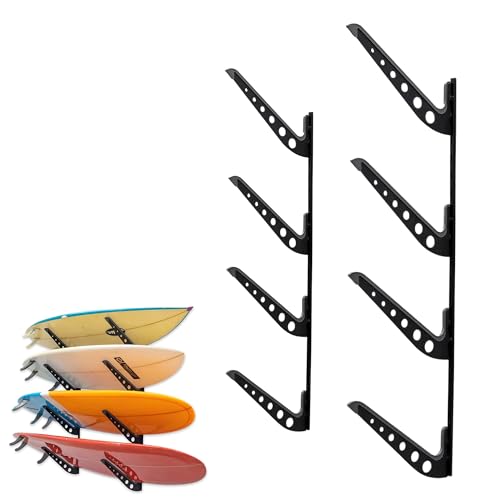 StoreYourBoard Adjustable Surfboard Storage Rack (B0BN6ZK6HQ) | Check price on Amazon |
How to Choose
Board Capacity and Quiver Size
Start by counting the boards you need to store now, then add one space for the board you are most likely to buy next. A rack that holds exactly the number of boards you own today will feel crowded within a season, and an overcrowded rack is where dings happen. Single-board racks suit a one-board household or a favourite board on display. Three-board racks suit most recreational surfers. Four-board racks suit families, couples who surf together, or anyone with a shortboard, a fish, a funboard and a longboard.
Capacity is usually stated per level as well as in total. A rack rated for 25 lbs per level can hold a heavy longboard on one level and a lighter shortboard on another, but the total rating still matters. Check both figures on the product page, and do not assume that a rack built for three shortboards will also hold three longboards comfortably. Longer boards need wider arm spacing and more clearance from the wall.
Horizontal Versus Cradle Mounting
Most wall mounted surfboard racks hold boards horizontally, deck up or deck down, on two or more padded arms. This is the most common layout for a garage wall, because it keeps boards parallel to the wall and easy to lift on and off. A cradle-style mount works differently. Two separate cradles are fixed to the wall at a chosen distance apart, and the board rests in the curved cradles. Cradles are useful when board lengths vary a lot, because the spacing can be set to suit a shortboard one week and a longboard the next, and they take up very little visual space when the board is out for a session.
Wall Type and Mounting Hardware
A wall mounted surfboard rack is only as strong as the wall it is fixed to. Solid studs give the most secure fixing, and most manufacturers recommend mounting directly into studs for heavier boards and multi-board racks. Drywall anchors are supplied with many racks, and they can work for lighter single boards, but they are not a substitute for a stud when a rack will hold several boards every day. Brick, concrete and block walls need masonry fixings rather than the screws supplied for timber studs.
Arm Length, Depth and Board Clearance
Arm length decides how far a board sits from the wall and how much clearance its fins and rails have. Short arms keep a board close to the wall and save space, which suits a narrow garage or hallway. Longer arms give more clearance for boards with larger fins, thicker rails or a wide tail, and they make it easier to slide a board in and out without scraping the wall. If your boards have removable fins, you may be able to use shorter arms by taking the fins off for storage, but that adds a step every time you go surfing.
Materials: Wood, Bamboo, Aluminum and Steel
Wood and bamboo racks bring warmth to a living room, hallway or beach house, and they suit boards that are displayed as much as stored. Bamboo is light and strong for its weight, while solid hardwood offers a furniture-like finish and a solid feel. Wooden racks need padding where the board touches the arms, because bare wood can mark a board over time.
Aluminum racks are light, resistant to rust and corrosion, and well suited to garages, sheds and outdoor walls. A one-piece aluminum cradle has no joints to loosen, and foam padding protects the board from scratches and pressure dings. Steel racks are the heaviest option and usually the strongest, which makes them a good choice for a four-board quiver or for heavy longboards. Powder-coated steel resists rust in a garage, but it is still worth checking the coating where screws and brackets meet.
Padding and Board Protection
Padding is the layer between a hard rack arm and a fibreglass, epoxy or soft-top board, and it prevents the small scratches and pressure marks that accumulate over a season. Cork, rubber and foam are the most common padding materials. Cork is firm and grippy, rubber strips grip well and resist slipping, and foam padding is soft and forgiving in a curved cradle.
Indoor, Garage and Outdoor Use
Where the rack will live changes what to look for. An indoor rack in a living room or bedroom is chosen as much for appearance as for strength, so wood, bamboo and minimalist aluminum designs tend to suit those rooms. A garage rack is chosen for capacity, durability and ease of loading, so steel and aluminum racks with adjustable spacing often win there. An outdoor rack on a shed, fence or patio wall needs to resist rain, sun and temperature changes, so rust-resistant aluminum or well-finished wood is a better choice than bare steel.
A damp garage can encourage mould on a board left in a rack for months, so leave air circulating around the boards and avoid pushing them tight against a cold exterior wall. Direct sunlight through a garage window can fade a board and warm wax, so a shaded wall is better than a sunny one.
The Best Wall Mounted Surfboard Racks Reviewed
COR Surf Wooden Surfboard Wall Mount (B072MRZN5S)
The COR Surf Wooden Surfboard Wall Mount is a triple-tier bamboo rack that holds up to three surfboards horizontally, or up to six boards vertically when the centre arm is removed and boards are stored on edge. It measures 24 x 4 x 4 inches, mounts to the wall, and includes a protective rubber strip on the arms to help protect boards from scratches. The bamboo finish suits a living room, hallway or beach house as well as a garage, and small grooves at the end of each arm allow a board to be displayed rather than simply stored.
This rack suits a surfer with two or three boards who wants storage that also looks good on the wall. It also suits a household that wants one rack to serve several board sports, because the same arms are designed to hold snowboards, skateboards, wakeboards and kiteboards as well as surfboards.
That versatility is also the point to note before buying. This is a multi-board rack rather than a surfboard-only rack, so if you want a rack designed solely around surfboard rails, fins and thickness, compare it with a surfboard-specific cradle or adjustable system. Who should skip it: anyone with more than three surfboards who needs a larger quiver rack, and anyone mounting on a wall where a 24-inch wide bamboo unit will not fit beside a door frame.
Extreme Max Aluminum Surfboard Wall Cradle (B07SX4W45R)
The Extreme Max Aluminum Surfboard Wall Cradle is a one-piece aluminum wall mount designed to hold a surfboard, longboard or stand-up paddleboard without straps. The board simply rests in the cradle, and durable foam padding protects it from scratches and pressure dings. It measures 19 x 7 x 3 inches, weighs 3.14 lbs, and is safe for indoor and outdoor use. Mounting is by direct fixing into a wall stud or with the included drywall anchors, and a built-in tie-down loop at the outer end allows a strap to be added for extra security in windy or high-traffic areas.
This cradle suits a surfer who wants a simple, low-profile mount for one board and does not want a large multi-tier unit on the wall. The aluminum construction resists rust and corrosion, which makes it a sensible choice for a damp garage or an outdoor wall.
Note the quantity before ordering. The listing is for a single cradle unit, and most setups use two cradles spaced apart to support one board along its length, so check the listing carefully and order the number of cradles your board needs. The cradle also fits other thin boards, including wakeboards and snowboards, so it is a versatile mount rather than a surfboard-only design. Who should skip it: anyone who needs to store three or four boards on one wall, and anyone who prefers a complete multi-board rack that arrives as a single boxed system.
LISS Solo Rack (B0FJGDJMP3)
The LISS Solo Rack is a single-board wall mounted surfboard holder made from bamboo with cork padding, designed for one board up to 12 feet long and up to 60 lbs. It includes two sets of interchangeable arms, so the same rack can be set up for a shortboard or a longboard, and it has a hidden storage drawer for smaller essentials such as wax and fins, plus accessory hooks underneath for a leash, paddle or bag. The wall-mounted design includes hardware, assembles without tools, and has a natural wax finish with a compact, minimalist appearance.
This rack suits a surfer with one favourite board who wants that board on display in a home, apartment, garage or surf studio, and who also wants a tidy place for the small accessories that usually end up in a drawer or on a shelf.
It is a single-board rack, so it is not the right choice for a quiver. If you own two or more boards, you would need a second unit or a different multi-board system. The hidden drawer and hooks add convenience, but they also mean the rack takes up more wall depth than a bare minimalist hanger, so measure the space and check that a door or walkway will not catch on it. Who should skip it: anyone storing more than one board on the same wall, and anyone who wants a purely industrial steel rack for a workshop-style garage.
StoreYourBoard Adjustable Surfboard Storage Rack (B0BN6ZK6HQ)
The StoreYourBoard Adjustable Surfboard Storage Rack is a four-board wall mounted system built from alloy steel in black, with two independent wall tracks and eight adjustable storage attachments. Each level is rated for 25 lbs, giving a total capacity of 100 lbs, and the slotted tracks allow each attachment to be locked in at a chosen height, so the spacing between levels can be set to suit shortboards, longboards, fish and funshape boards. Each attachment has a rubber-coated edge at a 30-degree angle to grip boards securely while helping to prevent scratches.
This rack suits a household with a mixed quiver of up to four boards, especially when those boards differ in thickness and length. The adjustable spacing is its main advantage: a thick longboard can have a wider gap above it, while thin shortboards can sit closer together, making better use of vertical wall space.
The two wall tracks need to be spaced to fit your wall studs, so measure stud spacing and wall width before ordering, and allow time to set the attachments at the right heights during installation. The system is larger and heavier than a single-board mount, so it is best on a solid wall with good fixings rather than a thin partition. Who should skip it: anyone with only one board, who would be better served by a single-board mount, and anyone who wants a wooden display rack for a living room rather than a steel storage system for a garage.
What to Check Before You Buy
Measure first, then order. Measure the length of your longest board, the width of the wall, the distance between studs, and the height from the floor to the ceiling where the rack will sit. A longboard stored horizontally needs its full length clear of doors, windows, shelves and light fittings, and a multi-tier rack needs enough vertical space for every level plus room to lift each board out. Mark the outline of the rack on the wall with painter’s tape and hold a board against it before drilling.
Check the fixings that come in the box. Most wall mounted surfboard racks include screws and drywall anchors, but masonry walls, brick and concrete need different fixings, and older plaster walls may need longer screws to reach a stud. A rack that pulls out of the wall can damage boards, walls and anything below it, so this step is worth the extra time.
FAQ
How many surfboards can a wall mounted rack hold?
It depends on the design. Single-board mounts and cradles hold one board, triple-tier wooden racks typically hold three boards horizontally, and adjustable steel track systems commonly hold four boards.
Should surfboards be stored horizontally or vertically on a wall rack?
Both work when the rack is designed for that orientation. Horizontal storage is the most common for wall mounted surfboard racks, because the board rests on two or more padded arms and is easy to lift on and off. Vertical storage on a wall rack can save horizontal wall space, but it needs a secure base and a top support so the board cannot slip or fall forward.
Can I mount a surfboard rack on drywall?
Many racks include drywall anchors, and those can work for a light single board, but mounting into wall studs is the more secure choice, especially for multi-board racks and longboards. If you cannot reach a stud, use anchors rated for the full weight of the rack plus the boards, and check them regularly.
Will a wall mounted surfboard rack damage my board?
A well-designed rack with padding at every contact point should not damage a board, but a bare metal or wooden arm can leave pressure marks and scratches over time. Look for cork, rubber or foam padding on the arms, check for exposed screw heads near the board, and avoid over-tightening straps or tie-downs.
How high should I mount a surfboard rack?
Mount it high enough to keep boards clear of car doors, bicycles and foot traffic, but low enough to lift a board on and off safely without a step ladder. For most garages, the lowest level sits above waist height and the highest level stays within comfortable reach.
Bottom Line
The best wall mounted surfboard racks keep boards off the floor, protected by padding, and easy to reach, while using wall space that would otherwise go to waste. For a single favourite board, a minimalist mount such as the LISS Solo Rack or the Extreme Max Aluminum Surfboard Wall Cradle keeps the setup simple and low-profile. For two or three boards in a living space, the COR Surf Wooden Surfboard Wall Mount adds display appeal as well as storage. For a mixed quiver of up to four boards in a garage, the StoreYourBoard Adjustable Surfboard Storage Rack offers the most flexibility, because its level spacing can be changed as boards come and go.
Choose by board count first, then by board length and weight, then by wall type and mounting hardware.
Disclosure: As an Amazon Associate, we may earn from qualifying purchases.
More from Amazon
Programs that pair well with the guide above. Offers and eligibility are set by Amazon and may change.
Collect the home and kitchen items you want in one registry that guests can shop from.
Create a wedding registrySet up recurring deliveries of everyday items on eligible products. Terms and savings are set by Amazon.
Explore Subscribe & SaveFree shipping on eligible items, Prime Video and more. Eligible new members can start with a free trial.
Start a Prime free trialAudiobooks and podcasts to listen to on the go. Eligible new members can start with a free trial.
Try Audible freeAs an Amazon Associate we earn from qualifying purchases.