Key takeaways
- Compare board game shelves that include storage bins for dice, cards and expansions, with cube sizes and bin counts to match your collection and room.
A board game shelf has to solve two different storage problems at once. The boxed games need flat, square compartments deep enough for standard titles to slide in spine-out, while everything that escapes the box — dice, card decks, tokens, score pads and loose expansions — needs a bin it can be dropped into before it migrates across the table. A shelf sold with its own bins settles both halves in one purchase, so openings and bins are guaranteed to fit each other.
This guide is for households building a first game corner around a dozen titles, families whose card games keep multiplying, and collectors who want a few cubes left open for display while clutter hides behind fabric. Every pick below is a furniture shelf or organizer frame sold with bins included, chosen from the product names and specifications on the Amazon listings rather than from separate bin sets you would have to match yourself.
Quick Picks
As an Amazon Associate we earn from qualifying purchases.
| Product | Best for | Key spec from title |
|---|---|---|
| LUKYTOWER Cube Storage Organizer Shelf with 6 Printed Bins + Labels | Labelled bins for every cube in a modular layout | 6 cubes with 6 printed fabric bins |
| EXPERLAM 8 Cube Storage Organizer with 4 Storage Bins | Mixing open boxed games with hidden accessory storage | Solid wood 8-cube shelf with 4 bins |
| EXPERLAM 6 Cube Storage Organizer with 3 Storage Bins | A smaller game corner that can stand tall or lie low | Solid wood 6-cube shelf with 3 bins |
| Humble Crew Supersized Toy Storage Organizer with 16 Removable Bins | Sorting many small games, cards and pieces by type | 16 removable bins on a 4-tier frame |
How to Choose
Match Cube Size to Your Largest Game Boxes
Measure the biggest box you own before you count cubes, because a shelf that fits most of a collection but not its largest title forces an awkward stack somewhere else. Standard square game boxes run close to twelve inches on a side, so an opening around that size takes them flat and spine-out, while smaller openings suit card games only. The LUKYTOWER bins, for example, measure about 11 by 11 by 11.8 inches, which suits components and small games. Write down your three largest games, compare them against the interior opening in the listing rather than the outside frame size, and leave a finger of clearance so boxes slide without chewing their corners.
Decide How Many Bins Versus Open Cubes You Need
Bins and open cubes do opposite jobs, and the right ratio depends on what your collection actually looks like. Open cubes show box art and make choosing a game feel like browsing a shelf, which matters on family game night. Bins hide the visual noise: sleeved cards, bagged tokens, dice trays and the expansion whose box disintegrated years ago. A half-and-half unit such as the eight-cube EXPERLAM, with four bins among eight openings, suits a mixed collection well. If most of your storage pain is small loose pieces, lean toward a bin-heavy frame instead. Count your loose items honestly before ordering, because buyers routinely overestimate display space and underestimate how much of a collection is really small parts.
Check the Frame Material Against Game Weight
Board games are deceptively heavy, since a single large title can weigh as much as a hardcover textbook and a full cube multiplies that load quickly. Solid pine frames, like the EXPERLAM shelves, tolerate that weight with a sturdier feel and can be stood vertically or horizontally. Metal-and-plastic modular cubes, like the LUKYTOWER, trade some rigidity for layouts you can rebuild when the collection grows. Tiered rod frames spread weight across levels, and the Humble Crew listing states a limit of 20 pounds per level, which is a useful ceiling to respect. Whatever you choose, put the heaviest games on the lowest level and use the wall anchor kit when one is included.
Plan Where Expansions and Card Games Will Live
The main box is the easy part; the buying mistake is forgetting everything that orbits it. Expansions often arrive in thin boxes that slide behind the base game, spin-off card games come in tuck boxes that vanish between larger titles, and play aids such as score pads never have a home at all. Bins solve this when you dedicate one per game family, so the base game sits in an open cube and its expansions, promos and sleeved cards share the labelled bin beside or below it. The LUKYTOWER set includes six labels for exactly this kind of sorting. Before you buy, list each game family and its extras, then check the bin count covers the families you actually expand.
The 4 Best Options
LUKYTOWER Cube Storage Organizer Shelf with 6 Printed Bins + Labels
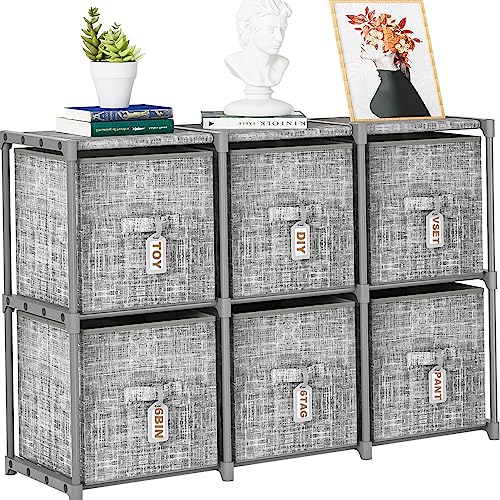
This modular cube shelf suits buyers who want every opening to come with its own bin and a label on the front. The frame builds in three layouts — two rows of three, three rows of two, or a stepped ladder arrangement — so it can run low under a window or stack taller in a corner. Each of the six printed fabric bins is sized for its cube, making it a natural home for dice, card decks and bagged components grouped by game, while a favourite boxed title can sit on top for display. Renters who may rebuild the shelf later will appreciate the modular design most.
Specs
- 6-cube modular organizer with 3 layout options
- 6 printed fabric bins included, about 11.02 x 11.02 x 11.81 inches each
- 6 bin labels included
- Powder-coated metal, plastic and printed fabric construction
- Grey finish; bins and shelf can be used separately
Best for: Players who sort components and card games into labelled bins, one family per cube.
Watch out for: The roughly 11-inch bins suit small games and parts, so large square boxes belong on top or elsewhere.
ASIN: B0C4DKLVP1
EXPERLAM 8 Cube Storage Organizer with 4 Storage Bins

Choose this solid pine shelf when you want a game corner that reads as furniture rather than utility storage. Four of its eight cubes arrive with foldable fabric bins that have handles, so expansions, dice and card decks disappear behind fabric, while the other four cubes stay open for boxed games standing spine-out where players can browse them. Two removable back panels let you mix backed and open-through cubes, and the frame stands vertically for a narrow wall or horizontally as a low console under a television. It fits living rooms where the collection is on permanent show and the loose pieces need to stay invisible between game nights.
Specs
- Solid pine wood frame, 8 cubes
- 4 foldable fabric storage bins with handles included
- 2 removable back panels
- Can stand vertically or horizontally
- Model 8CSO20240903
Best for: Living-room collections that mix displayed boxed games with hidden accessory storage.
Watch out for: Only half the cubes include bins, so heavily component-based collections may still need extra containers.
ASIN: B0DFXS9X72
EXPERLAM 6 Cube Storage Organizer with 3 Storage Bins

This is the smaller sibling for a compact game corner or bedroom wall where a full eight-cube unit would crowd the room. The solid pine frame carries six cubes and arrives with three fabric drawers, giving you a simple pattern: open cubes across the top for boxed games in current rotation, bins below for the cards, tokens and expansions that support them. Like the larger model it can stand vertically or lie horizontally, and its two removable back panels let you decide how enclosed each cube feels. It suits a starter collection of ten to fifteen titles.
Specs
- Pine wood frame, 6 cubes
- 3 fabric storage bins (fabric drawers) included
- 2 removable back panels
- Can stand vertically or horizontally
- Shelf thickness 0.59 inches; Burlywood finish
Best for: Small collections that need a few hidden bins without giving up open display cubes.
Watch out for: Three bins fill quickly once expansions multiply, so plan which game families share a bin.
ASIN: B0FFGSX9M5
Humble Crew Supersized Toy Storage Organizer with 16 Removable Bins

Although it is marketed for playrooms, this tiered frame is a practical answer for households whose game storage problem is really a small-pieces problem. Sixteen removable bins — twelve standard and four large — ride on steel rods across four levels, so card games, dice sets, tile bags and miniatures each get a bin that lifts out and travels straight to the table. The flat top shelf holds the big boxed games that anchor game night. The engineered wood frame includes stabilizing braces and an anti-tip kit, and each level is rated in the listing for up to 20 pounds.
Specs
- Engineered wood frame with steel shelving rods
- 16 removable bins: 12 standard size and 4 large
- Overall dimensions 42 x 16 x 31 inches
- Supports up to 20 pounds per level per the listing
- Includes stabilizing braces and anti-tip kit; model WO701; Grey/White
Best for: Families sorting many card games, dice and loose pieces into grab-and-go bins.
Watch out for: The open bins show their contents, so this frame looks busier than fabric-bin cube shelves.
ASIN: B07CF7HWPL
Which One Fits Your Situation
A Living Room Collection That Has to Look Tidy
Pick the EXPERLAM 8 Cube when the games live in shared space and appearances matter between sessions. Boxed titles stand in the open cubes like books, the four fabric bins swallow dice, cards and expansions out of sight, and the pine frame looks deliberate rather than improvised. Stand it horizontally under a window if you want the top surface free for a plant or the evening’s chosen game.
A Growing Collection in a Rental or Dorm
Go with the LUKYTOWER 6-cube shelf, because its three build layouts let the same unit adapt when you move rooms or the collection outgrows its first corner. Every cube already has a labelled bin, so sorting survives a move: pack the bins as they are and rebuild around them. Its lighter metal-and-plastic frame is also easier to carry up stairs than a solid wood bookcase.
A Family With Piles of Card Games and Small Pieces
Choose the Humble Crew 16-bin organizer when the frustration is dozens of small games and loose components rather than a wall of big boxes. Each card game or dice set gets its own removable bin that comes straight to the table, and the large bins take tile-heavy family games. Keep the anchor kit installed and the heaviest items low, as the listing directs.
A Starter Collection in a Tight Corner
Take the EXPERLAM 6 Cube when floor space is the binding constraint. Stood vertically it occupies a bookcase footprint, its three bins cover the accessories for a dozen or so titles, and the open cubes keep your most-played games visible. If the collection later doubles, the same unit lies horizontally as a low bench-style shelf in another room.
Common Mistakes
- Buying a shelf from its outside dimensions instead of the interior cube opening, then finding standard game boxes overhang or will not fit at all.
- Counting only boxed games and forgetting expansions, card decks and dice, which are exactly the items the included bins are meant to absorb.
- Filling every cube with a bin, leaving no open display space, so choosing a game means pulling out bins instead of browsing box spines.
- Loading the heaviest titles onto the top level of a tiered or modular frame instead of the lowest level, and skipping the anti-tip kit the listing includes.
- Assuming bins from a different brand will fit later; bin sizes are named for the opening they suit, and an 11-inch bin is usually smaller than its name suggests.
Frequently Asked Questions
Will standard board game boxes fit in cube shelves like these?
Most standard square boxes need an opening close to twelve inches, so check the interior cube measurement in the listing against your largest title rather than the frame’s outside size. Smaller cubes and the included bins still work well for card games, party games and components even when the biggest boxes live on the unit’s top surface instead.
Is this guide about in-box game organizers or shelves?
This guide covers furniture shelves that are sold with storage bins for a game collection. It is different from in-box organizers and inserts, which sort components inside a single game’s box. If your boxes already close properly and the problem is where the collection itself lives, a shelf with bins is the purchase that solves it.
How many bins does a typical collection need?
A workable starting point is one bin per game family that has expansions or loose pieces, plus one shared bin for dice, score pads and spare sleeves. Collections built mostly on self-contained boxed games can manage with bins in a third of the cubes, while card-heavy collections use far more, as the sixteen-bin frame above shows.
Should a board game shelf be anchored to the wall?
Yes for any tall or tiered unit, especially in homes with children who might pull bins toward themselves. Several listings here include an anti-tip kit or stabilizing braces, and using them costs a few minutes during assembly. Anchoring also protects the games themselves, since a tipping shelf of heavy boxes damages corners and components in one fall.
More from Amazon
Programs that pair well with the guide above. Offers and eligibility are set by Amazon and may change.
Collect the home and kitchen items you want in one registry that guests can shop from.
Create a wedding registrySet up recurring deliveries of everyday items on eligible products. Terms and savings are set by Amazon.
Explore Subscribe & SaveFree shipping on eligible items, Prime Video and more. Eligible new members can start with a free trial.
Start a Prime free trialAudiobooks and podcasts to listen to on the go. Eligible new members can start with a free trial.
Try Audible freeAs an Amazon Associate we earn from qualifying purchases.