Key takeaways
- Compare 5 short-handled garden weeders for taproots, bed edges and patio cracks, with fork, Cape Cod and L-blade picks matched to soil and grip.
Choosing a hand weeder starts with the weed and the soil in front of you, because the head that lifts one plant cleanly will snap another off at the crown. A dandelion or thistle with a long taproot needs a forked tip that slides down beside the root and a bend or base that gives leverage. Weeds in paving joints need the opposite: a thin hooked blade that fits the gap without levering against stone. Hard, dry ground rewards a thicker steel blade, while loose bed soil rewards a lighter tool you can work quickly.
This guide is for gardeners weeding flower and vegetable beds, lawn owners lifting scattered taproot weeds, and patio owners clearing joints and edges. Every pick is a short-handled hand weeder chosen from its name and specifications on its Amazon product page, covering forked dandelion weeders, a Cape Cod slicing blade, an ergonomic curved grip, and a narrow crack blade, so the shape can match the job.
Quick Picks
As an Amazon Associate we earn from qualifying purchases
| Product | Best for | Key spec from title |
|---|---|---|
| Radius Garden 102 Ergonomic Aluminum Hand Weeder | Long bed sessions when wrist angle and grip comfort limit the work | Ergonomic Aluminum Hand Weeder, Original Green |
| Edward Tools Weeding Tool | Lawn dandelions where a leverage base should lift the whole taproot | Leverage Metal Base, Sharp V Nose, Stainless Steel |
| A.M. Leonard Cape Cod Weeder | Slicing shallow weeds under mulch and between close plants in a bed | Cape Cod Weeder, 13 inches, wood handle |
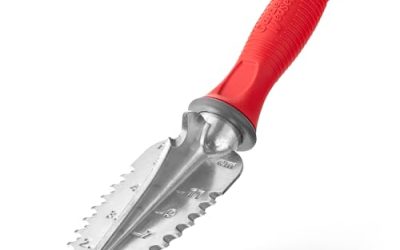
| Fiskars Ergo Scratch Tool Garden Weeder | Everyday taproot weeds in beds where a light angled head is enough | Ergo Scratch Tool Garden Weeder, cast aluminum head |
| GREBSTK Crack Weeder | Grass and moss rooted in paver joints, patio stones and driveway cracks | Crack Weeder, Stainless Steel, Beech Handle |
How to Choose
Match the Head Shape to the Root
Start with how the weed grows, not with the handle colour. A forked or V-shaped tip suits taproot weeds such as dandelion, thistle and burdock, because the two prongs can pass either side of the root and hold it while you lever. A Cape Cod blade suits shallow, spreading weeds, because its angled edge runs flat just under the surface and severs stems on the pull stroke. A thin L-shaped crack blade suits plants rooted in a joint, where there is no soil to lever against at all. If most of your weeds are fibrous and shallow, a deep fork adds work rather than removing it.
Judge Blade Material by Your Hardest Soil
Blade material decides what happens when the tip meets dry clay, grit or a hidden stone. Forged or tempered steel holds an edge and tolerates prying in compacted ground, which is why the heavier bed tools in this guide use it. Cast and die-cast aluminium will not rust and keeps a weeder light, but it is the wrong choice for levering against rock or hardpan, where it can chip or snap instead of flexing. Stainless steel sits between those poles, resisting rust while staying slim for crack work. Match the blade to the hardest patch you actually weed, not the softest bed you own.
Choose a Grip You Can Still Hold When Tired
Hand weeding is hundreds of small prying motions, so grip shape matters more than grip softness alone. A curved ergonomic handle that keeps the wrist nearer neutral helps gardeners whose hands tire or stiffen quickly, while a large cushioned grip over wood spreads pressure when you push a fork deep beside a root. A plain hardwood handle gives a firm, predictable hold and hangs easily, but offers no cushion on a long session. Check the listing for grip material and overall length, then picture the last weed of the day, not the first, because that is when a narrow handle starts to hurt.
Separate Bed Work From Crack Work
A tool that is excellent in soil can be useless in a patio joint, and the reverse is also true. In a bed you need depth, leverage and room to rock the handle, so a fork with a bend or a leverage base earns its place. Between pavers you need a blade thin enough to enter the joint, an edge that can hook under the crown, and a handle short enough to pull along the line of the crack. Gardeners with both jobs usually do better owning one bed weeder and one crack weeder than buying a broad tool that fits neither place well.
The 5 Best Options
Radius Garden 102 Ergonomic Aluminum Hand Weeder
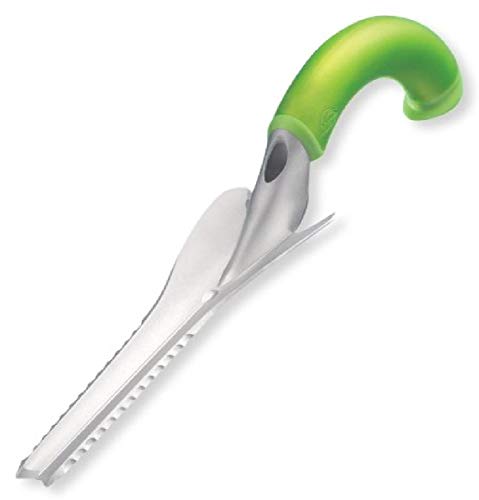
Choose this weeder when your hands, rather than the weeds, decide how long a session lasts. The listing centres the tool on a curved Natural Radius Grip that keeps the wrist in a more neutral position, paired with a serrated reinforced aluminium blade shaped to slide beside a taproot and lift it without pinching it apart. That combination suits bed and lawn gardeners with limited grip strength who still face dandelions in firm soil. It is a kneeling tool for close work, so pick it for control and comfort over a row or border rather than for clearing a large rough patch quickly.
Specs
- Brand: Radius Garden
- Model: 102, per the listing title
- Colour: Original Green
- Head material: Aluminium, serrated and reinforced, per the listing
- Grip material: Thermoplastic Elastomer, per the listing
- Item weight: 0.45 pounds, per the listing
- Warranty: Lifetime guarantee, per the listing
Best for: Bed and lawn weeding where a neutral wrist angle and a light tool matter most.
Watch out for: Aluminium is not a pry bar for rock or hardpan, so loosen very hard ground first rather than forcing the blade.
ASIN: B000Q6KPOO
Edward Tools Weeding Tool
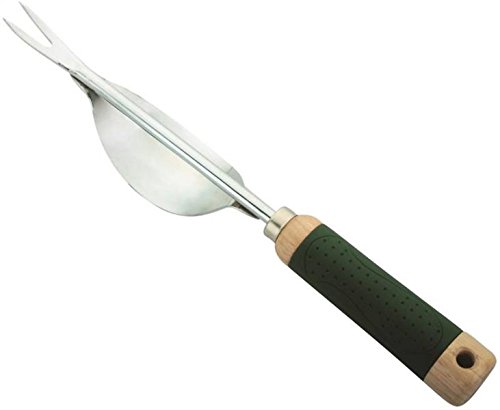
Pick this fork when lawn dandelions keep regrowing because the root snaps halfway down. The listing describes a deep V nose that reaches further along the taproot than short tips, plus a curved metal base that rests on the turf and acts as a fulcrum, so pushing the handle lifts the root instead of twisting it out by wrist force alone. A solid wood handle with an extra-large cushioned grip suits longer spells on a lawn or bed edge. Gardeners who mostly lift large, thick-rooted weeds from flat ground will get the most from the leverage design.
Specs
- Brand: Edward Tools
- Head: Deep V nose design, per the listing
- Base: Leverage metal base for the lever action, per the listing
- Material: Stainless rust proof steel, per the listing title
- Handle: Solid wood with extra-large cushioned grip, per the listing
- Item weight: 8.8 ounces, per the listing details
- Warranty: Lifetime warranty, per the listing
Best for: Lifting deep taproots from lawns and flat beds with a fulcrum doing part of the work.
Watch out for: Thin, fibrous roots can slip through the V, and the leverage base needs flat ground under it to work as described.
ASIN: B01MY8ZXG8
A.M. Leonard Cape Cod Weeder
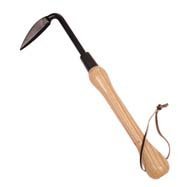
Reach for this tool when weeds are shallow, crowded and growing where a fork would tear up the plants you want to keep. The listing describes the traditional Cape Cod shape, with an angled forged-steel blade that cuts on the pull stroke just below the surface, plus a contoured hardwood handle finished for weather resistance. At the listed length it works under mulch, along bed edges and between close perennials without turning the soil over. It is described as a right-angle slicing tool rather than a root pry, so it suits frequent light passes that stop weeds before they seed.
Specs
- Brand: A.M. Leonard
- Model: ACW, per the listing
- Overall length: 13 inches, per the listing
- Cutting edge: 2-3/4 inches, per the listing
- Blade: Forged steel with a hardened blade surface, per the listing
- Handle material: Wood, contoured hardwood, per the listing
- Item weight: 7 ounces, per the listing
Best for: Slicing shallow weeds under mulch and between close plants with minimal soil disturbance.
Watch out for: The angled Cape Cod shape is handed in use, so check that the pull-stroke angle suits your dominant hand before ordering.
ASIN: B001QVKMK0
Fiskars Ergo Scratch Tool Garden Weeder

This is the straightforward everyday fork for gardeners who want a light tool for beds, borders and scattered lawn weeds without a specialised shape. The listing pairs an angled cast-aluminium head, shaped to give leverage beside a root, with an ergonomic SoftGrip handle and a hang hole for storage. Aluminium keeps the head rust resistant and the whole tool easy to carry in a tote from bed to bed. Choose it for routine taproot weeds in ordinary garden soil, especially where you weed little and often, rather than for a neglected plot in baked, stony ground.
Specs
- Brand: Fiskars
- Item type: Ergo Scratch Tool Garden Weeder, per the listing
- Head: Angled cast aluminium head, per the listing
- Handle: Ergonomic SoftGrip handle, per the listing
- Storage: Hang hole, per the listing
- Item weight: 0.42 pounds, per the listing details
- Warranty: Full lifetime warranty, per the listing details
Best for: Routine dandelion and thistle lifting in beds and borders with a light, rust resistant head.
Watch out for: Cast aluminium can fail if forced against buried rock, so keep this tool for soil rather than prying in stony ground.
ASIN: B004S0PGN4
GREBSTK Crack Weeder

Keep this narrow blade for the weeds none of the bed tools can reach: grass, moss and small taproot weeds rooted in paver joints, patio stones and driveway cracks. The listing describes a stainless steel crack weeder with a serrated blade that slices and lifts growth from tight gaps, a beech handle, and a length suited to pulling along a joint while kneeling or crouching. It also works along walkway edges where a crisp line matters. Because the blade is built for gaps, it is a companion to a bed weeder rather than a replacement for one.
Specs
- Brand: GREBSTK
- Model: Weeder Tool, per the listing
- Head material: Stainless steel, per the listing comparison table
- Handle material: Beech, per the listing comparison table
- Length: 12.5 inches, per the listing comparison table
- Item weight: 7 ounces, per the listing
- Blade: Serrated blade, per the listing description
Best for: Clearing weeds and moss from paver joints, patio cracks and driveway gaps.
Watch out for: Confirm the blade thickness against your narrowest joints, since a crack blade only helps if it actually enters the gap.
ASIN: B087C7X4Z1
Which One Fits Your Situation
Lifting Dandelions Scattered Across a Lawn
Start with the Edward Tools weeding tool, because its deep V nose and curved leverage base were listed for exactly this motion: seat the fork beside the root, rest the base on the turf, and lift. If your hands tire before the patch is finished, compare the Radius Garden 102, whose curved grip and lighter aluminium blade trade some prying strength for a kinder wrist angle over many repetitions.
Weeding a Crowded, Mulched Flower Bed
The A.M. Leonard Cape Cod weeder fits this job best, since its angled blade slides under mulch and severs shallow weeds on the pull stroke without digging the bed apart. Work in short passes and lift the cut growth out so it does not re-root on damp mulch. For an isolated taproot weed among the perennials, switch to the Fiskars fork for that plant instead of slicing near valued roots.
Clearing Paver Joints and a Driveway Edge
Use the GREBSTK crack weeder here and leave the bed forks in the tote. Its serrated stainless blade is listed for gaps between pavers and stones, and its beech-handled, joint-length shape lets you hook under a crown and pull along the crack. Clear one joint at a time, then brush the loosened growth out, because a forked tip wide enough for soil rarely fits a tight joint without chipping at the edges.
Gardening With Sore Hands or a Weak Grip
The Radius Garden 102 is the pick to examine first, because the listing builds the tool around a curved grip that keeps the wrist nearer neutral and a light aluminium blade. Pair it with kneeling work in beds you keep reasonably loose, and let the Edward Tools leverage base handle the occasional deep lawn root, so neither tool is forced into the job it handles worst.
Common Mistakes
- Using a forked dandelion weeder in a paving joint, where the tip cannot enter and the leverage only chips at the stone edge.
- Buying a Cape Cod slicing blade for deep taproot weeds, then cutting the crown off and leaving the root to regrow.
- Prying with a cast aluminium head in rocky or baked ground until the head chips or snaps instead of loosening the soil first.
- Choosing a handle by how soft it feels in the shop rather than by grip size, wrist angle and control at the end of a session.
- Weeding dry, hard ground by force instead of working after rain or watering, when roots release with far less leverage.
Frequently Asked Questions
Which hand weeder shape is best for dandelions?
A forked or V-nose weeder is usually the best match, because the prongs pass either side of the taproot and hold it while leverage lifts it out whole. Seat the tip beside the crown, loosen around the root, and lift steadily rather than pulling straight up. In hard ground, a leverage base or an angled head helps more than a straight, short tip.
Can one hand weeder handle both beds and patio cracks?
Rarely well. Bed weeding needs depth and leverage in soil, while crack weeding needs a blade thin enough to enter a joint and hook growth out along its line. A fork that excels in a border is often too wide for pavers, and a crack blade has no leverage for a deep lawn root. Gardeners with both jobs are usually better served by one tool for each place.
Is aluminium or steel better for a hand weeder?
Steel is better where the blade must pry in compacted or stony soil, because forged and tempered steel tolerates that force and holds an edge. Aluminium is better where weight and rust matter more than prying strength, such as routine weeding in kept beds. The deciding factor is your hardest regular patch, so choose steel if that patch is dry clay or full of stones.
How do I stop a taproot snapping off in the soil?
Work when the soil is moist, push the fork beside the root rather than into the crown, and loosen the ground on more than one side before lifting. Use the bend or leverage base to raise the root gradually instead of jerking the handle. If a root still snaps, dig to the broken end and remove it, because a living taproot section left in place can sprout again.
More from Amazon
Programs that pair well with the guide above. Offers and eligibility are set by Amazon and may change.
Collect the home and kitchen items you want in one registry that guests can shop from.
Create a wedding registrySet up recurring deliveries of everyday items on eligible products. Terms and savings are set by Amazon.
Explore Subscribe & SaveFree shipping on eligible items, Prime Video and more. Eligible new members can start with a free trial.
Start a Prime free trialAudiobooks and podcasts to listen to on the go. Eligible new members can start with a free trial.
Try Audible freeAs an Amazon Associate we earn from qualifying purchases.