Key takeaways
- Compare corner wardrobe cabinets with adjustable shelves for bedrooms without closets, including an L-shaped armoire with glass doors and a tall corner closet system.
When a bedroom has no closet, the corner is usually the last piece of floor nobody has claimed, and it is exactly where a wardrobe wants to go. The catch is geometry. A corner cabinet has to earn that spot twice over: it must give you genuine hanging depth, not a triangular token shelf, and its doors have to open without clipping the bed, the radiator, or the wall on the other side of the angle.
This guide is written for people dressing from a room with bare walls, especially renters who cannot build in a closet or fix a rail system along a whole wall. Both cabinets below were picked from their Amazon listings for the same two traits: a shape the listing describes as corner or L-shaped, and shelving you can adjust instead of accepting whatever spacing the factory chose. One is a fully enclosed armoire, the other an open corner system, and that difference drives most of the decision.
Quick Picks
As an Amazon Associate we earn from qualifying purchases.
| Product | Best for | Key spec from title |
|---|---|---|
| MOUMON Corner Wardrobe Closet | Enclosed storage behind glass doors in a true corner | Corner wardrobe closet with hanging rod and adjustable shelves |
| Homieasy Corner Closet System | Open, visible storage wrapped into a tall corner tower | Corner closet system with 2 rods, hutches, and 5 shelves |
How to Choose
Measure Both Walls of the Corner, Not Just One
A corner wardrobe reaches along two walls at once, so a single width measurement tells you almost nothing. Record how far the unit can run in each direction before it meets a door frame, a window, or a skirting board, and check that the two walls actually meet at a clean right angle, because older rooms often do not. Height matters in a corner too: measure at the corner itself, where sloping ceilings and picture rails steal space first. Finally, stand where the doors will swing. An enclosed corner armoire needs a clear arc in front of it every single morning, not just on the day it is assembled.
Decide How Much Hanging the Corner Must Carry
Corners tempt people into shelf-heavy cabinets, yet most clothing problems in a closet-free room are hanging problems. Coats, dresses, and work shirts need a rod with enough clear drop beneath it, and enough depth that shoulders are not twisted diagonally across the angle. If your wardrobe is mostly folded knitwear and boxed items, an open corner system with more shelves will serve you better and keeps everything visible. Be honest about the split before choosing, because an adjustable shelf can move up or down, but it cannot turn a shelving tower into a proper long-hang space after the fact.
Use the Anti-Tip Fixing on Tall Corner Units
Corner placement feels inherently stable, and that feeling is misleading. A tall cabinet wedged into an angle can still walk forward when a loaded drawer opens or a child pulls on a door, and its height gives it leverage. Where the listing includes an anti-tip device, fit it into a stud as the instructions direct. Renters who cannot drill should load the base heavily, keep the top shelves for light and bulky items such as bedding, and position the unit so both back edges sit flush, removing the small rocking gap that starts most tip-overs.
Match the Material and Build to How Long You Will Stay
Engineered wood corner armoires look like permanent furniture and keep dust off clothing, but they are heavy, arrive as many panels, and do not enjoy being dismantled repeatedly. Open wood-and-frame corner systems assemble faster, come apart into lighter sections, and suit someone expecting to move within a year or two. Think about the doorway and stairs as well as the bedroom: a wide corner panel that fits the room may not forgive a tight landing. If a future move is likely, favour the design you can realistically carry out of the building without damaging its fixings.
The 2 Best Options
MOUMON Corner Wardrobe Closet

The MOUMON is the enclosed answer to a closet-free corner. Its listing describes an L-shaped wardrobe in a wood grain finish, with two glass doors over the upper section, so clothes stay behind a front that looks deliberate rather than improvised. Inside there is a hanging rod for shirts, dresses, and suits, plus an adjustable shelf you can reposition to make room for folded stacks, hats, or storage boxes, and lower sections behind solid doors for smaller personal items. The footprint is essentially square, reaching about thirty-five inches along each wall, which makes planning simple: if a square of that size sits comfortably in your corner, the cabinet will too.
Specs
- Dimensions: 35.4 inches deep x 35.39 inches wide x 70.9 inches high
- Shape: L-shaped corner design, listed colour L Shape (Wood Grain)
- Shelves: 1 adjustable shelf
- Hanging: 1 hanging rod
- Doors: 2 glass doors, flat panel style
- Material: engineered wood (particle board)
- Safety: anti-tip device included, to be secured to a wall
- Installation: freestanding, assembly required
Best for: A main bedroom corner where clothes need to sit behind doors, out of sight, in a unit that reads as furniture.
Watch out for: There is only one adjustable shelf, so folded storage is limited; this cabinet is hanging-led, and the anti-tip device needs a wall fixing to do its job.
ASIN: B0D9Q7SR1Y
Homieasy Corner Closet System

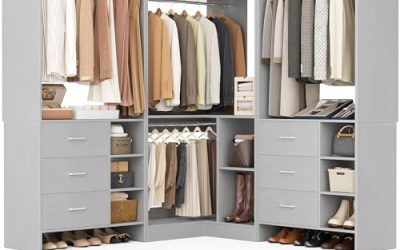
The Homieasy takes the opposite approach: no doors, no hiding, just a tall corner tower that keeps the whole wardrobe visible and reachable. The system is built around a thirty-six by thirty-six inch corner footprint standing eighty inches tall, with two hanging rods so long and short clothes can be separated instead of fighting over one rail. Five shelves run through the unit, and two of the storage compartments can be adjusted in height using the pre-set holes, which is where folded sweaters, boxes, and shoes get their tailored space. Because everything is open, it suits a corner of a dressing area or a guest room where speed matters more than concealment.
Specs
- Dimensions: 36 inches wide x 36 inches deep x 80 inches high
- Layout: corner closet system, freestanding tower format
- Shelves: 5 shelves, with 2 adjustable storage compartments
- Hanging: 2 hanging rods
- Doors: none, open-front design
- Model number listed: HE-CLS-LGSCYG
- Colour listed: white
- Installation: freestanding, assembly required
Best for: A corner where you want everything visible at a glance, with separate rods for long and short hanging.
Watch out for: The open front offers no dust protection and no way to hide a messy shelf, and at eighty inches tall it needs its corner measured for height as carefully as for width.
ASIN: B0F9FQNRD4
Which One Fits Your Situation
Your Corner Sits in a Guest Room
Take the MOUMON. Guests hang a few outfits, store the rest in a case, and appreciate a cabinet that closes. The glass doors keep the room looking finished even when the wardrobe inside is half empty, and the lower solid-door sections hide spare bedding or towels. Its single rod is enough for visitor clothing, and the adjustable shelf can be raised to swallow a folded spare duvet between stays.
You Dress in a Hurry Every Morning
The Homieasy system removes every barrier between you and your clothes. Two rods let you keep work outfits apart from weekend wear, the open shelves put folded staples at eye level, and nothing needs opening, closing, or moving aside. In a rented room where the corner is your entire closet, that visibility also stops you buying duplicates of things you already own but could never find.
The Room Is Small and the Corner Is Awkward
Measure first, then decide by footprint rather than by looks. Both cabinets ask for roughly thirty-five to thirty-six inches along each wall, so the real difference is height and door swing. The MOUMON stands lower but needs clear floor for its doors; the Homieasy stands taller yet asks for nothing in front. In a tight room where a bed edge crowds the corner, the open tower is usually the safer fit.
You Want the Corner to Hold More Than Clothes
Choose the Homieasy and treat its shelves as general storage. Adjustable compartments take storage boxes, bags, and folded bedding alongside clothing, and the open format makes the corner work as a household overflow zone for the things a closet would normally swallow, from spare pillows to board games. Keep the MOUMON for a clothes-first brief, because its enclosed sections and single shelf are shaped around garments rather than household bulk.
Common Mistakes
- Measuring one wall of the corner and assuming the other side matches, then finding a door frame or radiator exactly where the cabinet needs to reach.
- Forgetting that skirting boards push a corner unit slightly forward, leaving a gap at the back and a gentle rock that should be corrected before loading.
- Choosing a shelf-heavy corner cabinet when most of the wardrobe hangs, and ending up draping dresses over the doors the cabinet was bought to replace. Check, too, how many shelves actually adjust before ordering, because some corner listings offer only one movable shelf while the rest of the interior is fixed at the factory, which limits how much the layout can change later.
- Leaving an eighty-inch corner tower unanchored because the corner feels secure, even though height and open drawers can still pull it forward.
- Blocking the swing of enclosed corner doors with a bed or chair, making the wardrobe technically present but practically unusable every morning.
Frequently Asked Questions
How much wall does a corner wardrobe actually need?
Work on roughly thirty-five to thirty-six inches along each wall for the cabinets in this guide, plus a little forgiveness for skirting boards and walls that are not perfectly square. Measure both directions at floor level and again at the height of the unit, because corners drift. If either run falls short, a corner design stops being an advantage and a straight cabinet will fit better.
Can a corner wardrobe hold long dresses and coats?
Yes, if it has a rod with enough clear drop, which is why the hanging layout matters more than the shelf count here. Both picks include hanging rods; the Homieasy has two, which makes separating long items from shirts easier. Check the depth as well, because a rod set across a shallow corner can twist hangers and crease shoulders even when the height looks generous on paper.
Do corner wardrobes need to be fixed to the wall?
A tall wardrobe should be restrained, corner or not. The MOUMON listing includes an anti-tip device to be secured to a wall, and fitting it as directed is the sensible default. If fixing is impossible under your lease, compensate with low, heavy loading, light items only on top, and a unit sitting flush and level on both walls, while understanding that this reduces risk rather than removing it.
Are open corner systems practical for everyday clothes?
They are practical if you fold neatly and dress quickly, because everything stays visible and ventilated, and a shelf can be re-spaced in moments when a new category of clothing arrives. The trade-offs are dust settling on shoulders and shelves, and a room that always shows your storage. People who dislike visual clutter, or who store out-of-season clothes for months, usually prefer an enclosed armoire such as the MOUMON, even with its smaller shelf count.
More from Amazon
Programs that pair well with the guide above. Offers and eligibility are set by Amazon and may change.
Collect the home and kitchen items you want in one registry that guests can shop from.
Create a wedding registrySet up recurring deliveries of everyday items on eligible products. Terms and savings are set by Amazon.
Explore Subscribe & SaveFree shipping on eligible items, Prime Video and more. Eligible new members can start with a free trial.
Start a Prime free trialAudiobooks and podcasts to listen to on the go. Eligible new members can start with a free trial.
Try Audible freeAs an Amazon Associate we earn from qualifying purchases.