Key takeaways
- Compare the best sprinkler heads for spray zones and large lawns, from pop-up sprays to gear-drive rotors, with inlet, arc and throw checks before you buy.
Replacing a sprinkler head looks simple until the new one is in the ground and the zone tells a different story: a spray head where a rotor used to run leaves dry arcs, a rotor on a small bed drenches the path, and a mismatched inlet or pop-up height turns a quick swap into digging twice. The real decision is matching head type, throw, arc and connection to the zone you already have.
This guide is for homeowners replacing tired heads one zone at a time, owners expanding a spray area along beds and strips, and anyone reworking a larger lawn zone around rotors. Every product below was chosen from the name and specifications on its Amazon product page, including pop-up height, inlet size, arc range and spray distance.
Quick Picks
As an Amazon Associate we earn from qualifying purchases
| Product | Best for | Key spec from title |
|---|---|---|
| Rain Bird 1804 Spray Head with 15VAN Nozzle, Pack of 5 | Replacing several spray heads along a bed or narrow lawn strip | 4 inch pop-up, adjustable 0 to 360 degrees, 15 foot radius |
| Hunter PGP-adj Rotor Sprinkler Heads, Pack of 4 | Refreshing a medium to large lawn zone with matching rotors | Rotor heads with number 7 nozzle pre-installed, adjustment tool included |
| Orbit Voyager II Professional Pop-Up Gear Drive Rotor | A single worn rotor on a medium to large lawn area | 4 inch pop-up, adjustable 40 to 360 degrees, 25 to 52 foot spray |
| K-Rain K2 Pro Gear Drive Rotor, Pack of 4 | Taller grass where a standard rotor barely clears the blades | 5 inch pop-up, adjustable 40 to 360 degrees, 18 to 40 foot spray |
| Toro T5 Rapid Set Gear Drive Rotor with Check Valve | Sloped rotor zones where low heads drain after shutoff | 5 inch pop-up, check valve, arc set without tools |
How to Choose
Match the Head Type to the Zone It Waters
Spray heads and rotors are not interchangeable, even when both pop up from the same lawn. A spray head throws a fixed fan over a short radius, which suits beds, strips and small lawn shapes spaced closely together. A rotor sends a turning stream much farther and belongs on open lawn where heads can be spaced widely. Swapping one type for the other inside a zone breaks matched watering, because the two apply water at very different rates. Keep the type already running in that zone unless you plan to rebuild the whole zone around the new throw and spacing.
Check Inlet Size and Pop-Up Height Before Ordering
The connection under the head decides whether a replacement threads straight onto the existing riser or needs extra fittings. Spray bodies in this guide use a half inch inlet, while the rotors use a three quarter inch inlet, so measure or read the old head before ordering a pack. Pop-up height matters just as much: a 4 inch riser can disappear into thick turf, while a 5 inch riser clears taller grass and uneven ground near edging. Check both numbers against the head you are removing, not against a neighbour zone built at a different time with different parts.
Set Arc and Throw Around Paths, Beds and Corners
Arc is the slice of ground a head is allowed to cover, and throw is how far the water travels inside that slice. An adjustable arc, such as 0 to 360 degrees on a spray head or 40 to 360 degrees on a rotor, lets one model serve a corner, an edge and an open middle by changing the setting rather than the hardware. Fixed patterns are less forgiving: a half pattern on a corner wastes water, and a full pattern against a fence soaks timber. Walk the zone, note where each head sits relative to paths and planting, then choose adjustability where positions vary.
Plan for Pressure, Drainage and Dirty Water
Heads behave differently when the zone shuts off or the supply carries grit. On a slope, water left in the line can drain out of the lowest head and puddle at its base, which is why a built-in check valve is worth choosing for rotor zones that tilt. Wiper seals and inlet filters help spray bodies and rotors shrug off sand that would otherwise jam a riser or clog a nozzle. None of these features fixes a zone with far too many heads for its supply, so count the heads, keep types together, and treat seals, filters and valves as protection rather than a cure.
The 5 Best Options
Rain Bird 1804 Spray Head with 15VAN Nozzle, Pack of 5

This five pack suits owners replacing a run of spray heads in one go, especially along beds, side strips and small lawn shapes where the existing zone already uses short throw sprays. The adjustable nozzle lets each position cover a different slice, from a tight corner to a full circle, without stocking separate fixed pattern heads. It fits best as a like for like refresh of a spray zone that waters evenly today but has heads that stick, leak around the stem or no longer retract flush after the cycle ends.
Specs
- 4 inch pop-up height
- Adjustable spray pattern from 0 to 360 degrees
- Spray distance up to 15 feet
- Stainless steel spring for flush retraction
- Pressure-activated, co-molded wiper seal
- Pack of 5 spray heads with nozzle included
Best for: Replacing several worn spray heads in one bed or strip zone
Watch out for: Confirm your zone uses spray heads, not rotors, before replacing a whole run
ASIN: B00ML3ILG4
Hunter PGP-adj Rotor Sprinkler Heads, Pack of 4
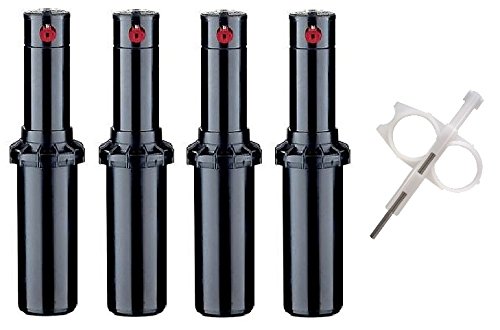
This four pack is aimed at lawn zones where several rotors have aged together and uneven rotation now leaves alternating wet and dry bands. Each head arrives with its nozzle already fitted, so the swap stays focused on setting arc and direction rather than assembling parts at the hole. An adjustment tool is included for those settings. It suits medium to larger open lawn where a turning stream, rather than a fixed fan, matches the spacing between heads, and where replacing rotors as a matched set keeps coverage more consistent than mixing old and new units.
Specs
- Pack of 4 rotor sprinkler heads
- Number 7 nozzle pre-installed in each head
- Adjustment tool included in the pack
- Full-circle adjustment from 50 to 360 degrees
- Plastic construction, rotary style
- Improved dirty-water tolerance on the internal gear drive
Best for: Renewing a matched set of rotors across one open lawn zone
Watch out for: This pack does not include extra nozzle racks, so check the fitted nozzle suits your spacing
ASIN: B00NCAME18
Orbit Voyager II Professional Pop-Up Gear Drive Rotor

Choose this rotor when a single head on a medium to large lawn has stopped turning or its arc has drifted onto paving, and the rest of the zone still runs well. The wide spray range gives room to cover open ground, while the adjustable arc keeps water off paths at the edges. A rack of extra nozzles is included, which helps when the fitted nozzle throws too far or too short for the gap between neighbouring heads. It is a practical one-off replacement for a gear drive position, provided the inlet below matches.
Specs
- 4 inch pop-up height
- Adjustable arc from 40 to 360 degrees
- Spray distance from 25 to 52 feet
- Three quarter inch female pipe thread inlet
- Pre-installed 3 gallon per minute nozzle
- Nozzle rack with additional standard and low-angle nozzles included
- Plastic construction
Best for: Replacing one failed gear drive rotor on an open lawn zone
Watch out for: Measure the existing inlet first, since this rotor uses a three quarter inch connection
ASIN: B001SN81CC
K-Rain K2 Pro Gear Drive Rotor, Pack of 4

The taller pop-up on this four pack makes it the pick for lawns kept long, rough areas beside edging, and zones where a standard rotor barely lifts its nozzle clear of the grass. That extra clearance helps the stream leave the head cleanly instead of breaking up on blades at the start of every cycle. The pack format suits a zone-wide refresh, and adjustments for arc and distance are made from the top of the head. It fits owners who want rotor coverage with a bit more height in hand for uneven, spongy or overgrown turf.
Specs
- 5 inch pop-up height
- Adjustable arc from 40 to 360 degrees
- Spray distance from 18 to 40 feet
- Three quarter inch threaded inlet
- Pre-installed 2.5 gallon per minute nozzle
- Pack of 4 gear drive rotors with install kit
- Flow control for shutting off an individual head
Best for: Rotor zones in taller grass where extra pop-up clearance matters
Watch out for: The taller body needs a deeper hole than a standard rotor when you dig the old one out
ASIN: B09RX33WH1
Toro T5 Rapid Set Gear Drive Rotor with Check Valve

This rotor fits sloped lawn zones where the lowest head weeps after shutoff and leaves a soggy ring, because the factory fitted check valve helps hold water in the line instead of letting it drain downhill. Arc setting is done by twisting the turret, with no separate tool to keep track of, which helps when several heads need aligning along a boundary. A full nozzle set is included for shaping throw to different gaps. It suits a single replacement or a small group of rotors on ground that is not level, where drainage is part of the problem.
Specs
- 5 inch pop-up riser
- Factory-installed check valve
- Pre-installed 3.0 gallon per minute nozzle
- Eight standard nozzles and four low-angle nozzles included
- Arc adjustment from 40 to 360 degrees without tools
- Three quarter inch inlet
- Body height of 7.5 inches
Best for: Sloped rotor zones where low heads drain and puddle after watering
Watch out for: A check valve helps drainage at the head, but it will not correct a leaking zone valve
ASIN: B01986JVNS
Which One Fits Your Situation
Your Spray Zone Along the Beds Has Several Sticking Heads
Replace the run together with the Rain Bird 1804 pack rather than swapping only the worst head. A matched set of new spray bodies retracts evenly, and the adjustable nozzle on each one lets corners, edges and open stretches keep their own patterns. This is the right route when the zone layout already works and only the hardware has aged, cracked or filled with grit over several seasons of use.
Your Open Lawn Waters in Stripes and the Rotors Are Old
Renew the zone as a set with the Hunter PGP-adj four pack or the K-Rain K2 Pro four pack. Stripes usually mean rotors of different ages turning at different speeds, so matched replacements restore a more even pattern. Pick the K-Rain set when grass is kept tall and extra pop-up helps, and pick the Hunter set when standard clearance is enough and you want the fitted nozzles and tool ready in the box.
One Rotor Has Failed but the Rest of the Zone Is Sound
Dig out only that position and fit the Orbit Voyager II as a single gear drive replacement. Its adjustable arc and nozzle rack give you the range to blend the new head into the spacing and patterns already set by its neighbours. Check the inlet size at the riser before you order, because a rotor connection differs from a spray body connection, and finding that out with the hole open wastes the dry weather window you set aside.
Your Lawn Slopes and the Lowest Head Always Puddles
Fit the Toro T5 Rapid Set at the low positions, where its check valve addresses the drainage that leaves the base soggy after every cycle. Set the arc by hand once the head is in, then run the zone and watch the shutoff: the puddle should shrink if drainage was the cause. If water still seeps, the fault sits at the valve or a cracked fitting rather than in the replacement head itself.
Common Mistakes
- Mixing a rotor into a spray zone, or a spray head into a rotor zone, which destroys matched watering even if the thread fits.
- Ordering by pop-up height alone and ignoring inlet size, so the new head will not thread onto the riser already in the ground.
- Replacing only one head in a zone of worn rotors, then blaming the new unit for stripes caused by its tired neighbours.
- Setting every arc to full circle, including heads on corners and edges that should only water a quarter or half slice.
- Burying the head too low, so grass grows over the cap and the riser scrapes soil every time it lifts and retracts.
Frequently Asked Questions
Can I replace a spray head with a rotor to get more range?
Not inside the same zone. Spray heads and rotors apply water at very different rates and are spaced for different throws, so mixing them leaves one part of the zone soaked and another dry. If you want rotor range, rebuild the whole zone around rotor spacing, or keep the spray layout and replace spray heads with spray heads of the same throw class.
How do I know which inlet size my replacement head needs?
Dig around the old head, unscrew it from the riser, and check the threaded connection it leaves behind. Spray bodies commonly use a smaller inlet than rotors, and the listings in this guide state the size for each model. Compare that measurement with the product specifications before ordering, especially when buying a pack, because returning four wrong heads is no easier than returning one.
Why does my new head not pop up fully?
Low pressure at that position, grit around the riser, or a head buried too deep are the usual causes. Clear soil and grass from around the cap, flush the line with the nozzle removed, and check that the top of the body sits flush with the ground. If several heads on the zone lift weakly together, the problem is supply or a blockage upstream, not the head.
How often should sprinkler heads be replaced?
Replace a head when it stops rotating, leaks steadily around the stem, no longer retracts flush, or its nozzle is damaged beyond cleaning. There is no fixed calendar interval, because soil type, water grit and mowing habits wear heads at different rates. A yearly spring check, running each zone while you walk it, catches failing heads before dry patches appear in summer heat.
More from Amazon
Programs that pair well with the guide above. Offers and eligibility are set by Amazon and may change.
Collect the home and kitchen items you want in one registry that guests can shop from.
Create a wedding registrySet up recurring deliveries of everyday items on eligible products. Terms and savings are set by Amazon.
Explore Subscribe & SaveFree shipping on eligible items, Prime Video and more. Eligible new members can start with a free trial.
Start a Prime free trialAudiobooks and podcasts to listen to on the go. Eligible new members can start with a free trial.
Try Audible freeAs an Amazon Associate we earn from qualifying purchases.