Key takeaways
- Fence quality: This is the single biggest differentiator under $1,000. A rack-and-pinion fence that stays parallel through its full travel will outperform a more powerful saw with a fence that drifts, because every rip depends on it.
- Rip capacity: Anything at or above 30 inches lets you break down a 4×8 sheet on-center without repositioning. If you build casework or plywood furniture, prioritize this over blade diameter.
- Motor and blade size: A 15-amp universal motor is standard here. Ten-inch blades give you roughly 3.1–3.5 inches of cut at 90°, enough for 4×4 stock; 8-1/4-inch saws trade depth for portability and lighter weight.
- Stand and stability: A rolling stand with a genuine lock is worth the premium. Flex at the legs telegraphs straight into your cut line, and a saw that walks during a rip is a saw you’ll stop trusting.
- Dust and noise management: Look for a shrouded blade with a 2-1/2-inch port. Capturing fine dust at the source protects your lungs and your sleep — airborne particulate in a home workshop doesn’t stay in the workshop, and it aggravates nighttime congestion far more than most woodworkers realize.
What's inside
Ripping sheet goods with a circular saw and a chalk line works right up until it doesn’t. Cabinet doors that won’t close square, face frames with hairline gaps, a bookcase that rocks on a flat floor — most of the frustration hobby furniture builders describe traces back to inconsistent rip cuts. A table saw fixes that, but the sub-$1,000 bracket is crowded with machines that look nearly identical in photographs and behave nothing alike under a 4/4 hardwood board.
This guide breaks down what actually matters at this price: fence accuracy, rip capacity, motor behavior under load, and dust control. One factor buyers routinely ignore is noise and vibration — a saw that screams at 100+ decibels in an attached garage shortens sessions, frays patience, and pushes projects into late evenings when fatigue quietly becomes the biggest safety hazard in the shop. Below, we cover selection criteria, review the strongest contenders, and answer the questions that come up most often before a first purchase.
As an Amazon Associate we earn from qualifying purchases.



How to Choose a Table Saw For Under 1000 (2026)
- Fence quality: This is the single biggest differentiator under $1,000. A rack-and-pinion fence that stays parallel through its full travel will outperform a more powerful saw with a fence that drifts, because every rip depends on it.
- Rip capacity: Anything at or above 30 inches lets you break down a 4×8 sheet on-center without repositioning. If you build casework or plywood furniture, prioritize this over blade diameter.
- Motor and blade size: A 15-amp universal motor is standard here. Ten-inch blades give you roughly 3.1–3.5 inches of cut at 90°, enough for 4×4 stock; 8-1/4-inch saws trade depth for portability and lighter weight.
- Stand and stability: A rolling stand with a genuine lock is worth the premium. Flex at the legs telegraphs straight into your cut line, and a saw that walks during a rip is a saw you’ll stop trusting.
- Dust and noise management: Look for a shrouded blade with a 2-1/2-inch port. Capturing fine dust at the source protects your lungs and your sleep — airborne particulate in a home workshop doesn’t stay in the workshop, and it aggravates nighttime congestion far more than most woodworkers realize.
The Best Table Saw For Under 1000 (2026)s Reviewed
DEWALT DWE7491RS 10-Inch with Rolling Stand
The benchmark in this category, and deservedly so: the 32-1/2-inch rip capacity handles full sheet goods, and the rack-and-pinion fence returns to true repeatedly after months of use. At 4,800 RPM with a 15-amp motor, it powers through hard maple without the bogging that plagues cheaper units.
SKIL TS6307-00 15 Amp Portable Jobsite Saw
SKIL’s standout feature is a worm-drive-inspired gearbox that delivers noticeably steadier torque in thick stock, paired with a folding stand that sets up in seconds. It undercuts the DEWALT on price while keeping the fence system honest, making it the value pick for weekend furniture builders.
DEWALT DWE7485 8-1/4-Inch Compact Saw
Choose this one if your shop is a corner of a garage that has to revert to parking space. At roughly 54 pounds it lifts easily onto a bench, and the 24-1/2-inch rip capacity still covers most furniture components — just accept the shallower 2-1/2-inch cut depth at 90°.
DOVAMAN DTS10A 10″ Table Saw with Stand
A copper-wound motor spinning at 5,300 RPM and a one-side extendable table give this saw more capability than its price suggests, with 3.35 inches of cut at 90°. Expect to spend an hour dialing in the fence and blade alignment out of the box; once tuned, it holds settings well.
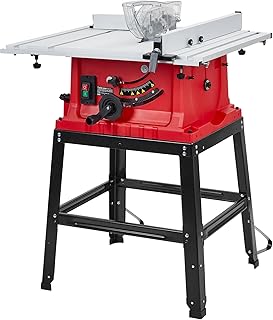
10-Inch 5000 RPM Table Saw with 36 x 25 Tabletop
The generous 36 x 25-inch work surface supports longer boards better than most portable saws in this bracket, and the included protective cover is a genuine plus for shops without climate control. Best suited to softwoods, plastics, and light hardwood work rather than daily production cutting.
Frequently Asked Questions
Do I need a 10-inch saw, or is 8-1/4 inches enough?
For furniture built from 3/4-inch plywood and 4/4 hardwood, an 8-1/4-inch saw is sufficient. Step up to 10 inches if you plan to cut 4×4 legs, thick tabletops, or want the wider selection of dado and specialty blades.
Is a jobsite saw accurate enough for furniture?
Yes, provided you verify the setup. Check blade-to-miter-slot parallelism, square the fence, and confirm the 45° and 90° stops with a reliable square before your first project — factory calibration is rarely perfect.
How loud are these saws, and does it matter?
Most run between 95 and 105 decibels under load. Hearing protection is non-negotiable, and if your shop shares a wall with bedrooms, schedule ripping for daylight hours — prolonged noise exposure late in the evening disrupts sleep onset for everyone in the house, including you.
What should I buy alongside the saw?
A quality 40-tooth combination blade, push blocks, a zero-clearance insert, and a shop vacuum with a fine-dust filter. Budget roughly $150 for accessories; they improve results more than any spec-sheet upgrade at this tier.
Final Thoughts
For most home furniture builders, the DEWALT DWE7491RS remains the safest investment under $1,000 — its fence and rip capacity simply don’t have a peer at this price. The SKIL TS6307-00 is the smarter buy if you want most of that performance for less, while the compact DEWALT DWE7485 is the right answer for anyone working in a shared or temporary space where the saw has to disappear at the end of the day.