Key takeaways
- Measure your tank clearance first: Run a tape from the floor to the highest point of your tank lid, including the flush handle and any lid overhang, then add two inches of breathing room. Units in this category typically clear 33–34 inches; if your tank sits taller, no amount of assembly cleverness will fix it.
- Insist on anti-tip hardware: Every unit worth buying ships with a bracket or strap that anchors the top rail to the wall. This is a single small screw into drywall — a repair you can patch with a fingertip of spackle when you move out — and it is the difference between furniture and a hazard, especially in a home with kids or pets.
- Match door style to your habits: Closed doors hide the visual noise of half-used product, which genuinely helps a room read as calm at night. Open shelving is faster to grab from and better for damp towels that need airflow. Most people are happiest with a hybrid: enclosed below, open above.
- Check the panel material and finish: FSC-certified MDF with a sealed laminate handles bathroom humidity well and is the sensible default at this price. What you’re really inspecting is edge sealing — exposed raw MDF at the base is where swelling starts after a year of shower steam.
- Look for an adjustable shelf and a crossbar: One repositionable shelf lets you fit a tall bottle of shampoo or a stack of folded bath sheets rather than wasting four inches of dead air. An adjustable rear crossbar means the frame straddles unusually shaped tanks instead of fighting them.
What's inside
Most bathroom clutter isn’t a storage problem — it’s a floor-space problem. The average American bathroom hovers around 40 square feet, and once you subtract the tub, the vanity, and the swing radius of the door, there is almost nothing left to work with. So the towels migrate to the tub ledge, the skincare bottles colonize the tank lid, and the backup toilet paper lives in a shopping bag behind the door. As someone who spends most of my working life talking to people about their evening wind-down routines, I can tell you this matters more than it sounds: a bathroom you have to negotiate with at 10pm is a bathroom that quietly erodes your pre-sleep routine. Friction is the enemy of consistency, and consistency is what actually builds good sleep.
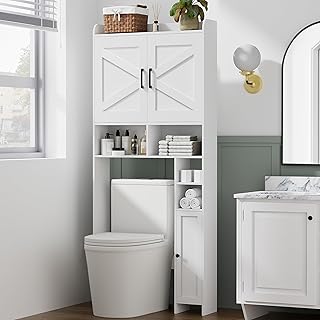
The wall above your toilet is roughly 24 inches wide and largely unused — the single most wasted vertical plane in the house. An over-the-toilet cabinet reclaims it without a stud finder, a landlord conversation, or a single drilled hole in tile. This guide covers six units I’d genuinely recommend in 2026, what separates a stable freestanding frame from a wobbly one, how to measure your tank clearance before you order, and which pick makes sense depending on whether you’re storing linens, toiletries, or the overflow from a shared bathroom.
As an Amazon Associate we earn from qualifying purchases.


How to Choose an Over The Toilet Storage Cabinet (2026)
- Measure your tank clearance first: Run a tape from the floor to the highest point of your tank lid, including the flush handle and any lid overhang, then add two inches of breathing room. Units in this category typically clear 33–34 inches; if your tank sits taller, no amount of assembly cleverness will fix it.
- Insist on anti-tip hardware: Every unit worth buying ships with a bracket or strap that anchors the top rail to the wall. This is a single small screw into drywall — a repair you can patch with a fingertip of spackle when you move out — and it is the difference between furniture and a hazard, especially in a home with kids or pets.
- Match door style to your habits: Closed doors hide the visual noise of half-used product, which genuinely helps a room read as calm at night. Open shelving is faster to grab from and better for damp towels that need airflow. Most people are happiest with a hybrid: enclosed below, open above.
- Check the panel material and finish: FSC-certified MDF with a sealed laminate handles bathroom humidity well and is the sensible default at this price. What you’re really inspecting is edge sealing — exposed raw MDF at the base is where swelling starts after a year of shower steam.
- Look for an adjustable shelf and a crossbar: One repositionable shelf lets you fit a tall bottle of shampoo or a stack of folded bath sheets rather than wasting four inches of dead air. An adjustable rear crossbar means the frame straddles unusually shaped tanks instead of fighting them.
The Best Over The Toilet Storage Cabinets (2026), Reviewed
Spirich Over The Toilet Storage Cabinet with Doors
The most thoroughly considered unit here: 33.3″ of clearance, an adjustable rear crossbar for awkward tanks, FSC-certified MDF, and a beadboard door face that flatters older homes without committing hard to farmhouse. If you want one recommendation and no further deliberation, this is it.
UTEX Over The Toilet Storage Cabinet
UTEX buys you an extra inch of tank clearance — 34″ — plus a genuinely useful split between enclosed cabinet space and open display shelving. Assembly is straightforward and the anti-tip bracket is included rather than sold separately.
Spurgehom Over Toilet Storage Cabinet, Arch Design
The arched silhouette does real work in a small room, softening the vertical lines that make narrow bathrooms feel like corridors. Warm wood tones and a solid anti-tipping kit make this the pick for anyone treating the bathroom as a deliberate design space rather than pure utility.
Extra Tall Cabinet with 4 Open Shelves and 2 Barn Doors
The highest-capacity option in this roundup, with four open shelves stacked above a barn-door cabinet — ideal for a shared bathroom where two people’s routines are competing for the same square footage. Its height also makes wall anchoring non-negotiable.
IFGET Arched Cabinet with Acrylic Doors, Natural Oak
Fluted acrylic doors diffuse what’s behind them, so shelves read as texture instead of clutter — a small trick with an outsized calming effect. The natural oak finish suits Scandinavian and Japandi bathrooms where white laminate would look cheap.
Frequently Asked Questions
Do I have to drill into the wall?
You should. All of these are freestanding, so they’ll technically stand unassisted, but a top-heavy cabinet loaded with towels needs one anti-tip screw into drywall. It takes five minutes and is trivially patchable.
Will it fit over a tall or elongated toilet?
Usually, but measure first. Check floor-to-tank-lid height against the stated clearance, and confirm your unit’s inner leg width exceeds the widest point of the toilet base and seat.
How does MDF hold up to bathroom humidity?
Sealed, FSC-certified MDF performs fine in a ventilated bathroom. Run your exhaust fan during and for fifteen minutes after showers, and wipe standing water off the base promptly.
Can I use one in a laundry room or closet?
Absolutely. The straddle-leg design works over any low fixture or appliance, and several of these units are popular above front-loading washers.
Final Thoughts
For most bathrooms, the Spirich cabinet is the safest bet — the adjustable crossbar solves fitment problems the others can’t. Choose the UTEX if your tank is on the tall side and you want open and closed storage in one frame, or the IFGET arched acrylic unit if you want the room to feel quieter at the end of the day, which is a better reason to buy furniture than it gets credit for.