Key takeaways
- Height parity of the pop-up trundle: The single most important spec. The trundle platform must lock at the same height as the main deck, and both mattresses should be the same thickness and firmness. A mismatch of even an inch creates a pressure ridge that disrupts sleep posture; two identical 8–10″ mattresses are the safest pairing.
- Verified adult weight capacity: Look for a stated figure — 400 lb per surface is a reasonable benchmark for two adults plus bedding. Solid wood rails and center-supported slat systems resist long-term deflection far better than particleboard side panels with staple-mounted slats.
- Slat count and spacing: Aim for slats no more than 3″ apart. Wider gaps allow foam mattresses to bulge downward between supports, which shortens mattress life and creates uneven surface tension you feel by morning.
- Mechanism ergonomics: You’ll be lifting the trundle repeatedly. Gas-assisted or spring-lift systems are worth the premium over pure manual frames, especially if the person setting up the bed is doing it alone or has shoulder or back limitations.
- Storage versus expansion: Drawers and pop-up trundles compete for the same cavity. Decide honestly which you need more — a bed that stores linens year-round is more useful than one that converts twice annually, and vice versa.
What's inside
Most people shopping for a twin-to-king daybed aren’t furnishing a bedroom at all — they’re solving a math problem. One room has to work as an office on Tuesday, a reading nook on Saturday, and a legitimate place for two adults to sleep when family arrives in December. The trouble is that convertible daybeds were designed decades ago with children in mind, and plenty of models still carry that legacy: shallow trundle mechanisms, slat spacing that sags under adult weight, and pop-up frames that stop several inches short of the main mattress, leaving a ridge right where a sleeper’s spine lands.
From a sleep-quality standpoint, that gap matters more than the finish or the fabric. A guest surface that forces the body into a mild lateral tilt all night produces exactly the stiff-shouldered, unrested guest you were trying to accommodate. This guide evaluates the current crop of twin-to-king extendable daybeds through that lens: how flush the two platforms sit when joined, whether the support system can carry adult loads without deflection, and how the frame behaves in a room people actually live in during daylight hours. Below are the models worth your attention this year, followed by the criteria I’d apply before clicking buy.
As an Amazon Associate we earn from qualifying purchases.


🛒 Best Price Today on Amazon
Prime members get fast, free shipping on everything above, plus member-only deals. New members get a 30-day free trial — cancel anytime.
How to Choose a Twin To King Daybed For Adults (2026)
- Height parity of the pop-up trundle: The single most important spec. The trundle platform must lock at the same height as the main deck, and both mattresses should be the same thickness and firmness. A mismatch of even an inch creates a pressure ridge that disrupts sleep posture; two identical 8–10″ mattresses are the safest pairing.
- Verified adult weight capacity: Look for a stated figure — 400 lb per surface is a reasonable benchmark for two adults plus bedding. Solid wood rails and center-supported slat systems resist long-term deflection far better than particleboard side panels with staple-mounted slats.
- Slat count and spacing: Aim for slats no more than 3″ apart. Wider gaps allow foam mattresses to bulge downward between supports, which shortens mattress life and creates uneven surface tension you feel by morning.
- Mechanism ergonomics: You’ll be lifting the trundle repeatedly. Gas-assisted or spring-lift systems are worth the premium over pure manual frames, especially if the person setting up the bed is doing it alone or has shoulder or back limitations.
- Storage versus expansion: Drawers and pop-up trundles compete for the same cavity. Decide honestly which you need more — a bed that stores linens year-round is more useful than one that converts twice annually, and vice versa.
The Best Twin To King Daybeds For Adults (2026) Reviewed
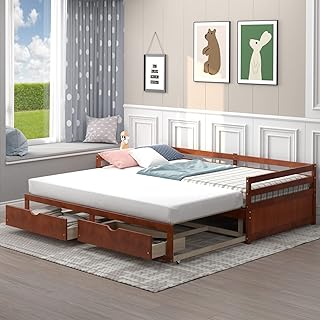
Alaterre Harmony Solid Wood Twin-to-King Daybed
Solid wood construction and a stated 400 lb capacity make this the most structurally confident pick here, and the two pull-out drawers earn their keep in rooms with no closet to spare. The 36.75″ frame height reads more like real furniture than a convertible, which is exactly what you want in a room that’s a living space six days a week.
Twin-to-King Corduroy Daybed with USB Port
The corduroy upholstery is a genuinely smart material choice — it resists the slick, sliding feel of faux leather and softens the visual weight of a large frame in a small room. Integrated USB charging removes the classic guest-room annoyance of a phone marooned across the room, which quietly improves sleep hygiene by keeping devices within reach but off the mattress.
Merax Modern Wood Daybed with Pop-Up Trundle
A clean, low-profile wood frame in espresso that reads adult rather than juvenile, with a pop-up trundle that raises to platform height without box springs. It’s the most visually restrained option on this list, making it the easiest to slot into a home office or den without announcing itself as a spare bed.
KEIKI Tufted Bouclé Extendable Daybed
Bouclé and channel tufting give this one the softest silhouette of the group, and the upholstered rails make it comfortable to lean against for daytime lounging — the failure point of most bare-wood daybeds. Assembly is genuinely straightforward, and the erectable trundle locks flush for a usable king surface.
Farmhouse Wooden Daybed with Drawers, LED Lights and Charging
Three storage drawers plus shelving make this the most functionally dense option, and the built-in charging station and LED lighting mean guests aren’t fumbling for a wall switch at 2 a.m. Choose warm, low-intensity LED settings and keep them off in the hour before sleep — bright cool light near the head of the bed works directly against melatonin release.
Frequently Asked Questions
Is a twin-to-king daybed genuinely comfortable for two adults?
Yes, provided the two mattresses match in height and firmness and the trundle locks securely at deck level. A joined king surface is 76″ wide — the same as a standard king — so width is never the issue. Surface continuity is.
Do I need a box spring?
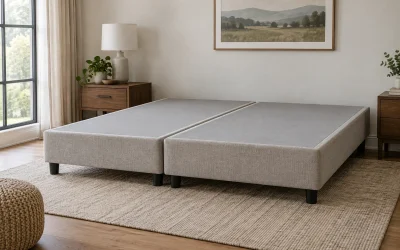
No. Every model here uses a slatted platform designed to support a mattress directly. Adding a box spring would raise the main deck above the trundle and defeat the conversion entirely.
What mattress thickness works best?
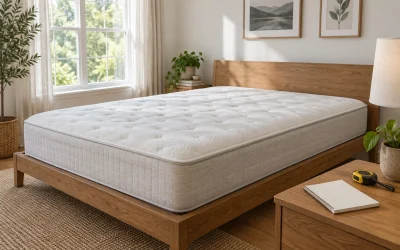
Eight to ten inches is the sweet spot. Thinner mattresses telegraph the slats; thicker ones can sit above the trundle’s maximum lift height and reintroduce the ridge you’re trying to avoid.
How do I bridge the seam between the two mattresses?
A foam bed-bridge wedge plus a king fitted sheet pulled taut over both surfaces effectively eliminates the seam. It’s a small purchase that meaningfully changes how the bed sleeps.
Final Thoughts
If structural durability and adult-scale support are your priorities, the Alaterre Harmony solid wood daybed is the most dependable long-term investment, with real weight capacity and drawers that justify its footprint. For rooms where the bed must look like a sofa most of the year, the KEIKI bouclé model offers the most comfortable daytime seating, while the Merax espresso frame is the quietest, most versatile choice for a shared office or den.