Key takeaways
- Resaw capacity: Look for at least 6 inches of clearance under the guide post, and confirm whether a riser block is available. If you plan to slice your own headboard veneers or bookmatch a panel, 12 inches of resaw height changes what you can build entirely.
- Motor and voltage: One horsepower handles curves in 4/4 and 8/4 hardwood all day. Step up to 1-1/2 or 2 HP if resawing wide maple or white oak is a regular part of your work, and wire for 230V when possible — the same motor runs cooler and recovers faster under load.
- Frame and table mass: Cast iron beats stamped steel every time. A rigid frame resists flex when you tension a wide blade, and a heavy ground-iron table keeps your workpiece flat instead of rocking mid-cut, which is where most drift originates.
- Blade guides and tensioning: Ball-bearing guides adjust more precisely and generate less heat than basic blocks. A quick-release tension lever is a small luxury you’ll appreciate every time you swap from a 1/4-inch curve blade to a 3/4-inch resaw blade.
- Dust collection and shop comfort: Band saws throw fine dust straight down and back. A 4-inch port that mates cleanly with your collector keeps the air breathable — worth noting if your shop shares walls with the room you sleep in.
What's inside
Anyone who has spent a season building beds knows the bottleneck isn’t the joinery — it’s the curves. A gently scooped headboard, a cabriole leg for a nightstand, tapered bed rails that don’t look like lumber: all of it lives or dies on a saw that can track a smooth line through thick stock without wandering. Most home shops try to muscle through with a jigsaw or an underpowered benchtop unit, then spend twice as long sanding out the wobble. Worse, a saw that stalls in the middle of a cut leaves burn marks and blade drift you’ll be fighting until finish day.
A 14-inch band saw is the sweet spot for bedroom furniture work. It fits a garage or basement footprint, runs on standard household power (or 240V if you have it), resaws wide enough to bookmatch a headboard panel, and slows down enough to handle the occasional aluminum bracket or brass hardware. Below I’ve broken down what actually matters when you’re choosing one — frame rigidity, resaw height, speed range, guide quality — then reviewed the models worth your money in 2026, from a budget-friendly two-speed to cast-iron machines you’ll hand down to someone.
As an Amazon Associate we earn from qualifying purchases.


How to Choose a/an 14-Inch Band Saw (2026)
- Resaw capacity: Look for at least 6 inches of clearance under the guide post, and confirm whether a riser block is available. If you plan to slice your own headboard veneers or bookmatch a panel, 12 inches of resaw height changes what you can build entirely.
- Motor and voltage: One horsepower handles curves in 4/4 and 8/4 hardwood all day. Step up to 1-1/2 or 2 HP if resawing wide maple or white oak is a regular part of your work, and wire for 230V when possible — the same motor runs cooler and recovers faster under load.
- Frame and table mass: Cast iron beats stamped steel every time. A rigid frame resists flex when you tension a wide blade, and a heavy ground-iron table keeps your workpiece flat instead of rocking mid-cut, which is where most drift originates.
- Blade guides and tensioning: Ball-bearing guides adjust more precisely and generate less heat than basic blocks. A quick-release tension lever is a small luxury you’ll appreciate every time you swap from a 1/4-inch curve blade to a 3/4-inch resaw blade.
- Dust collection and shop comfort: Band saws throw fine dust straight down and back. A 4-inch port that mates cleanly with your collector keeps the air breathable — worth noting if your shop shares walls with the room you sleep in.
The Best 14-Inch Band Saw (2026)s Reviewed
Powermatic PWBS-14CS
This is the machine I’d point a serious hobbyist toward if the budget allows: 1-1/2 HP, a genuinely rigid cast frame, and a fit and finish that means you spend setup time cutting rather than shimming. Curves in thick walnut come out clean enough that scraping replaces most of your sanding.
JET JWBS-14SFX-BLK
The SFX platform earns its price through the details — a tall resaw column, smooth quick-tension mechanism, and guides that stay put once dialed in. At 1.75 HP it resaws wide stock without bogging, making it the best all-rounder here for someone building bed frames and case goods in the same shop.
JET JWBS-14CS
The classic 1 HP JET remains one of the most upgradeable saws on the market, with riser blocks, aftermarket guides, and fences readily available. Buy it as a solid foundation and grow into it rather than replacing it.
WEN BA1411
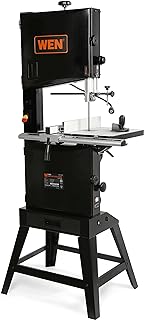
A genuinely capable industrial-leaning saw at a mid-range price, with dual-voltage 1 HP power and two speeds for wood and non-ferrous metal. Expect to spend an hour tuning the guides and tracking out of the box; after that it cuts far above its cost.
WEN BA1487
The best entry point for a first band saw, arriving with its own stand and a two-speed drive that handles everything from headboard curves to small metal brackets. Fit a quality blade immediately — the stock one undersells what the machine can do.
Frequently Asked Questions
Do I need 240V power?
Not necessarily. Every saw here runs on 120V, and 1 HP is plenty for curve work in hardwood. If you have a 240V circuit available, wiring for it reduces heat and voltage drop during long resaw cuts.
What blade should I start with?
A 1/2-inch, 3-TPI blade covers most furniture work well, with a 1/4-inch, 6-TPI blade for tight curves like cabriole legs. Add a 3/4-inch resaw blade only when your saw can properly tension it.
Can a 14-inch saw resaw a full headboard panel?
With a riser block installed, yes — roughly 12 inches of height covers most panel widths, and you can glue up two slices for a wider board. Feed slowly and let the blade clear its own dust.
How much space does one need?
Plan on a 24-by-24-inch footprint plus clearance in front and behind for long boards. Casters make a small shop far more workable.
Final Thoughts
For most furniture builders, the JET JWBS-14SFX-BLK is the saw to buy — enough power and resaw height to grow into, with guides that hold a line. Spend up to the Powermatic PWBS-14CS if precision and longevity matter more than price, or start with the WEN BA1487 if you’re proving out the hobby before committing.